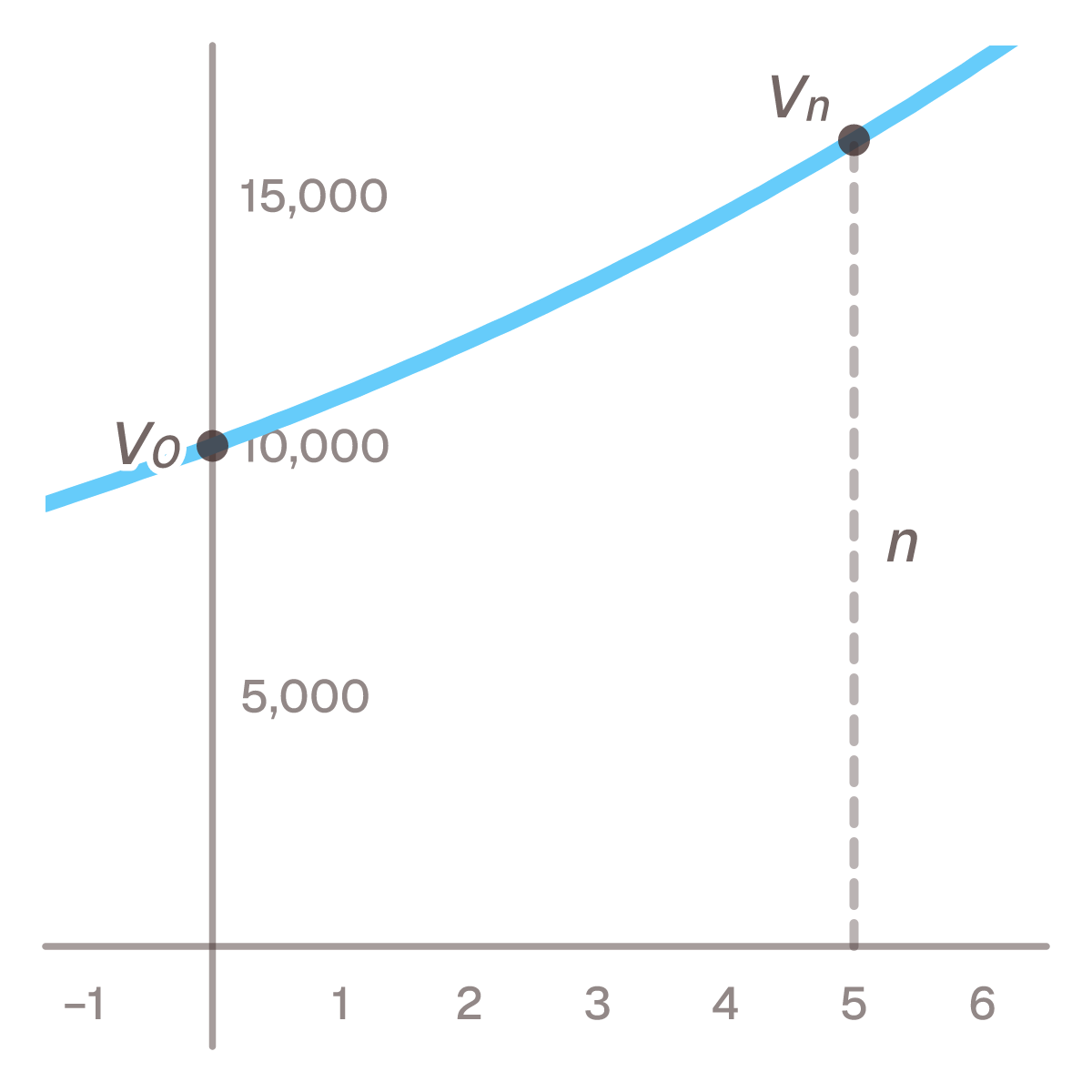
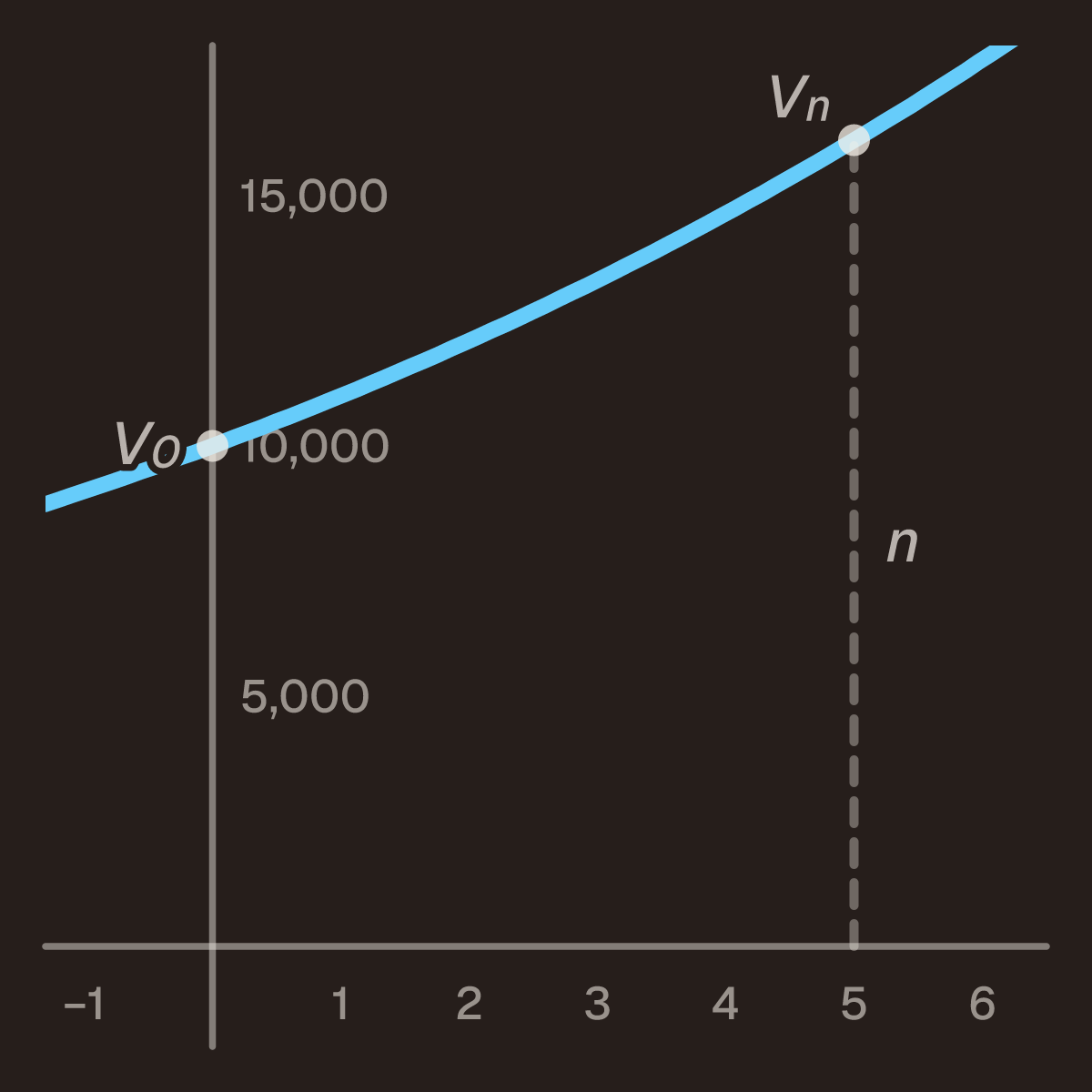
- r = 100 · ((Vₙ/V₀)^(1/n) − 1)
The 100 turns the factor into a percentage. Written without it — r = (Vₙ/V₀)^(1/n) − 1, as it usually
appears — you get 0.1 where this page writes 10%. It is the same number.
The ratio Vₙ/V₀ is the total change factor over the whole period. Raised
to 1/n it is the nth root of that — the factor which, multiplied by itself n times, gives the same
result. The 1 subtracted at the end is what you already had.
10,000 that became 16,105 in five years: 100 · ((16,105/10,000)^(1/5) − 1) = 100 · (1.1 − 1) = 10% a year.
It is the same arithmetic as compound interest, read backwards. One
formula asks what will it become; this one asks what was the rate.
Why averaging the years does not work
An investment that rises 20% for three years and then falls 10% for two:
| Year |
Change |
Factor |
| 1–3 |
+20% |
1.2 · 1.2 · 1.2 |
| 4–5 |
−10% |
0.9 · 0.9 |
The total factor is 1.2³ · 0.9² = 1.3997, so +39.97% over five years. The CAGR is therefore
100 · (1.3997^(1/5) − 1) = 6.96% a year.
Averaging the percentages gives (20 + 20 + 20 − 10 − 10)/5 = 8% — more than a percentage point out,
and always out in the same direction. Percentages do not add; factors multiply. The more the value swings,
the larger the gap.
CAGR or total return
The two answer different questions about exactly the same numbers:
- Total return (ROI): 10,000 → 16,105 is +61.05%. It says how
much it became.
- CAGR: 10% a year. It says how fast it got there.
Only CAGR compares investments held for different lengths of time. 61% over five years and 61% over ten
years are the same total return and two completely different investments.
Common mistakes
- Using CAGR as a forecast. It describes what happened, not what will happen. Two entirely different
paths with the same start and end value have identical CAGR.
- Including deposits made during the period. The formula uses only two values and a length of time.
If you added money along the way, it counts your deposits as if they were returns.
- Confusing the number of years with the number of values. From the 2020 value to the 2025 value is
five years, not six.
Frequently asked questions
Can CAGR be negative?
Yes. If the value fell, the ratio is below 1 and so is the root, so the answer is negative. Both values
still have to be positive — a rate between a positive and a negative value is not a rate at all.
Does the period have to be years?
No. The formula counts only the number of periods. Work in quarters and you get a quarterly rate — but
never compare that figure with an annual one without converting it.