The number in the bracket is the change factor. At 5% it is 1.05, and one
year of interest is one multiplication by 1.05. Two years is two multiplications, ten years is ten — and
ten multiplications by the same number is exactly what a power means. The exponent is not a calculating
trick; it is the number of times something happened.
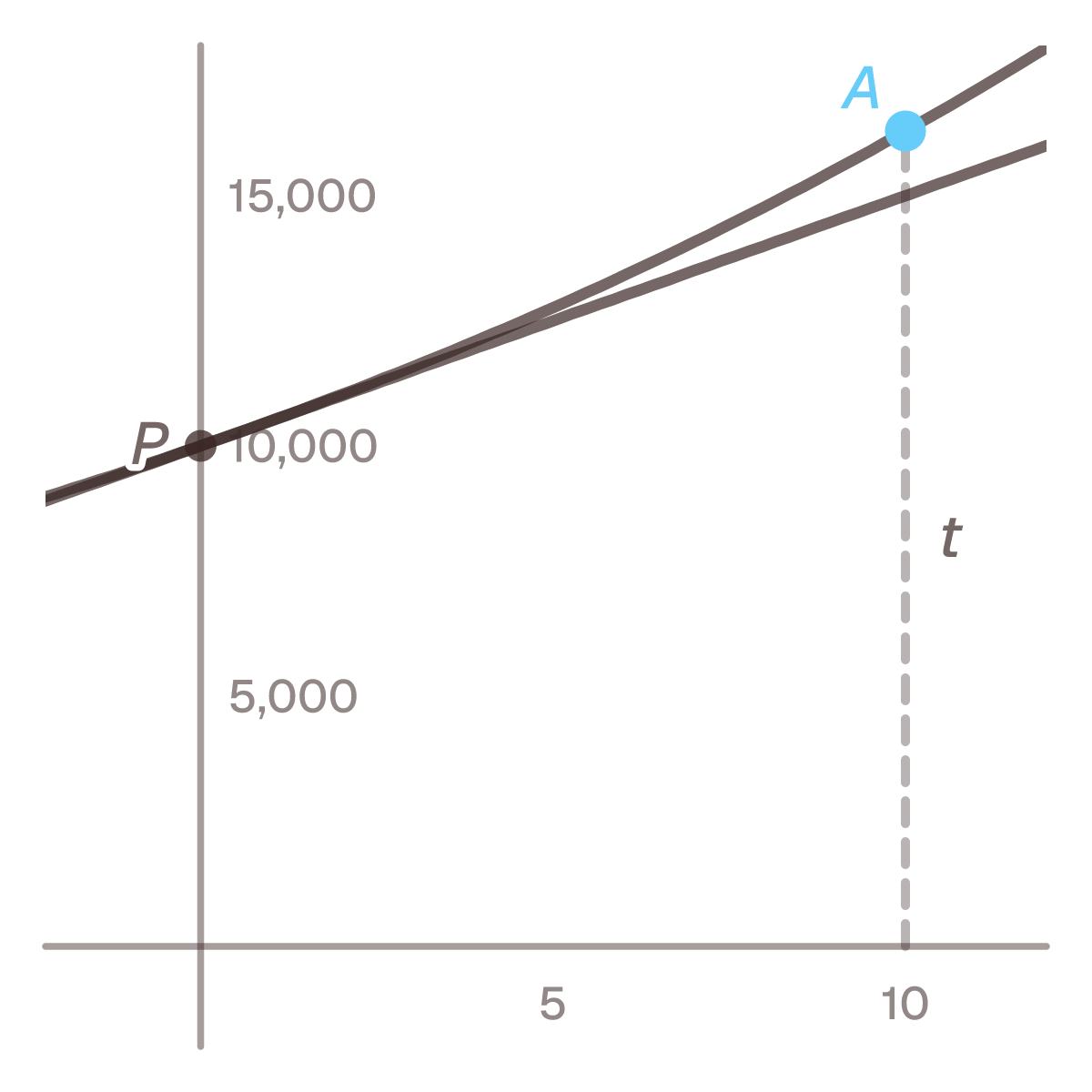
10,000 for two years at 10%: 10,000 · 1.10² = 10,000 · 1.21 = 12,100.
Why it is not 12,000
Simple interest on the same amount pays 1,000 a year, so 12,000. The 100
that separates them is the interest on the first year’s interest. Over one year it barely shows; it is
year after year that the gap grows.
| Year |
Simple interest |
Compound interest |
| 1 |
11,000 |
11,000 |
| 2 |
12,000 |
12,100 |
| 5 |
15,000 |
16,105 |
| 10 |
20,000 |
25,937 |
| 30 |
40,000 |
174,494 |
After thirty years one figure is four times the deposit and the other is seventeen times it. That is the
difference between adding a percentage and multiplying by a factor.
Solving for the other variables
The starting amount is a division: P = A / (1 + r/100)^t. That is the present value — what you need
to put in today to have A in t years.
The number of years needs a logarithm, because it sits in the exponent:
- t = ln(A/P) / ln(1 + r/100)
The base makes no difference: the two logarithms divide and the base cancels, so log base 10 gives the
same answer as ln.
The rate needs a root, written as a fraction in the exponent:
- r = 100 · ((A/P)^(1/t) − 1)
That is the same arithmetic as a compound annual growth rate: the factor raised
to one over the number of years, minus the 1 that was only ever the capital you already had.
Present value and future value
Finance has its own names for the two amounts, and they are two directions of one formula rather than two
formulas. The future value is A: what an amount has grown to after t years. The present value
is P: what an amount arriving in t years is worth today, discounted by the same factor.
- Future value: A = P · (1 + r/100)^t
- Present value: P = A / (1 + r/100)^t
The rate is called the discount rate when you run it backwards — the return you measure the future
amount against, not interest anyone pays out. $100,000 in five years at a 6% discount rate:
100,000 / 1.06⁵ ≈ $74,726. At that discount rate it is not worth paying more than that today to receive it.
The present value of several payments is the sum of each payment’s own present value. When the payments
are equal and arrive year after year, that sum is the annuity formula
read backwards — the same geometric series, once forward and once
back.
Common mistakes
- Multiplying the rate by the number of years. 5% for ten years is not 50% but 1.05¹⁰ ≈ 1.629, so
62.9%. Adding percentages gives simple interest.
- Using 0.05 instead of 1.05. The factor always contains what you already had.
- Mixing up the period. If interest is added monthly then
t is a number of months and r is the
monthly rate — not the annual one.
Frequently asked questions
What if the rate is negative?
The formula still holds. −10% for three years is 0.9³ = 0.729, so 72.9% is left. The rate only has to
be above −100%, because at exactly −100% everything is gone in the first year.
Does it apply if I save every month?
No. This formula is for one amount left alone. Regular deposits are a sum of many such amounts, each
with its own number of years, and the
compound interest calculator does that arithmetic for you.
How fast does the money double?
Set A = 2P and the capital cancels, leaving only the rate. That is
doubling time.