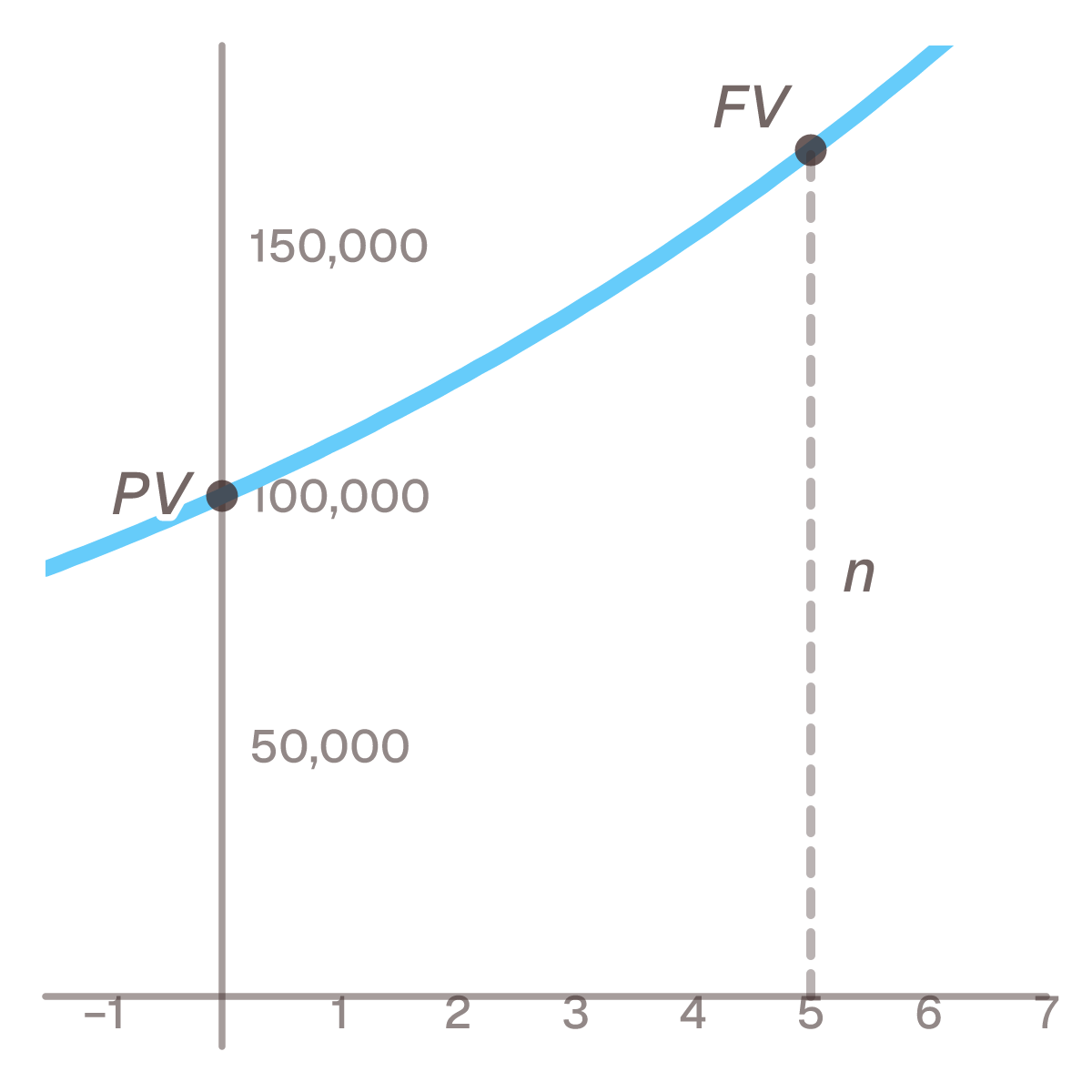
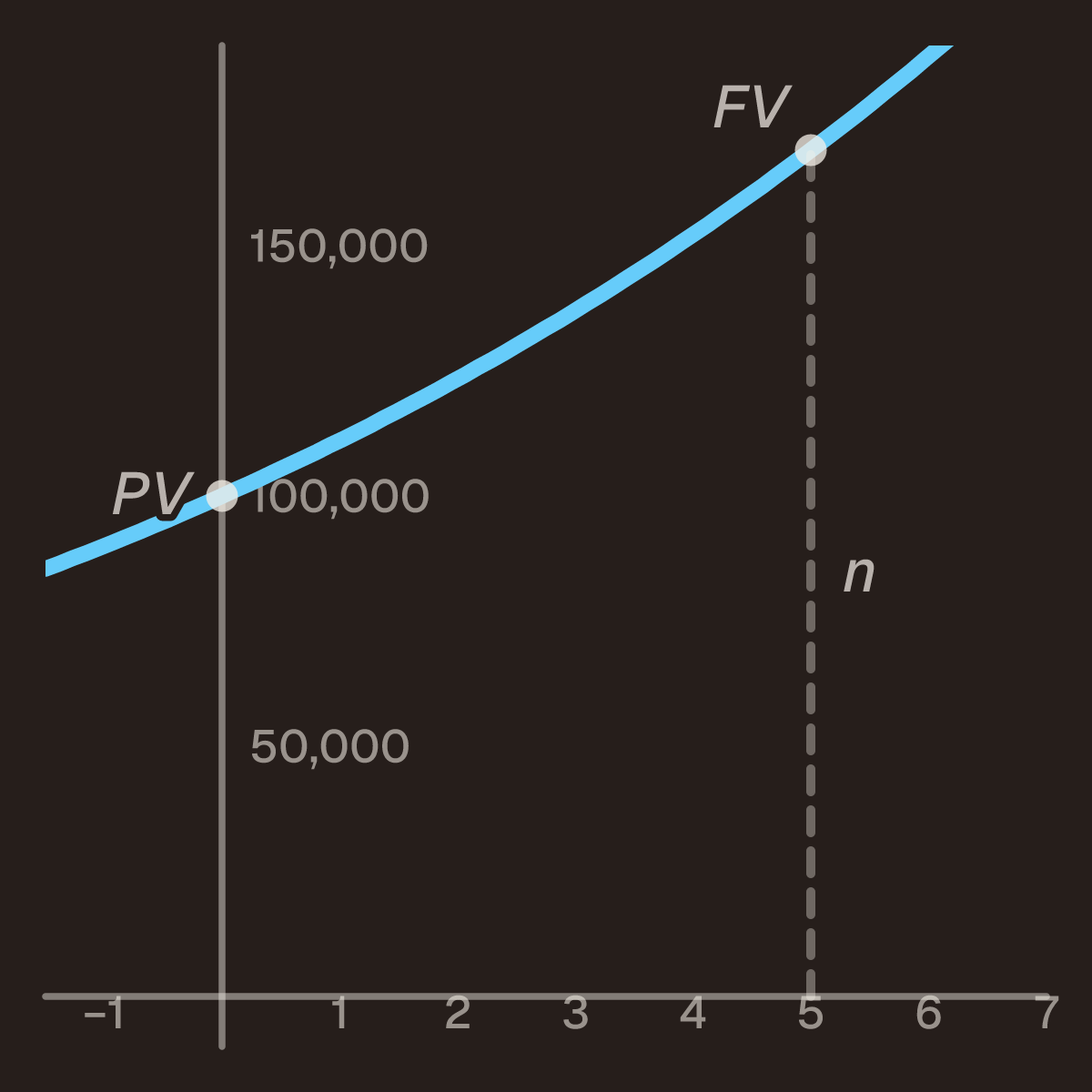
- MIRR = (FV / PV)^(1/n) − 1
PV is the present value of all the outflows, discounted at the finance rate. FV is the future value of all
the inflows at the final year, compounded at the reinvestment rate. n is the number of years. The card works
the rate in per cent, so it multiplies by 100.
It takes three steps: discount the outflows to today, compound the inflows to the final year, and find the
rate that grows the first amount into the second in n years.
An investment of 100,000, cash inflows of 30,000 a year for 5 years, reinvestment rate 6%.
- PV: the only outflow is today, so PV = 100,000.
- FV: 30,000 · (1.06⁴ + 1.06³ + 1.06² + 1.06 + 1) = 30,000 · 5.6371 = 169,112.79.
- MIRR = (169,112.79 / 100,000)^(1/5) − 1 = 1.6911^0.2 − 1 = 11.08%.
Why MIRR comes out below the IRR
The internal rate of return of the same
investment is 15.24%. That figure assumes every inflow can be put back to work at 15.24% until the final
year. If the money earns 6% when it arrives, 15.24% is a return the business never sees. MIRR lets you
enter the rate the inflows can actually earn.
The higher the reinvestment rate, the higher the MIRR, and at a reinvestment rate equal to the IRR the two
agree:
| Reinvestment rate |
FV |
MIRR |
| 0% |
150,000 |
8.45% |
| 3% |
159,274 |
9.76% |
| 6% |
169,113 |
11.08% |
| 10% |
183,153 |
12.87% |
| 15.24% |
203,228 |
15.24% |
When there are later outflows
This is where the finance rate comes in. An investment costs 80,000 today and another 30,000 after one
year, then returns 50,000 a year in years 2, 3 and 4. Finance rate 5%, reinvestment rate 8%.
- PV: 80,000 + 30,000 / 1.05 = 80,000 + 28,571.43 = 108,571.43. The outflow today is not discounted.
- FV at year 4: 50,000 · 1.08² + 50,000 · 1.08 + 50,000 = 58,320 + 54,000 + 50,000 = 162,320.
- MIRR = (162,320 / 108,571.43)^(1/4) − 1 = 10.58%.
The exponent is 1/4 because the investment runs for four years, from today to the last inflow — not the
three years in which money comes in.
To compare against a required rate rather than as a rate, work out the
net present value.
Common mistakes
- Dividing the growth by the number of years. 169,112.79 / 100,000 = 1.691 is 69.1% over five years,
but 69.1 / 5 = 13.82% is wrong: with compounding, 11.08% a year is enough. Take the fifth root.
- Discounting the inflows. They are compounded forward to the final year at the reinvestment rate, not
brought back to today.
- Compounding today’s outflow at the finance rate. An outflow at year 0 is already a present value.
- Taking n as the number of inflows. n is the time from the first outflow to the last inflow.
- Entering PV as a negative number. The ratio FV / PV needs two positive amounts; the sign is dealt
with when the outflows are collected into PV.
Questions people ask
How do I calculate MIRR in Excel?
With =MIRR(values, finance_rate, reinvest_rate), where the values are the cash flows year by year with
outflows as negative numbers. With −100,000 and five times 30,000 in A1:A6, =MIRR(A1:A6, 5%, 6%) gives
11.08%. The finance rate does not change the answer there, because the only outflow is today.
Which reinvestment rate should I use?
The return the money can reasonably earn when it comes in. The company’s cost of capital is a reasonable
choice when the inflows can pay down debt or fund other projects earning that return.
Why use MIRR when there is already an IRR?
The IRR assumes reinvestment at the IRR itself, and an investment whose cash flows change sign more than
once can have several IRRs or none. MIRR uses a rate you choose and gives a single answer as long as PV and
FV are positive.