Unit cost
The relation
c
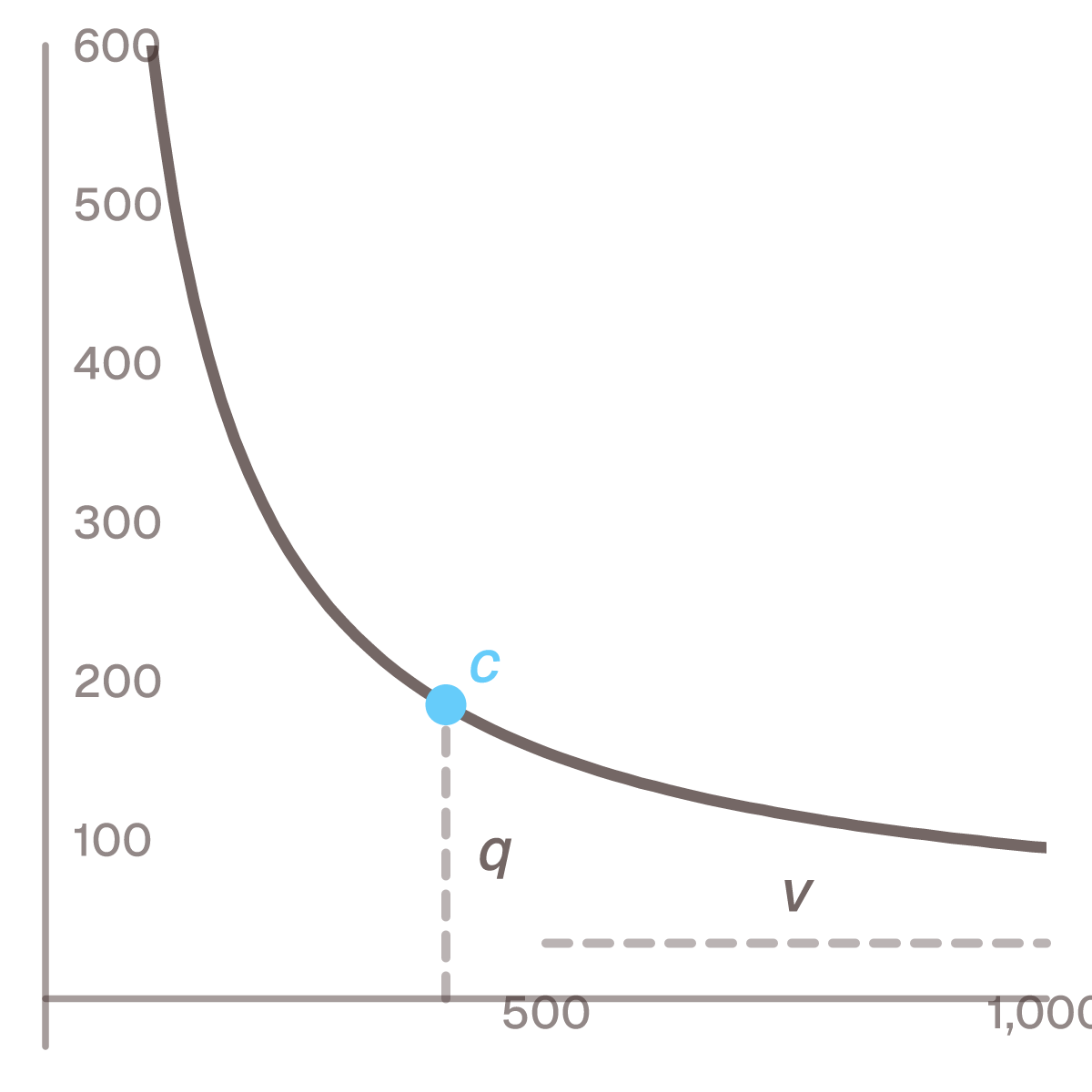
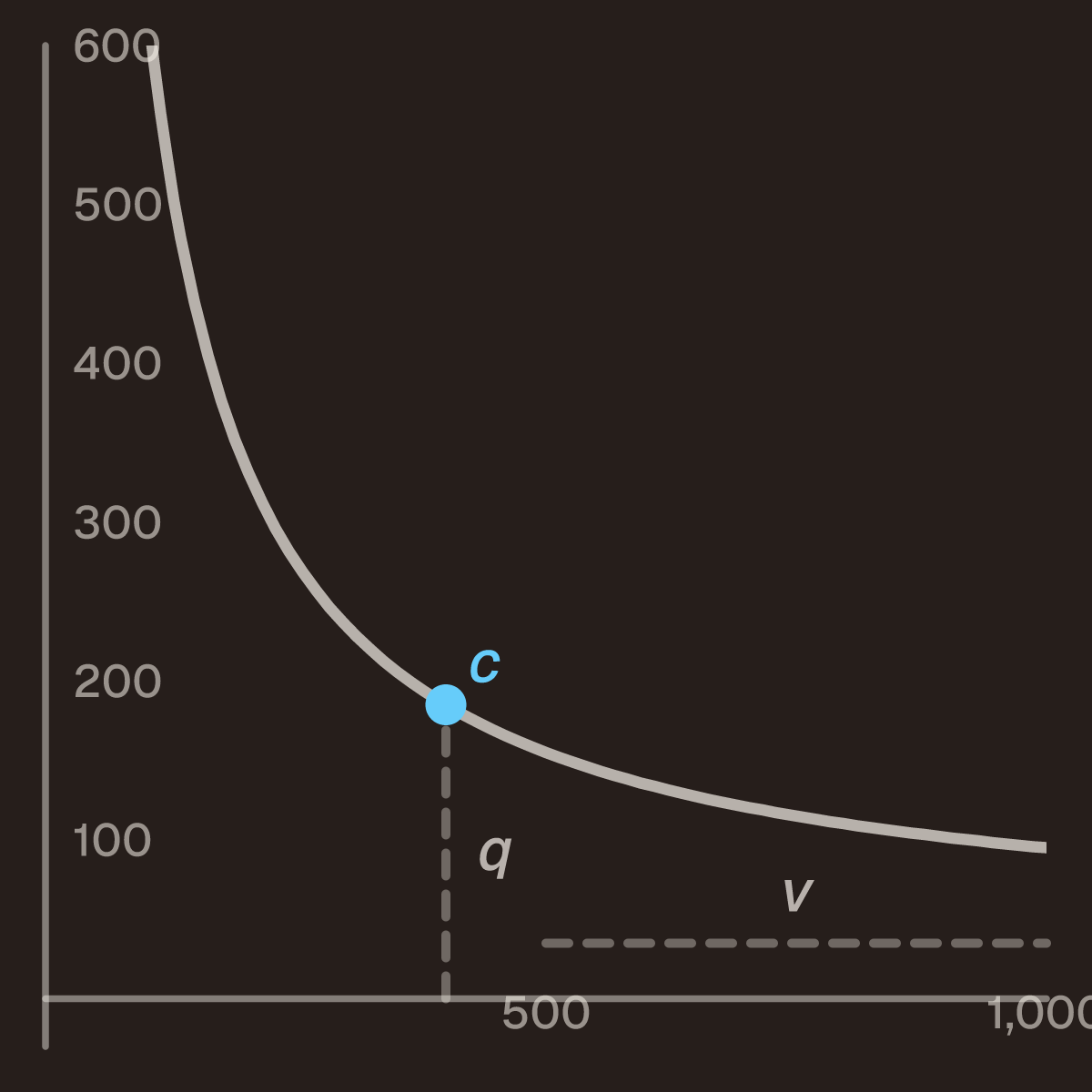
What one unit costs on average: the fixed costs shared out over the volume, plus the variable cost of the unit itself.
Solve for
c=185
c equals (60,000 divided by 400) plus 35, equals 150 plus 35, equals 185
Den här sidan finns på svenska. Byt till svenska
Definition — what does that mean?
What one unit costs on average, once the fixed costs are shared out over everything made.
In Swedish: Styckkostnad
c
What one unit costs on average: the fixed costs shared out over the volume, plus the variable cost of the unit itself.
c=185
c equals (60,000 divided by 400) plus 35, equals 150 plus 35, equals 185
You are given
where F is the fixed costs, q the quantity, v the variable cost per unit and c the unit cost. It is
the same number as total cost divided by quantity, (F + v · q) / q, written so that the two parts show
separately.
Holds when the variable cost is the same for every unit and the fixed costs do not change within the volume you are working with.
An example: 60,000 in fixed costs a month, 400 units, a variable cost of 35 per unit.
The variable part is the same at every volume. The fixed part is shared over more units the more are made, so the unit cost falls as the volume rises.
| Quantity | Fixed share per unit | Unit cost |
|---|---|---|
| 200 | 300 | 335 |
| 300 | 200 | 235 |
| 400 | 150 | 185 |
| 600 | 100 | 135 |
| 1,000 | 60 | 95 |
A price of 200 makes a profit on every unit at 400 units and a loss at 200. Where the line falls is the break-even quantity: 60,000 / (200 − 35) ≈ 364 units.
The card at the top of the page solves for any of the four. The quantity that gives a certain unit cost
is q = F / (c − v): a unit cost of 110 in the example takes 60,000 / 75 = 800 units. The unit cost never
gets down to the variable cost, however large the volume.
What the next unit costs is a different question. That is the
marginal cost, and with a constant variable cost per unit
it is exactly v — 35, not 185.
v.Is unit cost the same as average total cost?
Yes. Economics calls it average total cost, ATC: total cost divided by quantity. The fixed share is the
average fixed cost and the variable part the average variable cost, so ATC = AFC + AVC.
Does the unit cost keep falling as the volume grows?
In this formula it does, because the variable cost per unit is fixed. In practice that holds only up to
capacity: past it, overtime or a second shift raises the variable cost, or a new machine adds to the
fixed costs, and the unit cost can rise again.
What if the variable cost changes with the volume?
Work out the total variable cost at the volume you have, with any volume discount counted in, and divide
everything by the quantity. The formula on this page assumes a fixed amount per unit.
| Solve for | Rearranged | With the numbers | Comes to |
|---|---|---|---|
| F | (c | (185 | 60,000 |
| q | Fc | 60,000185 | 400 |
| v | c | 185 | 35 |
| c | Fq | 60,000400 | 185 |
Last reviewed October 6, 2026 ·How pages are reviewed
Copy the code into your page where the formula card should appear. It loads from lovetocalc.com, so it stays current on its own — all we ask is that the credit line comes with it.