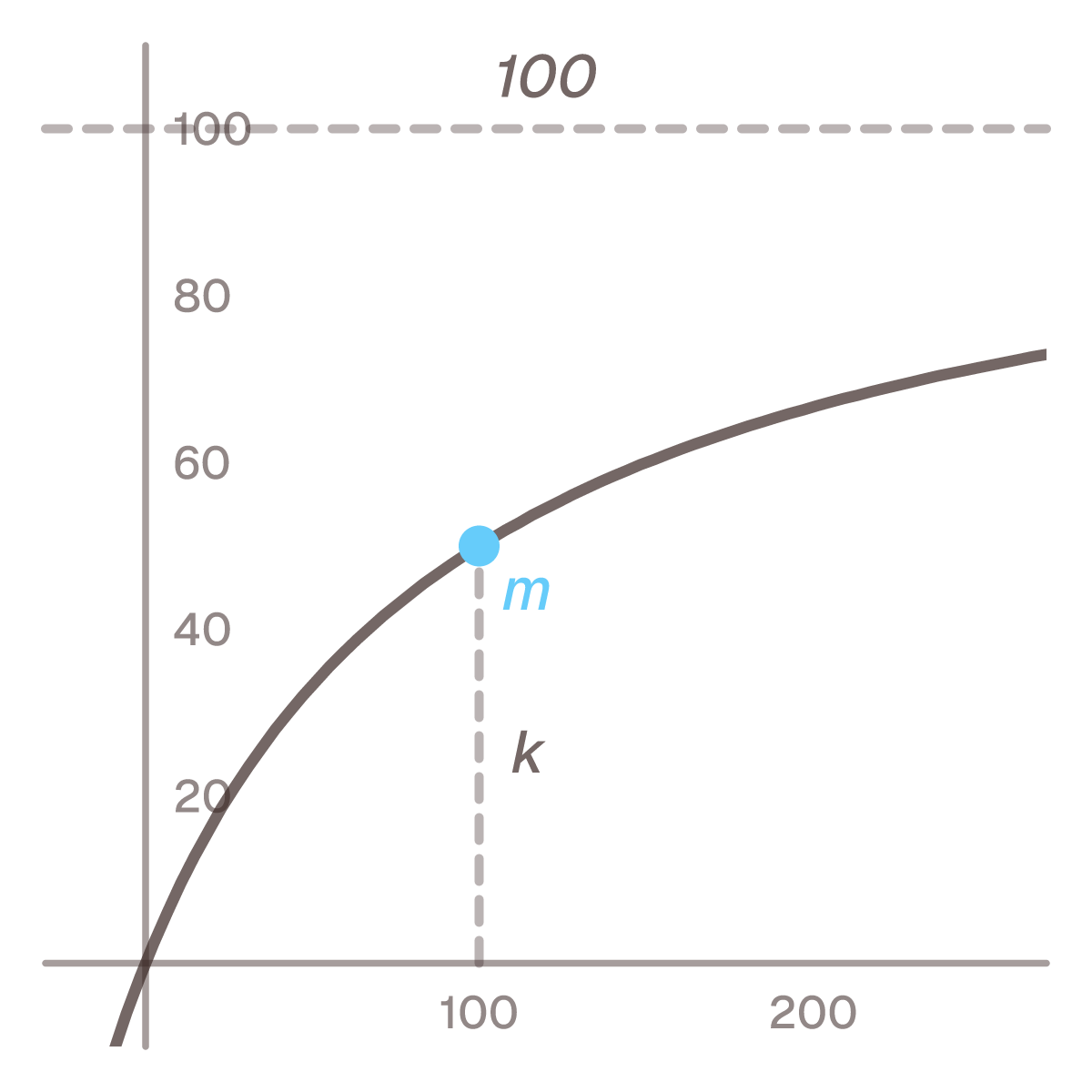
- margin = 100 · markup / (100 + markup)
And the other way:
- markup = 100 · margin / (100 − margin)
Neither one has a currency in it. That is the point: the conversion does not depend on what the item
costs, only on which of the two numbers you are holding.
Set the cost to 100. A markup of k per cent adds k, so the selling price is 100 + k and the profit
is k.
Margin is the profit divided by the price, which is k / (100 + k) — times
100 to put it back into per cent, that is the formula above.
At a 50% markup: an item “costing 100” sells for 150, the profit is 50, and 50 / 150 ≈ 33.3%.
Going back the other way, multiply out and gather the markup terms: m · (100 + k) = 100 · k gives
100 · m = k · (100 − m), and so k = 100 · m / (100 − m).
The conversion table
| Markup |
Margin |
| 10% |
9.1% |
| 25% |
20% |
| 33.3% |
25% |
| 50% |
33.3% |
| 66.7% |
40% |
| 100% |
50% |
| 150% |
60% |
| 233% |
70% |
| 300% |
75% |
| 900% |
90% |
Read it in either direction — the rows are pairs, not arrows.
Two things the table shows
The margin is the lower number. With a profit it divides by a bigger number, so it cannot be anything else.
The gap widens too: at 10% the two are nearly equal, at 300% they differ fourfold.
The margin never reaches 100%. However large the markup gets, the margin approaches 100% without
arriving — a 100% margin would mean the goods cost nothing. Markup has no matching ceiling.
Common mistakes
- Adding or subtracting instead of converting. A 50% markup is not a 50% margin less some fixed
amount, and the gap between them is different on every row of the table.
- Converting a target once and then reusing it. A 40% margin target needs a 66.7% markup — but only
while the target is 40%.
- Converting numbers that treat sales tax differently. If the markup is worked before tax and the
margin reported after it, neither figure means what it says.
Common questions
What markup do I need for a 50% margin?
100%. You double the cost — what retail calls keystone pricing. The card above converts any margin
target into the markup it takes.
Can I convert without the formula?
For the usual numbers, in your head: divide the markup by 100 plus the markup. 25 / 125 = 20%,
100 / 200 = 50%. It is the same arithmetic as the formula, without the per cent signs.
Does the conversion work on negative numbers?
Yes, down to a markup of −100%, where the goods are given away. Below that the numbers describe nothing
that can be sold, and the card above says so.