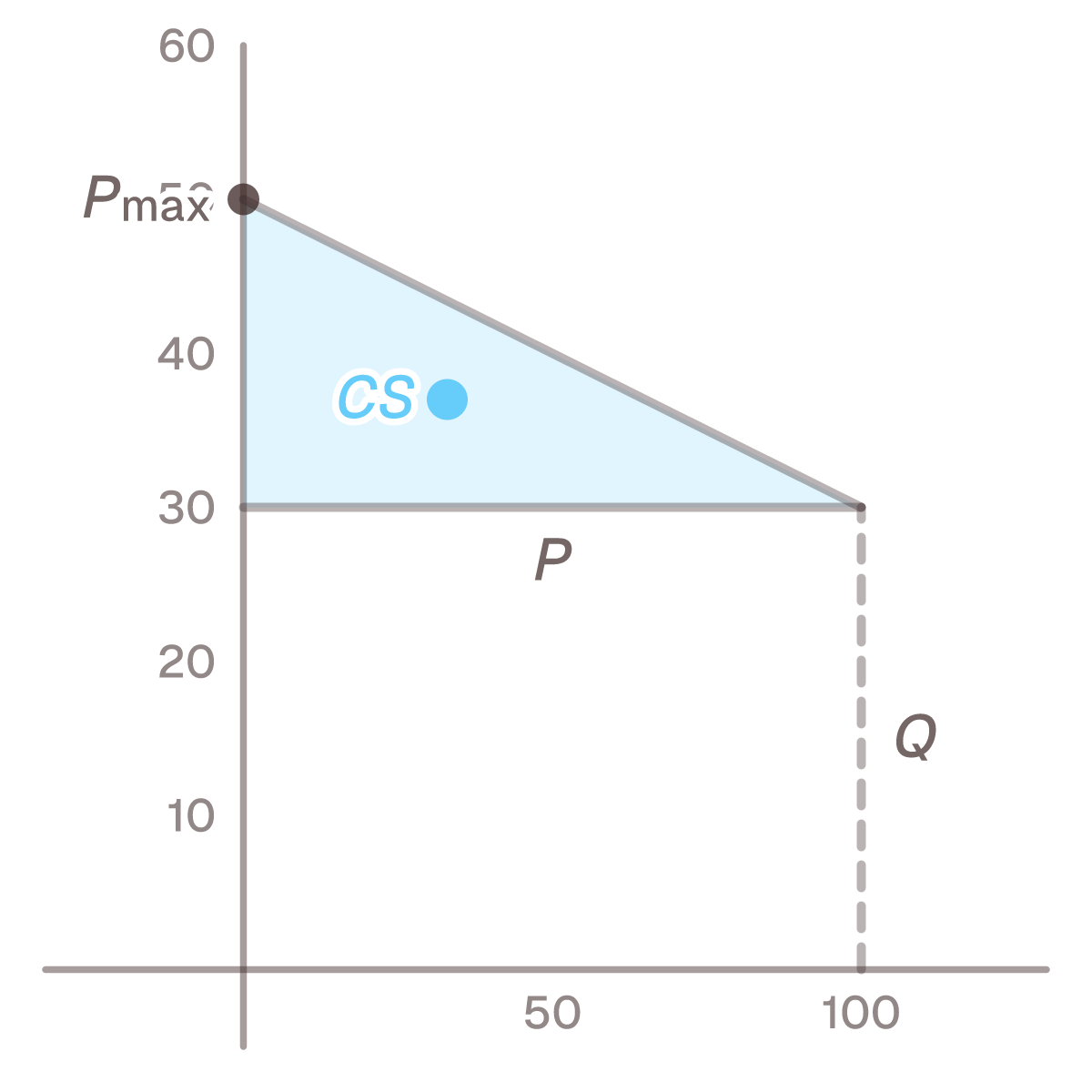
With a straight demand line:
Q is the quantity bought at the market price P, and P_max the choke price — the price at which nobody buys
at all, where the demand line meets the price axis.
At a price of 30, 100 tickets are sold. Nobody would buy at 50: CS = ½ · 100 · (50 − 30) = 1,000.
Why it is a triangle
The first buyer would have paid almost 50 and paid 30: a gain of nearly 20. The next would have paid a
little less, and so on down to the hundredth, who was only just willing to pay 30 and gains nothing. The
gains shrink evenly from 20 to 0 across the hundred buyers, so they add up to the
area of a triangle: half the base times the
height.
The formula only holds for a straight demand line. For a curved one, the surplus is the area between the
curve and the price, found by integration.
What a price cut is worth
Lower the price to 25. The demand line through (0, 50) and (100, 30) falls 0.2 per ticket, so at 25 it
reaches 125 tickets.
| Price |
Tickets |
Consumer surplus |
| 30 |
100 |
1,000 |
| 25 |
125 |
1,562.50 |
The gain of 562.50 comes from two places: the hundred buyers who were already there each save 5 (500),
and the 25 new buyers get a small triangle of their own (½ · 25 · 5 = 62.50).
Common mistakes
- Forgetting the half. 100 · 20 = 2,000 is the rectangle, twice the triangle.
- Using the price as the height. The height is the gap P_max − P, not P.
- Changing the price but keeping Q. A lower price moves along the demand line; the quantity changes
too.
Questions people ask
What is producer surplus?
The mirror image: the triangle between the price and the supply curve — what sellers receive above the
least they would have accepted.
What does a tax do to consumer surplus?
It raises the price buyers pay, which shrinks the triangle. Part of the loss becomes tax revenue; the rest
is lost to everyone.