Skip to content
LoveToCalc

Definition — what does that mean?

Arc elasticity (midpoint method)

Elasticity between two points, measured so that the direction you travel does not change the answer.

In Swedish: Bågelasticitet (mittpunktsmetoden)

Arc elasticity (midpoint method)

The relation

E=Q₂−Q₁Q₁+Q₂P₂−P₁P₁+P₂

The price elasticity between two points on a demand curve, each change measured against the average of its two ends, so that a rise and a fall over the same stretch give the same answer.
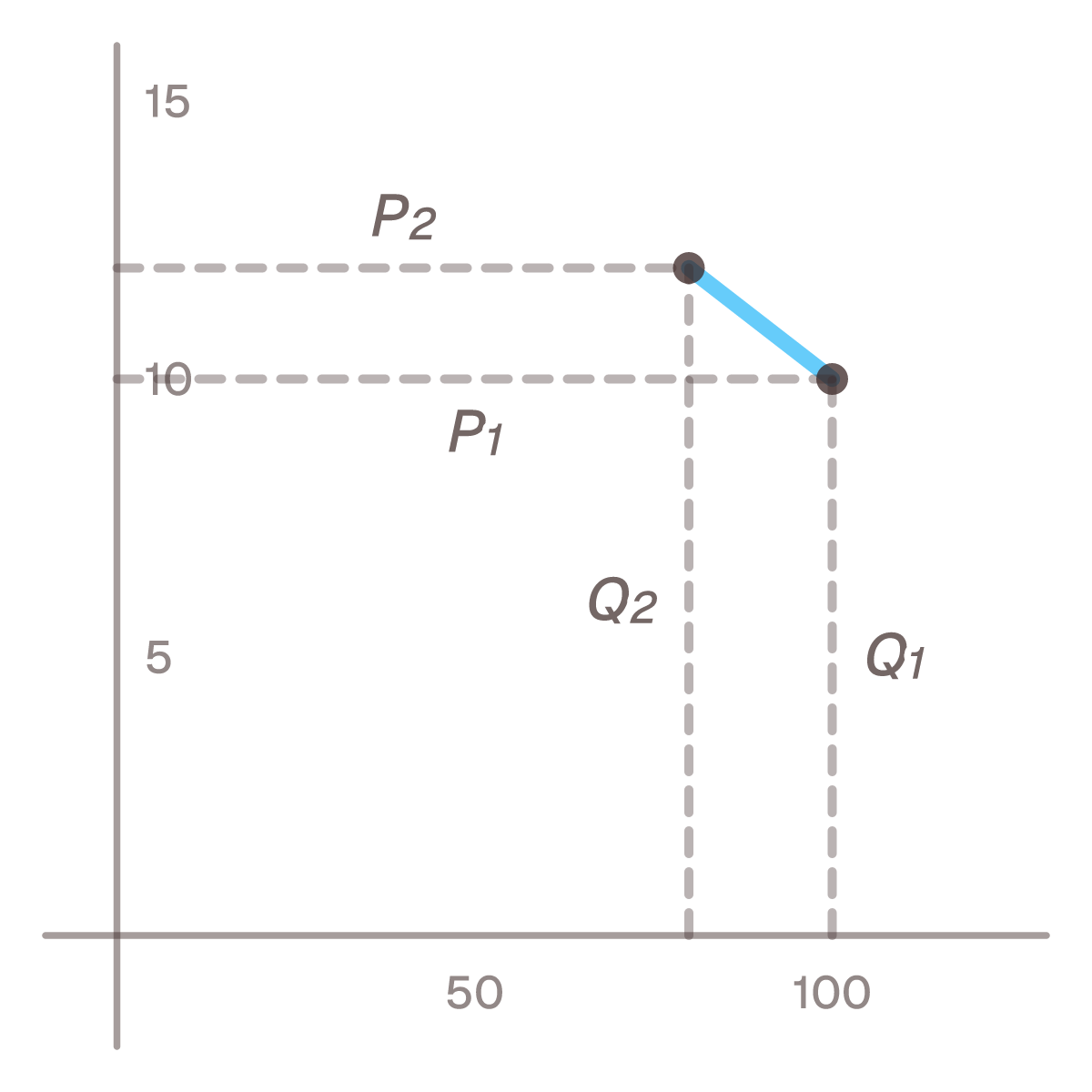
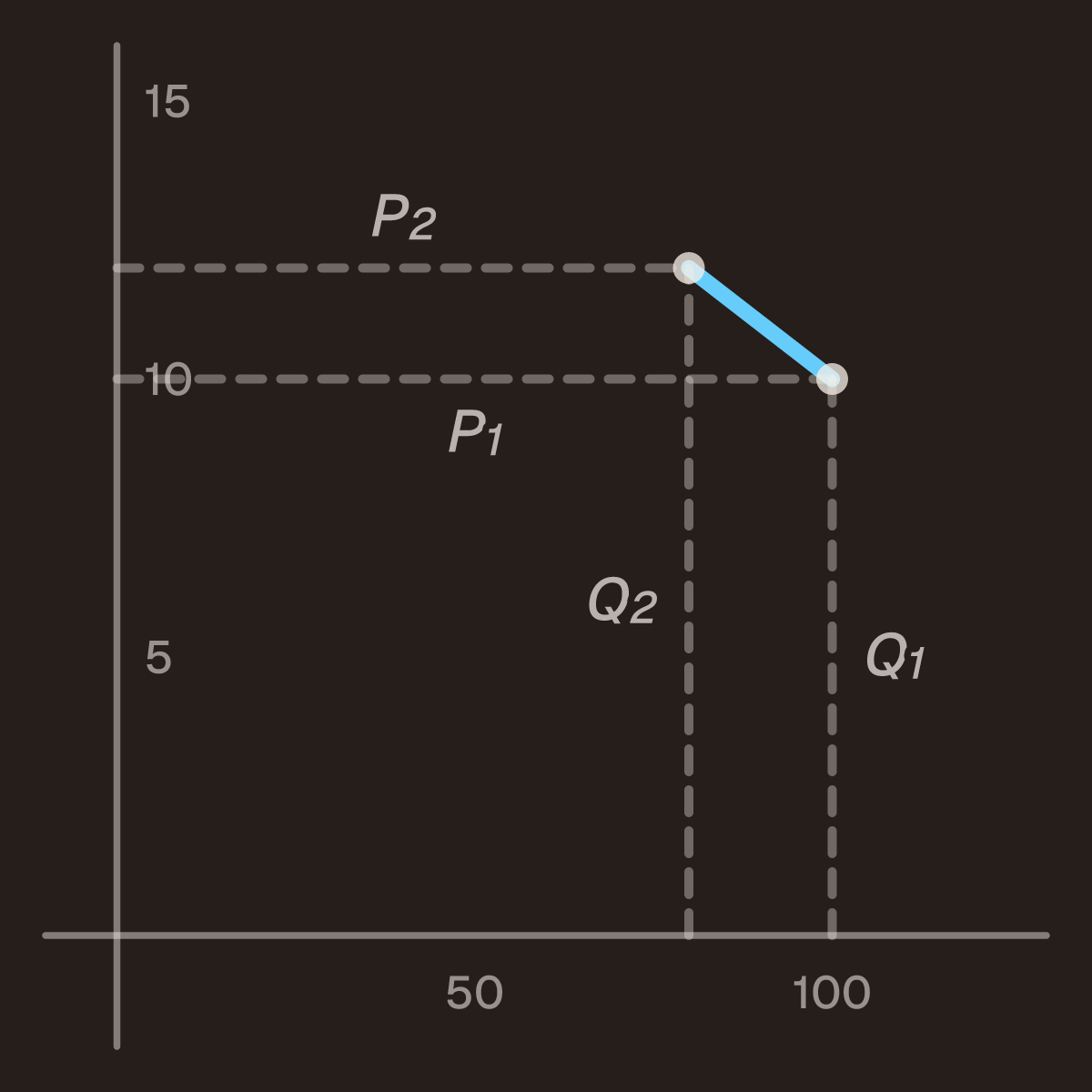
Solve for

E≈−1.2222

E equals ((80 minus 100) divided by (100 plus 80)) divided by ((12 minus 10) divided by (10 plus 12)), equals (−20 divided by 180) divided by (2 divided by 22), is approximately −0.1111 divided by 0.0909, is approximately −1.2222

Working4 steps

Practice questions

You are given

  • Q₂=80
  • Q₁=100
  • P₂=12
  • P₁=10

Round to 2 decimals.

The formula

Each change is divided by the average of its two values — the midpoint between them — instead of by the starting value.

The price rises from 10 to 12 and sales fall from 100 to 80:

The start-point trap

Measure from the start instead, as the ordinary price elasticity does:

The same two points, the same demand curve, and two different elasticities — one says unit elastic, the other clearly elastic. The midpoint version sits between them and gives −1.22 whichever way you go.

Method 10 → 12 12 → 10
From the start −1.00 −1.50
Midpoint (arc) −1.22 −1.22

When to use which

For small changes the two methods agree closely. Use the arc method whenever the change is large, when a problem gives two points rather than a percentage, and whenever someone could ask “measured from where?”

Common mistakes

Questions people ask

Why is it called arc elasticity? It measures the average elasticity along the arc of the demand curve between the two points, rather than at one point.

Is this the formula for cross-price or income elasticity too? The same midpoint idea works for any elasticity: replace price with the other good’s price or with income.

Looking for another letter? The formula solved for each one
Solved for each letter
Solve forRearrangedWith the numbersComes to
Q₁Q₂(1−E(P₂−P₁)P₁+P₂)1+E(P₂−P₁)P₁+P₂80(1−(−1.2222)(12−10)10+12)1+(−1.2222)(12−10)10+12100
Q₂Q₁(1+E(P₂−P₁)P₁+P₂)1−E(P₂−P₁)P₁+P₂100(1+(−1.2222)(12−10)10+12)1−(−1.2222)(12−10)10+1280
P₁P₂(1−Q₂−Q₁E(Q₁+Q₂))1+Q₂−Q₁E(Q₁+Q₂)12(1−80−100−1.2222(100+80))1+80−100−1.2222(100+80)10
P₂P₁(1+Q₂−Q₁E(Q₁+Q₂))1−Q₂−Q₁E(Q₁+Q₂)10(1+80−100−1.2222(100+80))1−80−100−1.2222(100+80)12
EQ₂−Q₁Q₁+Q₂P₂−P₁P₁+P₂80−100100+8012−1010+12−1.2222

Last reviewed October 6, 2026 ·How pages are reviewed

BusinessAll formulas

Put this formula on your site

Copy the code into your page where the formula card should appear. It loads from lovetocalc.com, so it stays current on its own — all we ask is that the credit line comes with it.