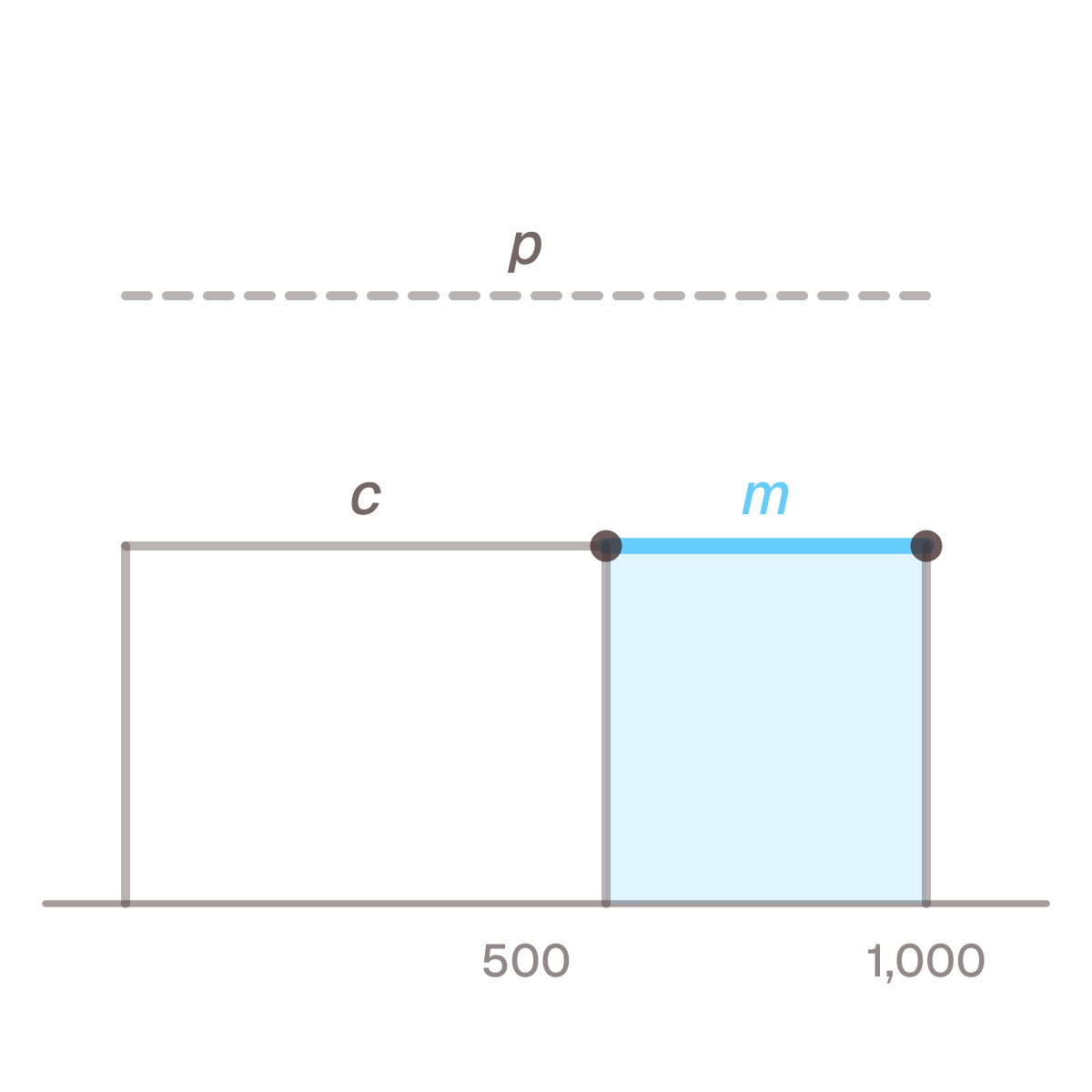
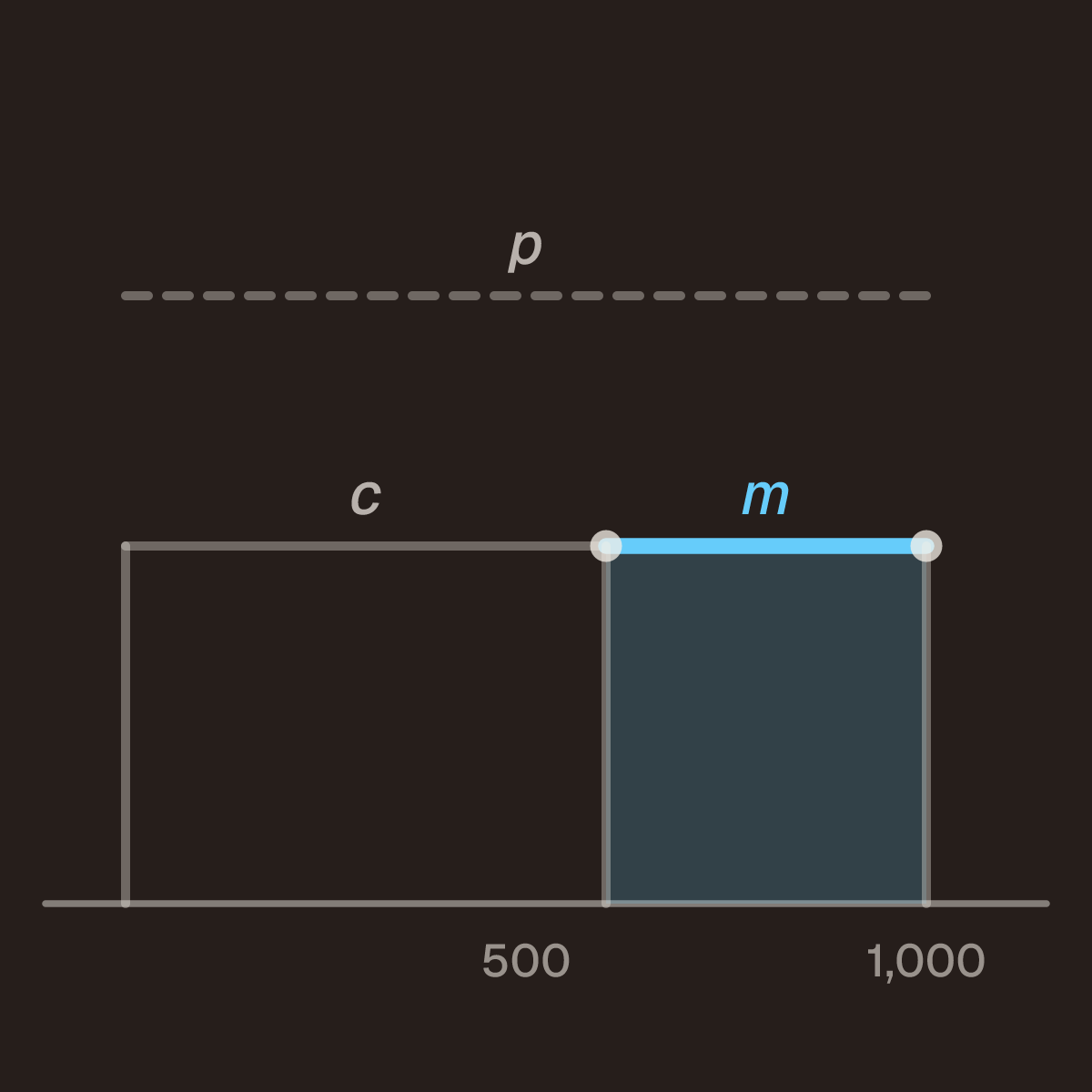
Margin is profit expressed as a share of the price:
- margin = 100 · (price − cost) / price
An item sold for 1,000 that cost 600 leaves 400 in profit. 400 / 1,000 = 0.4, so a 40% margin.
The price from a target margin
This is often the direction that is needed. You know what the goods cost and what margin you have to
hit — the question is what the price tag should say. Set the card above to solve for Price, fill in the
cost and the margin, and it works it out. The relation is the same formula solved for the price:
- price = 100 · cost / (100 − margin)
A cost of 600 at a 40% margin gives 100 · 600 / 60 = 1,000.
What surprises people is how fast the price runs away as the target margin approaches 100%. The
denominator (100 − margin) shrinks, and a small number in the denominator is a large number in the answer:
| Target margin |
Price on goods costing 600 |
| 20% |
750 |
| 40% |
1,000 |
| 50% |
1,200 |
| 75% |
2,400 |
| 90% |
6,000 |
From 40% to 50% is ten percentage points and 200. From 80% to 90% is also ten percentage points — but
3,000. At 100% the denominator would be zero, which is why the card requires a margin below 100 in this
direction.
A common mistake here is multiplying instead of dividing. 600 · 1.4 = 840 is not a 40% margin
but a 40% markup, and leaves a margin of 28.6%. See the next section.
Margin is not markup
This is the trap that costs money. Margin and markup describe the same profit, but they divide by
different numbers.
|
Measured against |
Same item (600 → 1,000) |
| Margin |
The price |
400 / 1,000 = 40% |
| Markup |
The cost |
400 / 600 ≈ 66.7% |
Adding 40% to 600 gives 840 and a margin of only 28.6%. Anyone who prices by a markup and reports against a
margin target of the same percentage comes in under the target every time.
The rule of thumb: when there is a profit, margin is lower than markup, because the price is the larger number to divide by.
Some margins to compare against
| Margin |
Markup that gives the same thing |
| 10% |
11.1% |
| 25% |
33.3% |
| 40% |
66.7% |
| 50% |
100% |
| 60% |
150% |
Common mistakes
- Confusing margin with markup. See the table above. Same profit, different denominator.
- Working the margin on a price that includes tax. The cost is usually net of tax, so the price has to
be too, or you are measuring two different things.
- Assuming the margin can pass 100%. At 100% the cost would be zero, so the card above
requires a margin below 100 when it solves for the price.
- Mixing gross margin with net profit. “Cost” here is the cost of the goods themselves. Fold in rent,
wages and other fixed costs and you get a different figure altogether — that one belongs to the
break-even quantity.
Questions people ask
How do I find the price I need to charge?
Divide the cost by (1 − the margin as a decimal). A cost of 600 at a 35% margin is 600 / 0.65 ≈ 923. The
margin calculator does it in both directions.
What counts as a good profit margin?
It depends on the industry, and on which margin is meant. The margin on this page is a gross margin,
before rent, wages and other fixed costs, and a business with a healthy gross margin can still be left
with a thin profit once everything is paid. Compare with similar businesses, and like with like.
What if the cost is higher than the price?
The margin comes out negative, and the formula says exactly that: every sale deepens the loss. The
relation still works; the answer is a warning rather than a metric.