Marginal cost
The relation
MC
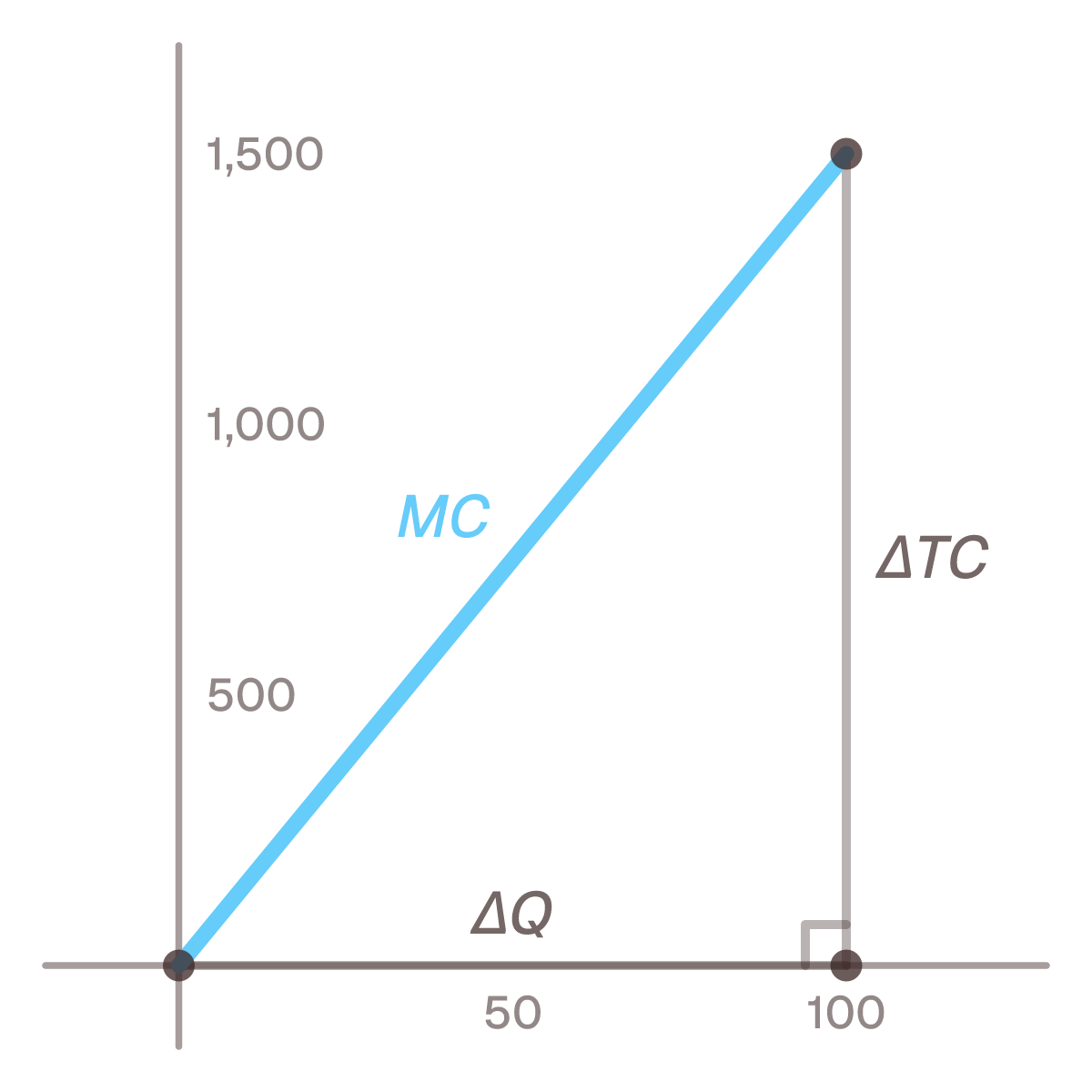
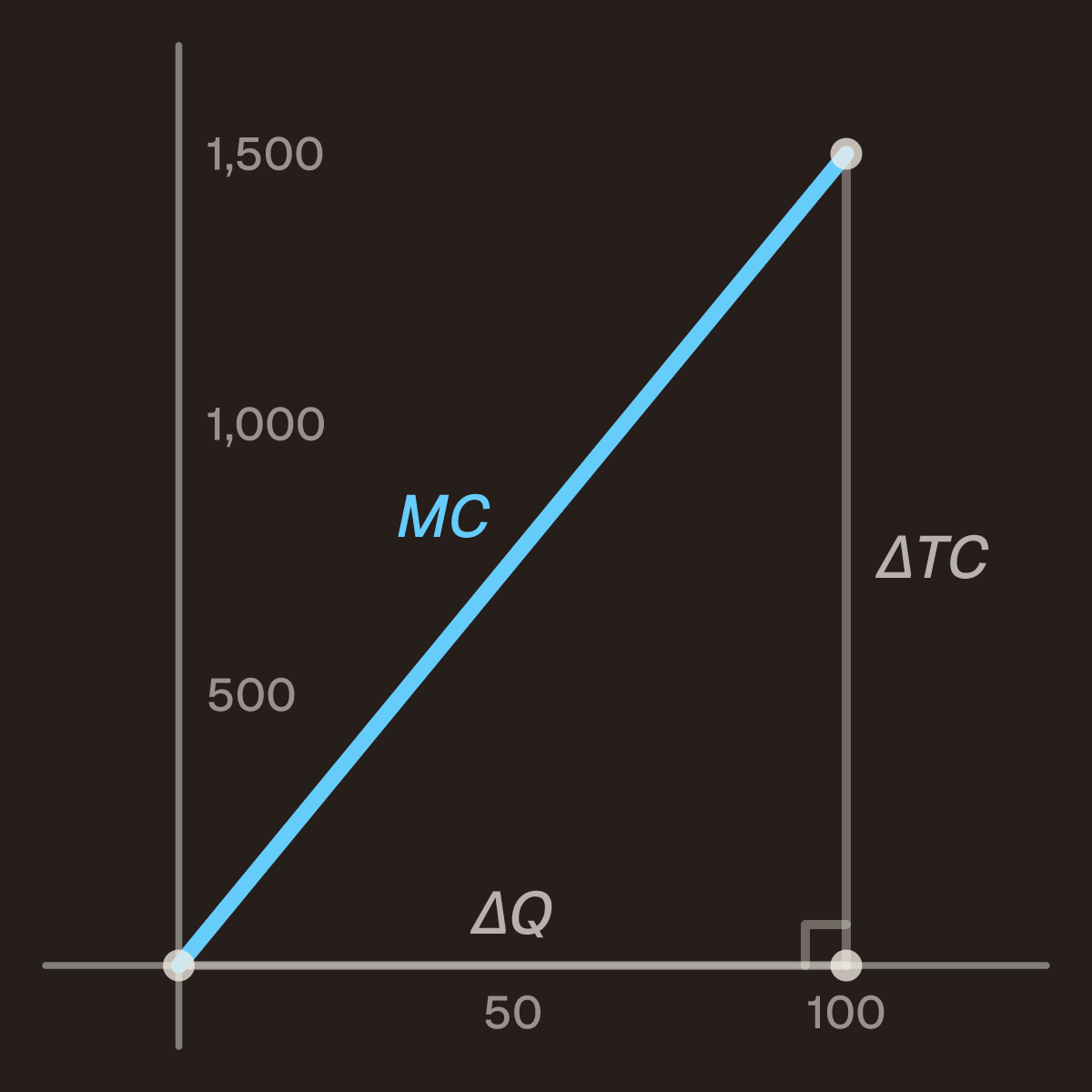
What producing one more unit adds to the total cost: the change in cost divided by the change in quantity.
Solve for
MC=15
MC equals 1,500 divided by 100, equals 15
Den här sidan finns på svenska. Byt till svenska
Definition — what does that mean?
What it costs to make one more unit.
In Swedish: Marginalkostnad
MC
What producing one more unit adds to the total cost: the change in cost divided by the change in quantity.
MC=15
MC equals 1,500 divided by 100, equals 15
You are given
Round to 2 decimals.
ΔTC is the change in total cost and ΔQ the change in the number of units made.
A bakery makes 1,000 loaves for 20,000. Making 1,100 costs 21,500: MC = 1,500 / 100 = 15 per loaf.
Each of the extra hundred loaves cost 15 to make. If they sell for more than 15, making them adds to profit.
At 1,000 loaves the average cost is 20,000 / 1,000 = 20. It is tempting to say a loaf costs 20 and refuse an order at 18. But the extra loaves only cost 15 each — the oven, the rent and the staff are paid for already. Taking the order at 18 earns 3 per loaf.
| Loaves | Total cost | Average cost | Marginal cost of the last 100 |
|---|---|---|---|
| 1,000 | 20,000 | 20.00 | — |
| 1,100 | 21,500 | 19.55 | 15 |
Because the marginal cost is below the average, making more pulls the average down: from 20 to 19.55. When marginal cost climbs above average — overtime, a second shift — the average starts rising.
Fixed costs are the same at 1,000 loaves and at 1,100, so they cancel in ΔTC. That is why marginal cost is the number for short-run decisions — one more order, one more shift — and why a price that covers marginal cost but not the average is still worth taking, for a while. In the long run every cost has to be covered; the break-even quantity is where that happens.
With a cost function TC(Q), marginal cost is its derivative, MC = dTC/dQ — the limit of ΔTC/ΔQ as the step shrinks. The formula here is the average rate of change over a finite step; the definition of the derivative takes it to a point.
Why do firms produce where marginal cost equals price?
That holds for a firm that cannot move the price itself, as under perfect competition, and whose marginal
cost is rising. Below that point each extra unit earns more than it costs; above it, less. Profit is
highest where the two meet. A firm that has to cut its price to sell more compares marginal cost with
marginal revenue instead.
Can marginal cost be zero?
Nearly, for digital goods: one more download costs almost nothing, so a price set from marginal
cost alone would never pay for building the software.
| Solve for | Rearranged | With the numbers | Comes to |
|---|---|---|---|
| ΔTC | MCΔQ | 15·100 | 1,500 |
| ΔQ | ΔTCMC | 1,50015 | 100 |
| MC | ΔTCΔQ | 1,500100 | 15 |
Last reviewed October 6, 2026 ·How pages are reviewed
Copy the code into your page where the formula card should appear. It loads from lovetocalc.com, so it stays current on its own — all we ask is that the credit line comes with it.