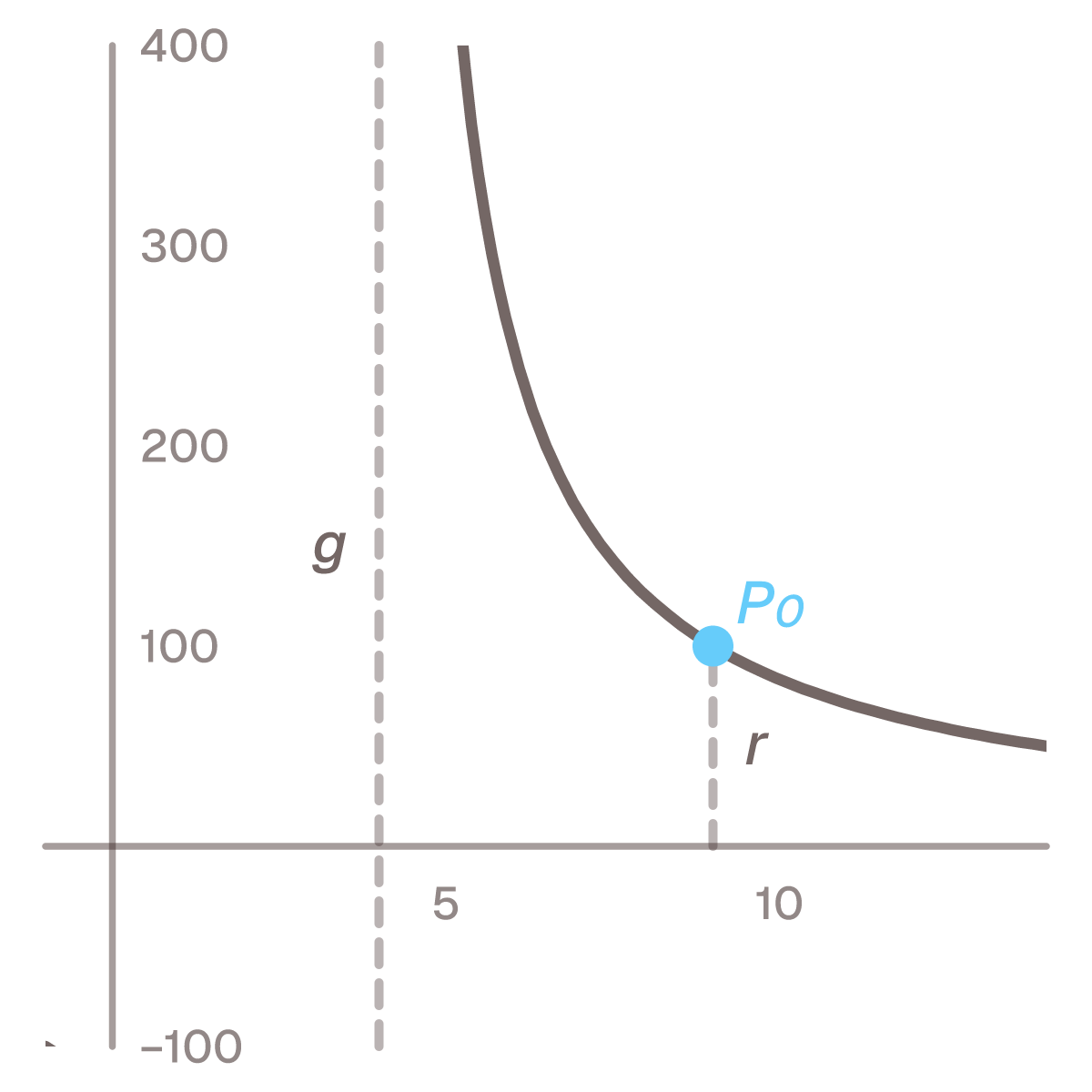
D₁ is the dividend expected next year, r the return an investor requires and g the yearly growth of
the dividend, both in per cent.
Next year’s dividend is 5, the required return 9% and growth 4%: P₀ = 100 · 5 / (9 − 4) = 100.
It is a perpetuity with growth. Growth
eats into the discounting, so the dividend is divided by the gap between return and growth rather than by
the return alone.
D₁, not D₀
The dividend in the formula is the next one, not the one just paid. If the company has just paid 5 and
the dividend grows 4%, next year’s is 5 · 1.04 = 5.2, and the price is 100 · 5.2 / 5 = 104, not 100.
Textbooks write it both ways — P₀ = D₀(1 + g)/(r − g) is the same formula with that step inside it. The
question to ask of any problem is which dividend it gives you.
The price is very sensitive to growth
| Growth g |
Price at r = 9%, D₁ = 5 |
| 2% |
71.43 |
| 4% |
100.00 |
| 5% |
125.00 |
| 6% |
166.67 |
| 8% |
500.00 |
As g approaches r, the denominator approaches zero and the price has no ceiling. At g ≥ r the model gives
no price at all: a dividend growing as fast as the return never gets smaller in today’s money, and the sum
has no end. The card refuses that case rather than print a negative price.
That is also the model’s honest limit. No company grows faster than the economy for ever, so g belongs
near long-run growth — a few per cent — and a model fed 8% is saying more about the input than the share.
Reading it backwards
Solved for r, it says what return the market price implies: r = g + 100 · D₁ / P₀ — the dividend yield
plus the growth. That rearrangement is one of the standard ways to estimate the cost of equity for
WACC, alongside CAPM.
Common mistakes
- Using the dividend just paid. See above — it is D₁.
- Mixing a fraction and a per cent. 5 / (0.09 − 4) is nonsense; keep both rates in the same form.
- Using it for a company with no dividend. The model values dividends. A company that pays none has a
price the model cannot see.
Questions people ask
Is it the same as the dividend discount model?
It is the dividend discount model with constant growth — the simplest version, which is why the two names
are often used for each other.
What if growth is negative?
It still works. A dividend shrinking by 2% a year at a 9% return gives 100 · 5 / 11 ≈ 45.45.