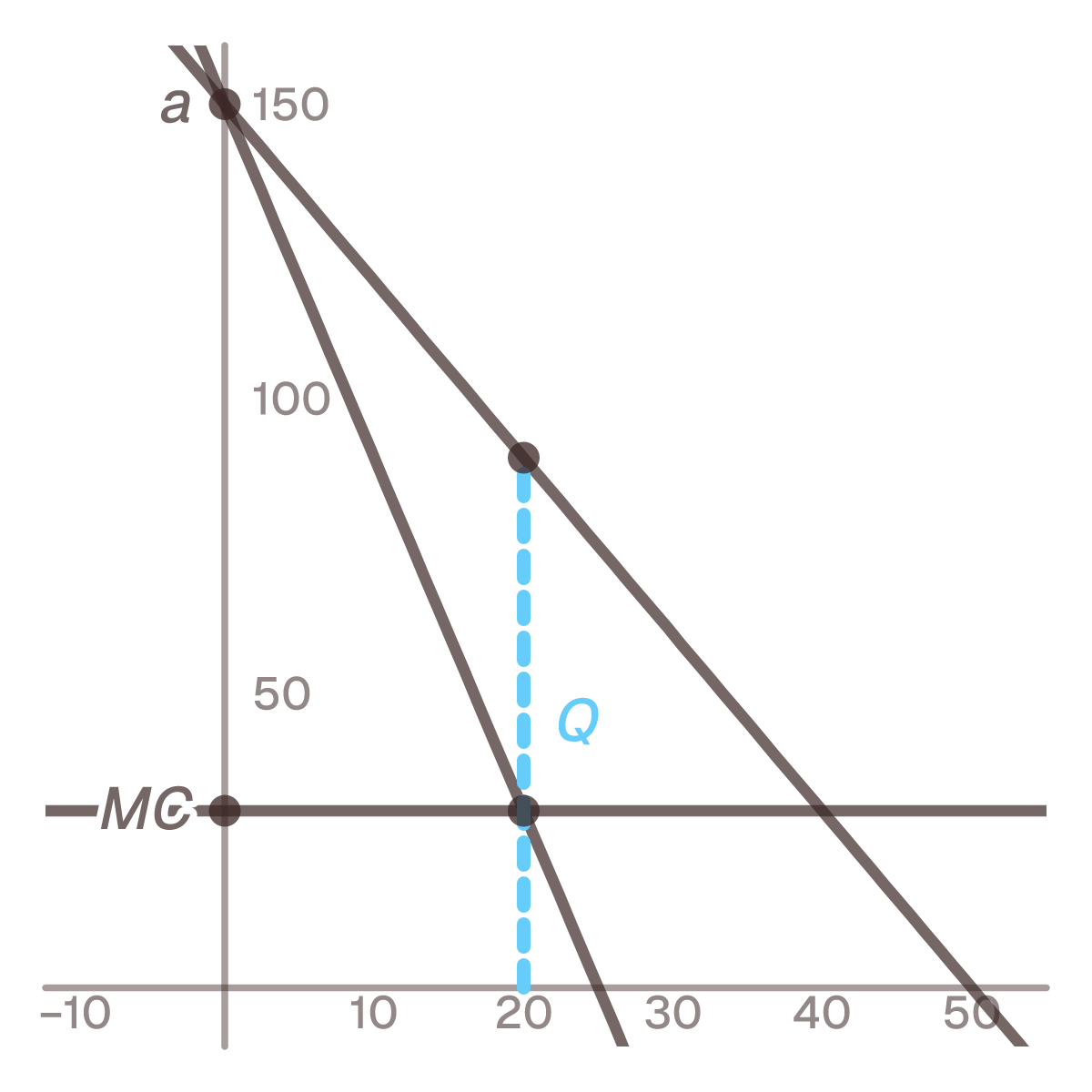
With the demand curve P = a − bQ, marginal revenue is MR = a − 2bQ. Profit is highest where marginal
revenue equals marginal cost:
a is the choke price, where the demand line meets the price axis, b the slope of the line, Q the quantity
and MC marginal cost. The price is then read off the demand curve: P = a − bQ. The pair (Q, P) is
sometimes called the Cournot point.
Holds when the monopolist charges one price to every buyer, demand is a straight line and marginal cost is
constant. With a curved demand or a rising marginal cost the principle MR = MC still holds, but this
particular formula does not.
Demand P = 150 − 3Q and MC = 30.
- MR = 150 − 6Q
- 150 − 6Q = 30 gives Q = 120 / 6 = 20 units
- The price: P = 150 − 3 · 20 = 90
The contribution is (90 − 30) · 20 = 1,200, before fixed costs.
The price is read on the demand curve
The crossing MR = MC gives the quantity, and at that height sits marginal cost, 30. That is not the price.
Buyers pay what the demand curve says at 20 units: 90.
| Q |
Price |
Revenue |
Variable cost |
Contribution |
| 10 |
120 |
1,200 |
300 |
900 |
| 20 |
90 |
1,800 |
600 |
1,200 |
| 30 |
60 |
1,800 |
900 |
900 |
| 40 |
30 |
1,200 |
1,200 |
0 |
Wrong: setting the price at 30, the height where MR and MC meet. Right: 90.
The last row is the output at which price equals marginal cost, which a perfectly competitive market with
the same costs would produce. The monopolist sells half as much at a higher price.
A steeper or flatter demand
With the same a and MC but b = 1.5, so P = 150 − 1.5Q:
- 150 − 3Q = 30 gives Q = 40 units
- P = 150 − 1.5 · 40 = 90
The quantity doubles, but the price stays the same. With straight-line demand and constant marginal cost,
the price lands halfway between the choke price and marginal cost, (a + MC) / 2 = (150 + 30) / 2 = 90,
whatever the slope.
What each extra unit costs is on the marginal cost page,
and how sensitive demand is to price on the
price elasticity of demand page.
Common mistakes
- Reading the price at MR = MC. That height is marginal cost. The price is on the demand curve,
directly above.
- Using the demand slope in MR. Marginal revenue falls twice as fast as price: MR = a − 2bQ, not
a − bQ.
- Setting price equal to marginal cost. That gives the competitive output, not the monopoly’s profit
maximum.
- Forgetting the fixed costs. MR = MC gives the output with the largest contribution. Whether that
covers the fixed costs is a separate question.
Questions people ask
Why does MR = MC give the most profit?
As long as the next unit brings in more revenue than it costs, selling it adds to profit. Once marginal
revenue has fallen to marginal cost there is nothing more to gain, and beyond that profit falls. With
calculus: profit (a − bQ)Q − MC · Q has derivative a − 2bQ − MC, which is zero exactly there.
Why does marginal revenue fall twice as fast as price?
To sell one more unit, the monopolist has to lower the price on all units, not just the last one. Revenue
is (a − bQ) · Q = aQ − bQ², and its derivative is a − 2bQ.
Does this hold if the monopolist charges different customers different prices?
No. The formula assumes a single price. With price discrimination the monopolist does not have to cut the
price for everyone to sell one more unit, and marginal revenue looks different.