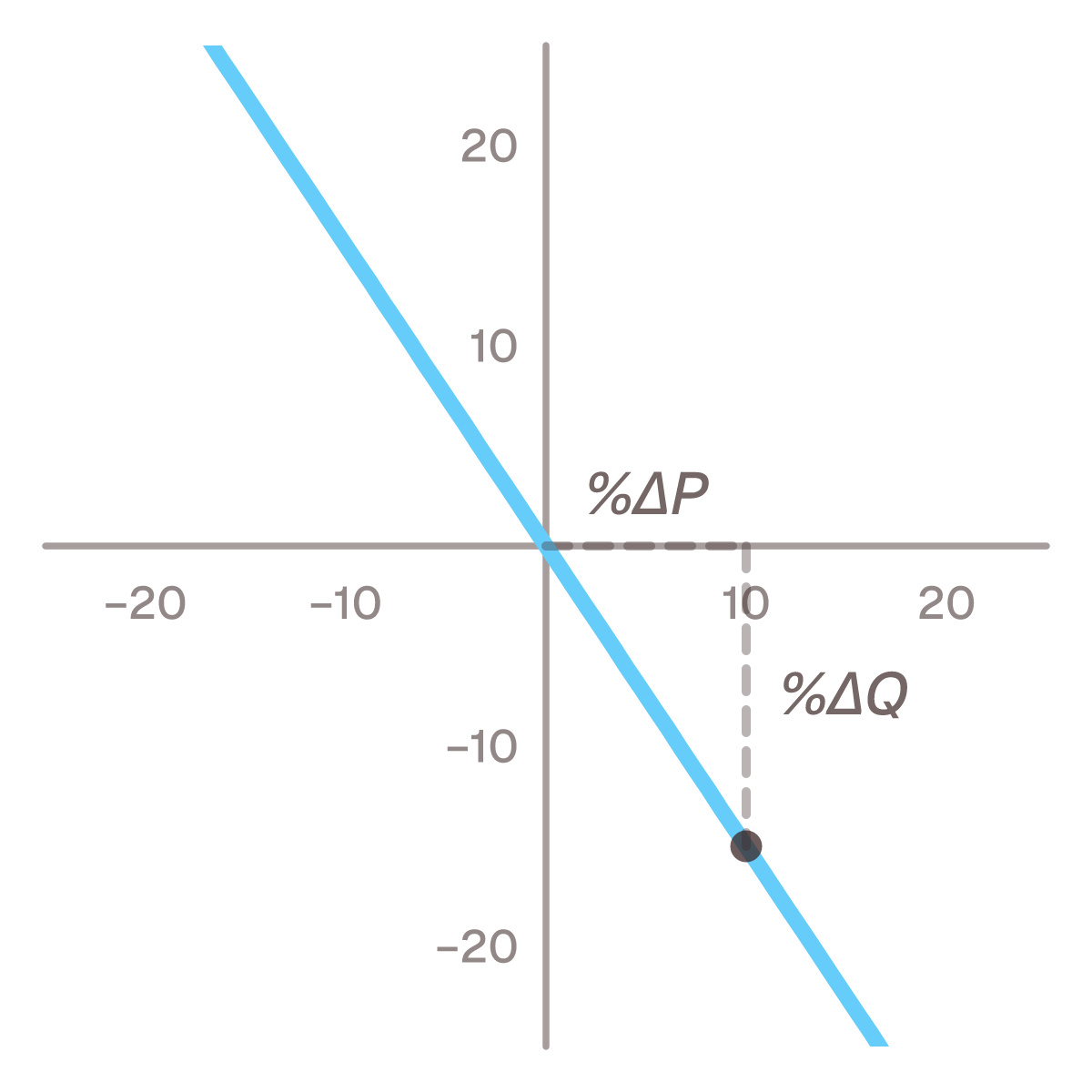
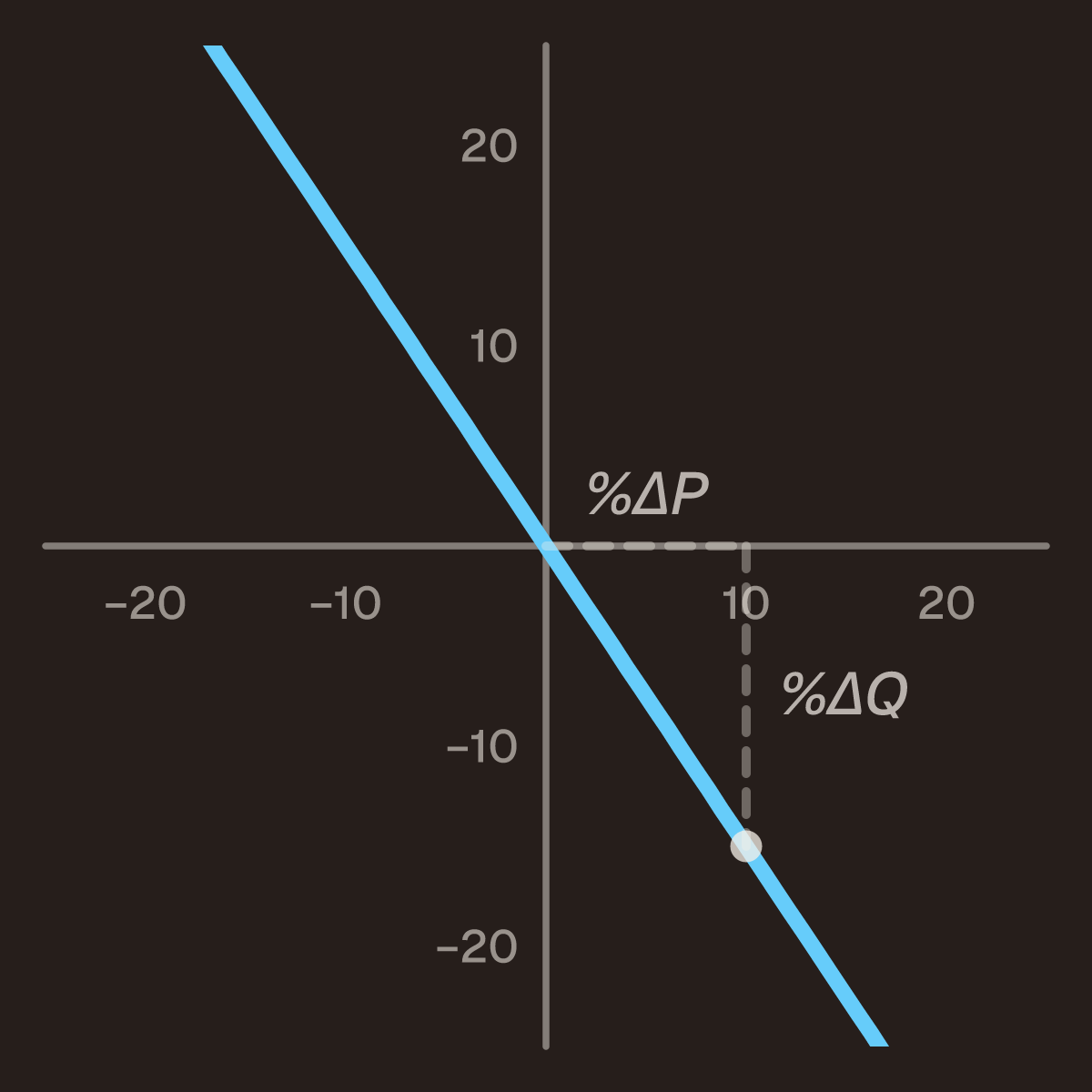
%ΔQ is the percentage change in the quantity
demanded, %ΔP the percentage change in price.
A café raises its price by 10% and sells 15% fewer coffees: E_d = −15 / 10 = −1.5.
The quantity moved one and a half times as much as the price. That is elastic demand: customers are
sensitive to the price, and the café sells less money’s worth of coffee after the increase, not just
fewer cups.
Elastic or inelastic
The size of the number, ignoring the sign, is what matters:
| |E_d| |
Called |
Price up 10% — revenue |
| above 1 |
elastic |
falls |
| exactly 1 |
unit elastic |
roughly unchanged |
| below 1 |
inelastic |
rises |
Petrol goes up 10% and people buy 4% less: E_d = −4 / 10 = −0.4. Inelastic — people still have
to drive. Revenue rises, because 1.10 · 0.96 = 1.056: 5.6% more money on 4% fewer litres.
The café’s revenue, by the same arithmetic: 1.10 · 0.85 = 0.935, 6.5% less.
Why the answer is negative
Price up, quantity down: the changes have opposite signs, so the ratio is negative for almost every
good. Many textbooks drop the sign and write 1.5; both mean the same. When comparing, compare sizes —
−1.5 is more elastic than −0.4, even though it is the smaller number.
Which percentage?
A percentage change depends on where you start: going from 10 to 12 is +20%, back from 12 to 10 is
−16.7%. For a small change it hardly matters. For a large one, the arc elasticity
measures from the midpoint and gives the same answer in both directions.
Common mistakes
- Dividing the wrong way. %ΔP / %ΔQ gives −0.67 for the café and reverses the conclusion.
- Using changes in money or units. The formula takes percentages, which is what makes the elasticity
of coffee comparable with the elasticity of cars.
- Assuming elasticity is the same along the whole demand curve. On a straight demand line it changes
from point to point.
Questions people ask
What makes demand inelastic?
Few substitutes, a necessity, a small share of the budget, or a short time to adjust. Salt, petrol in the
short run and medicines are the textbook cases.
Is there an elasticity for supply too?
Yes, the same formula with the change in quantity supplied. It is usually positive.