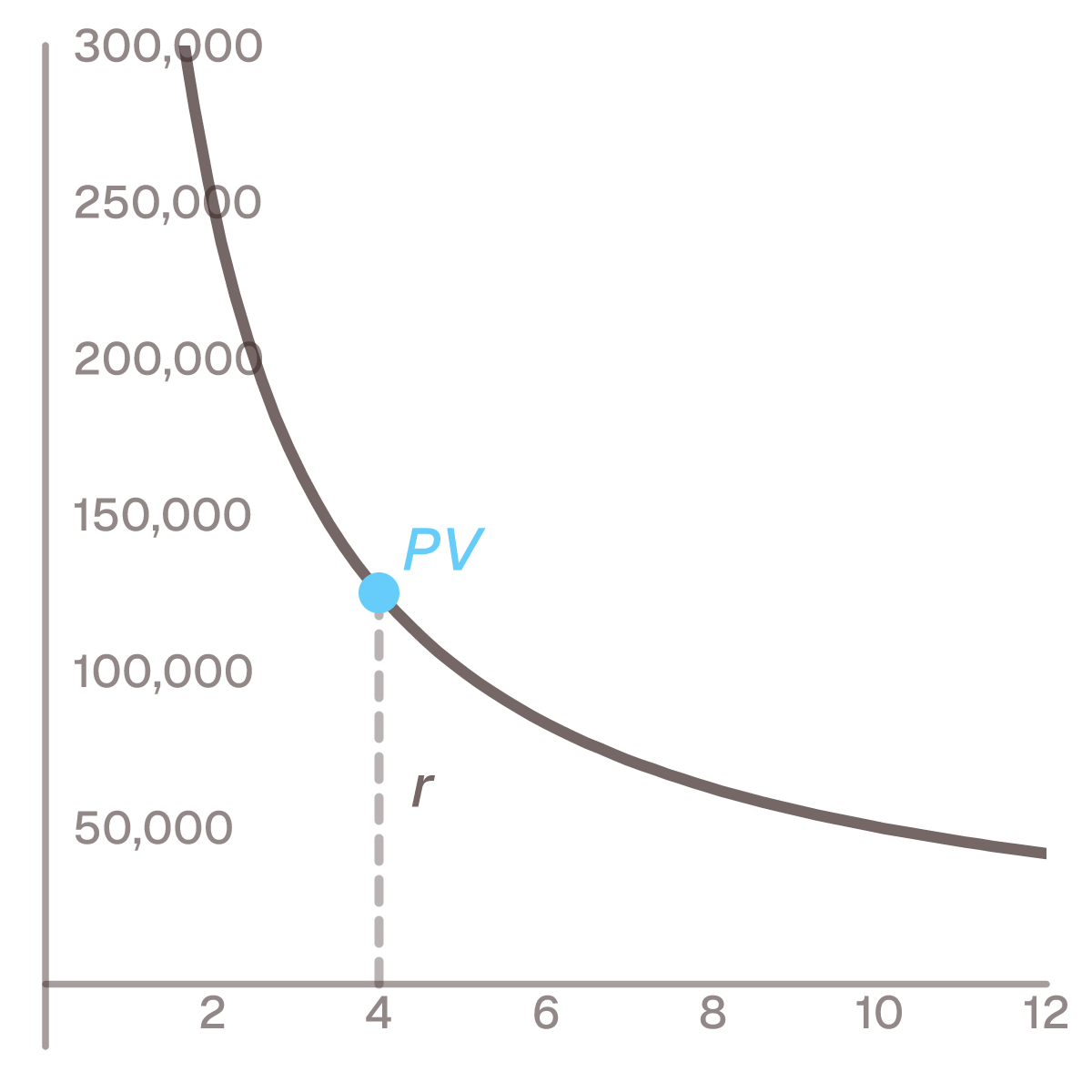
C is the payment each year, starting one year from now, and r the discount rate in per cent.
5,000 a year for ever, at 4%: PV = 100 · 5,000 / 4 = 125,000.
Put the other way: 125,000 in an account paying 4% gives exactly 5,000 a year in interest, and the
125,000 is still there afterwards. That is the idea, and the quickest way to trust the formula.
An infinite sum with a finite answer
The payments never stop, so the present value is a sum without an end:
- PV = C/(1 + r) + C/(1 + r)² + C/(1 + r)³ + …
Each term is the one before divided by 1 + r, which makes it a geometric series with ratio 1/(1 + r).
Because that ratio is less than one, the sum converges, and the
infinite geometric series gives its value:
C/(1 + r) divided by 1 − 1/(1 + r), which simplifies to C/r.
Payments far in the future count for very little. At 4%, the payment in year 50 is worth 14% of its face
today and the one in year 100 under 2%. Most of the 125,000 comes from the first few decades.
The rate decides almost everything
| Rate |
Present value of 5,000 a year |
| 2% |
250,000 |
| 4% |
125,000 |
| 5% |
100,000 |
| 8% |
62,500 |
| 10% |
50,000 |
Halving the rate doubles the value. That sensitivity is why long-lived assets — land, infrastructure,
shares — swing so hard in price when interest rates move.
Where it goes next
A perpetuity whose payment grows at a steady rate is the Gordon growth model.
A payment that runs for a fixed number of years is a perpetuity minus a second one that starts when the
payments stop — which is exactly the annuity factor in net present value.
Common mistakes
- Dividing by 4 instead of 0.04. 5,000 / 4 = 1,250, a hundred times too small. The card takes the rate
in per cent; by hand, divide by the rate as a fraction.
- A first payment today. The formula assumes the first payment comes after one period. If one is paid
now as well, add it: 125,000 + 5,000 = 130,000.
- Using it for a payment that grows. A payment that rises with inflation is worth more — use the
growth model.
Questions people ask
Do perpetuities actually exist?
A few: British consols paid interest from the 18th century until 2015, and some preferred shares and
endowments come close. Mostly the formula is a building block for other valuations.
What happens at a rate of 0?
Nothing discounts the payments, the sum has no end, and the value is unlimited. That is why the card
asks for a rate above zero.