The formula
- MC = ATC
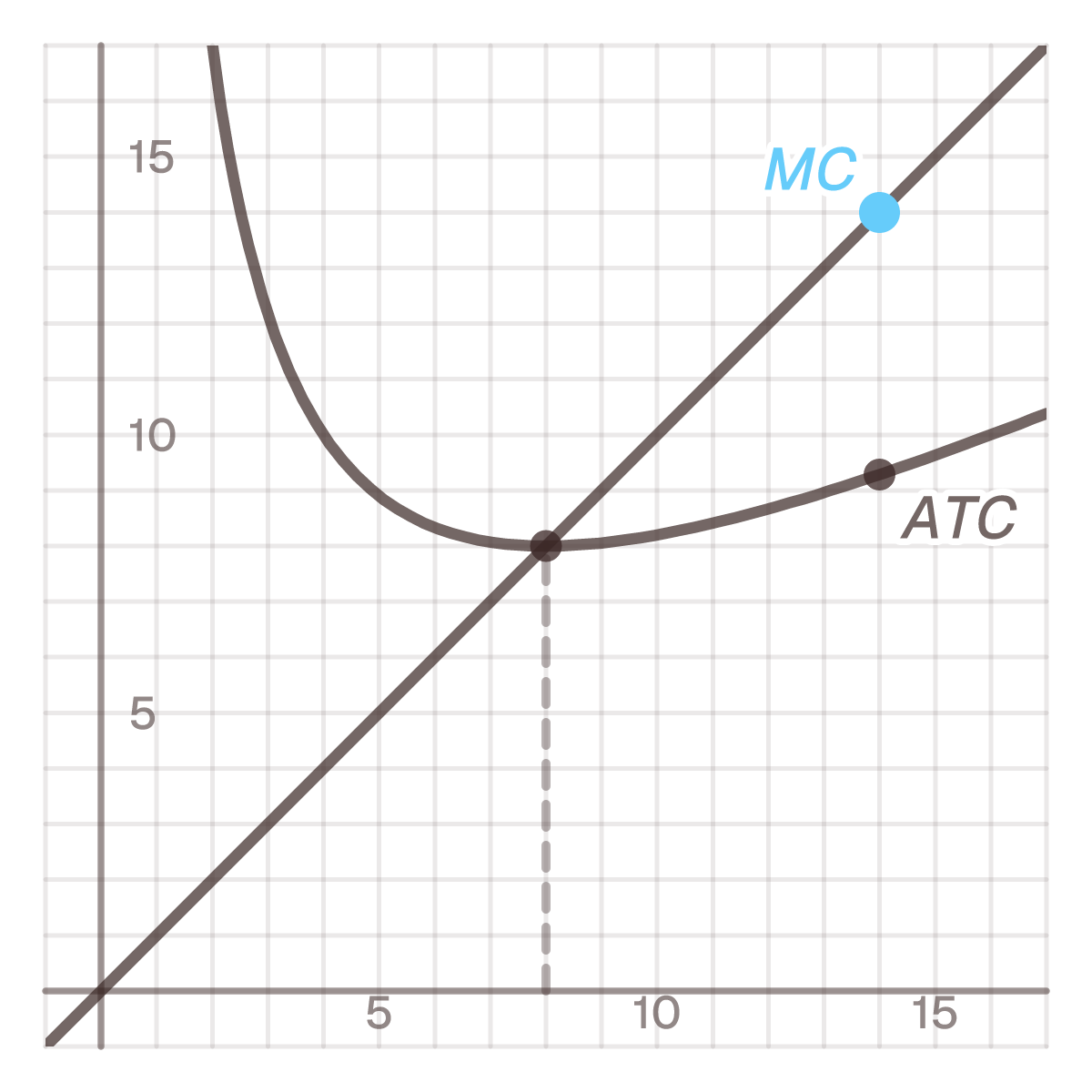
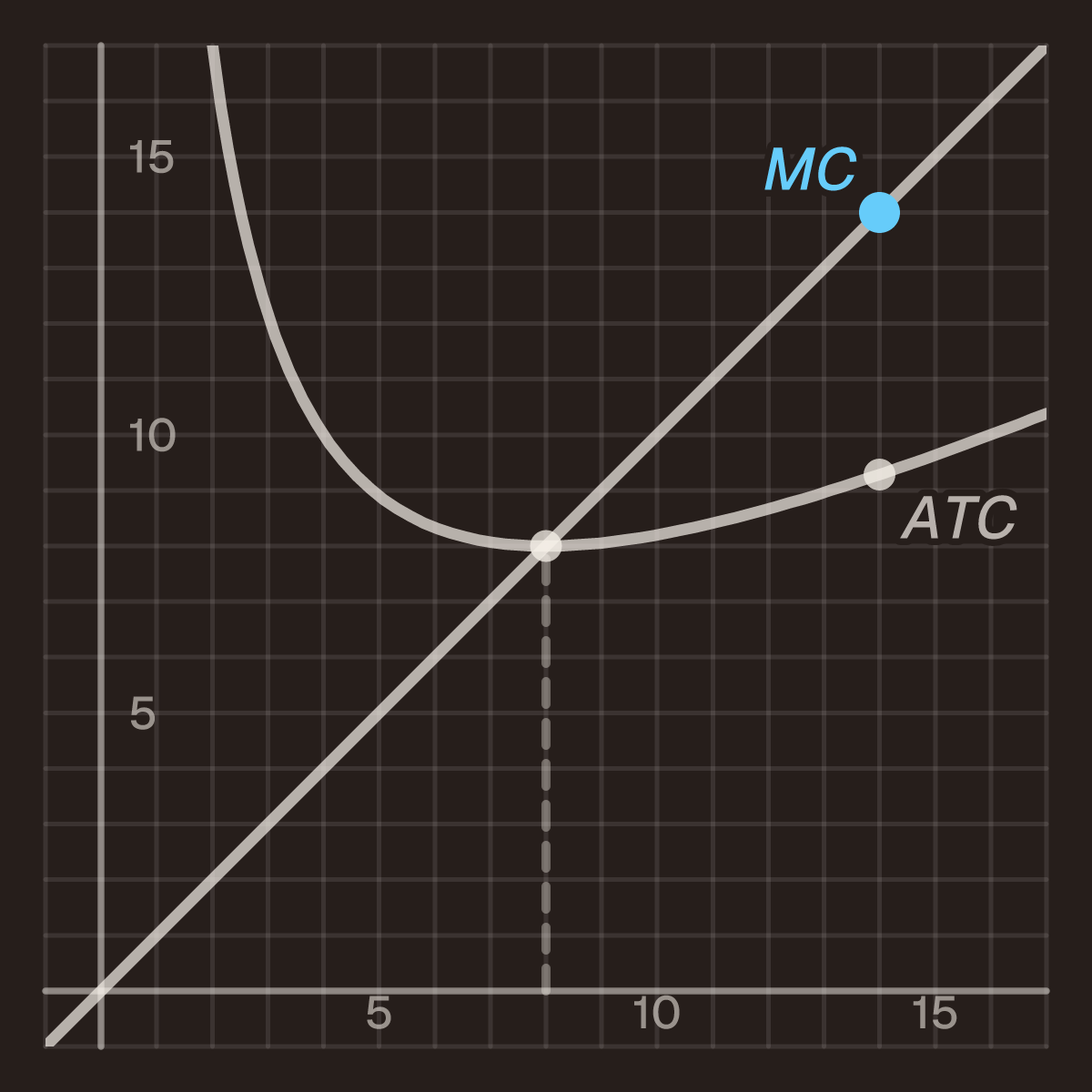
MC is marginal cost, what one more unit costs. ATC is average total cost, total cost divided by the quantity. Efficient scale is the quantity at which ATC is lowest, and there the two are equal.
Holds when the average total cost curve is U-shaped — falling at first, then rising — and cost changes smoothly with the quantity. In a table with whole steps, the two come out roughly equal at the row nearest the minimum.
Fixed costs of 50,000 and variable costs of 30q + 0.05q², where q is the quantity. Then
- ATC = 50,000 / q + 30 + 0.05q
- MC = 30 + 0.1q (the derivative of total cost)
Set them equal: 30 + 0.1q = 50,000 / q + 30 + 0.05q, so 0.05q = 50,000 / q and q² = 1,000,000. Efficient scale is q = 1,000 units, with ATC = 50 + 30 + 50 = 130.
Why they meet at the minimum
If the next unit costs less than the average, it pulls the average down. If it costs more, it pulls it up. While MC is below ATC, ATC falls; once MC has passed ATC, ATC rises. The turning point, the lowest ATC, is where the two are equal.
| Quantity | ATC | MC | ATC heading |
|---|---|---|---|
| 500 | 155 | 80 | down |
| 800 | 132.50 | 110 | down |
| 1,000 | 130 | 130 | lowest |
| 1,250 | 132.50 | 155 | up |
| 1,500 | 138.33 | 180 | up |
It is the same as an average of test scores: a score below the average pulls it down, one above pulls it up.
When there is no efficient scale
With a constant variable cost per unit, as on the unit cost page, MC equals that variable cost and stays below ATC. Average cost then falls all the way to capacity, and the lowest ATC is at the largest output the firm can make. There is no crossing to solve for.
Efficient scale is also where the long-run break-even price is read: the price that covers the lowest ATC.
Common mistakes
- Taking efficient scale for the most profitable output. The lowest cost per unit is not the same as the highest profit, which depends on price too; a firm with market power chooses the output where marginal revenue equals marginal cost, as on the monopoly profit maximization page.
- Looking for the minimum of MC. Marginal cost turns earlier than average cost. The point wanted is the lowest ATC.
- Comparing MC with average variable cost. With a U-shaped AVC curve, MC crosses that at its minimum too, but at a different, lower output — the one that gives the shutdown price.
Questions people ask
What is the difference between efficient scale and capacity?
Capacity is the most the firm can make. Efficient scale is where average cost is lowest, and with a
U-shaped cost curve it lies below capacity: producing more is possible, but each unit costs more.
How do I find efficient scale in a table?
Work out ATC on each row as total cost divided by quantity, and pick the row with the lowest value. Working
out MC between the rows is a check: it should go from below ATC to above it at that row.
Is minimum efficient scale the same thing?
Not quite. Minimum efficient scale, used in industrial economics, is the smallest output at which long-run
average cost reaches its lowest level, which matters where that cost stays flat over a range. With a
U-shaped curve the minimum is a single point and the two coincide.