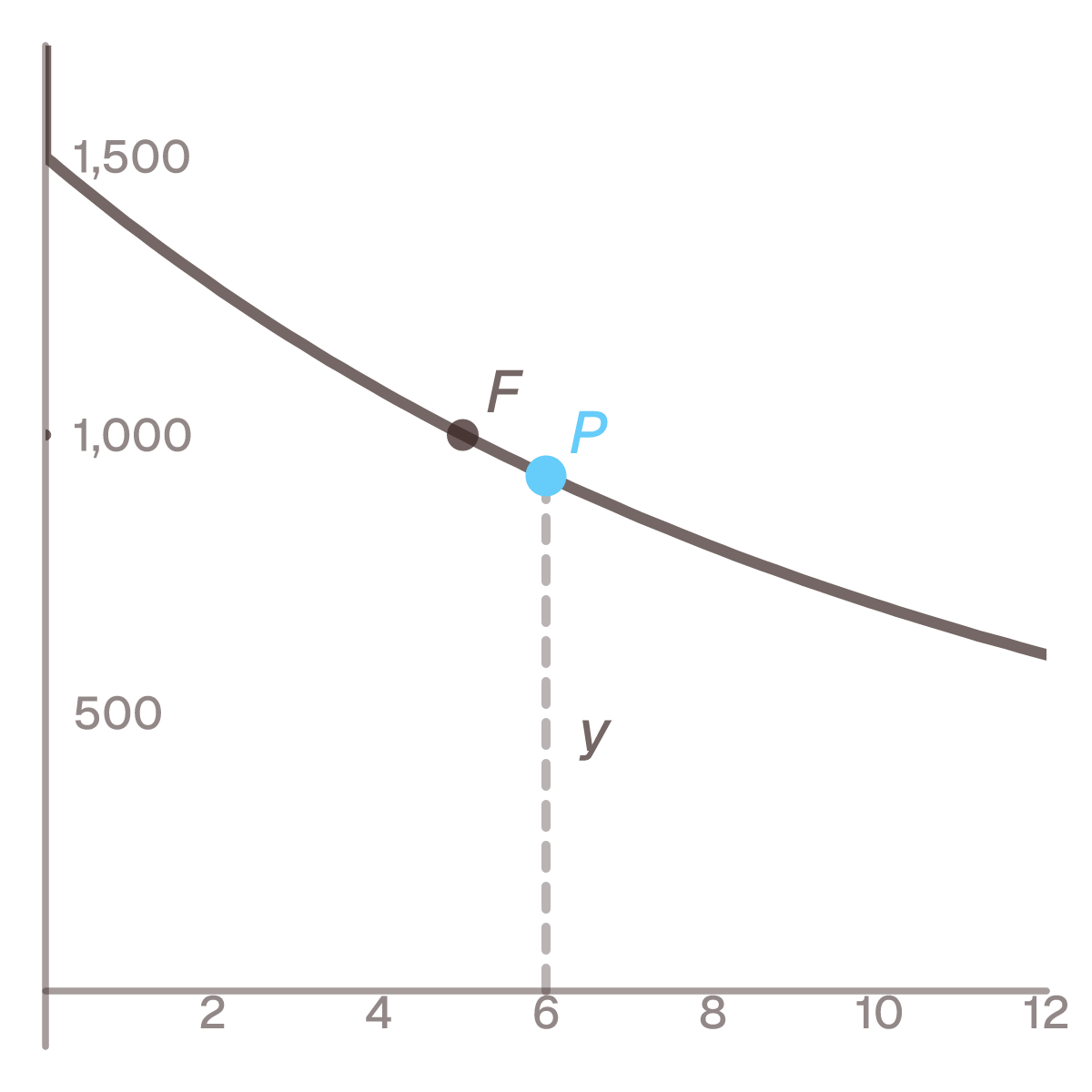
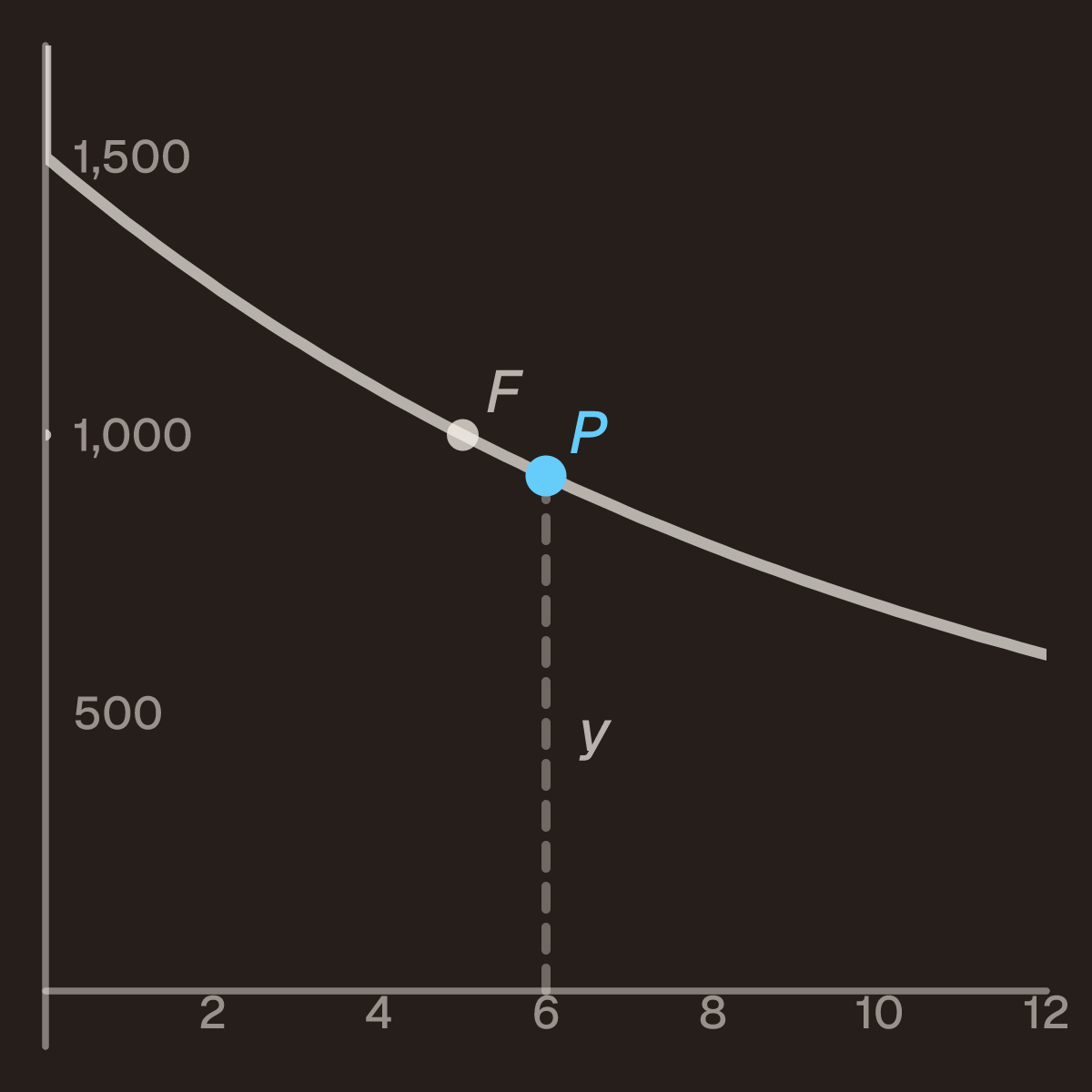
- P = C · (1 − (1 + y)⁻ⁿ) / y + F / (1 + y)ⁿ
F is the face value paid back at maturity, C the coupon paid each year, n the years left and y the yield
to maturity — the return the market demands on a bond like this today. The card takes y in per cent.
Face value 1,000, coupon 50 a year, 10 years left, market yield 6%:
- The coupons: 50 · (1 − 1.06⁻¹⁰) / 0.06 = 50 · 7.3601 = 368.00.
- The face value: 1,000 / 1.06¹⁰ = 558.39.
- P = 368.00 + 558.39 = 926.40.
The bond pays 5% on its face value, but the market wants 6%. The only way to give a buyer 6% is to sell
the bond for less than 1,000, and 926.40 is exactly the price at which it does.
Price and yield move in opposite directions
| Market yield |
Price |
|
| 4% |
1,081.11 |
above face — the coupon beats the market |
| 5% |
1,000.00 |
at face — yield equals the coupon rate |
| 6% |
926.40 |
below face |
| 7% |
859.53 |
further below |
The relation to hold on to: when market yields rise, the price of a fixed-coupon bond falls. The coupon
is fixed; the only thing that can adjust to a new market rate is the price.
Long bonds move more
The same bond at 6%, with different time left:
| Years left |
Price at 6% |
| 2 |
981.67 |
| 10 |
926.40 |
| 30 |
862.35 |
A two-year bond is nearly at face, because the face value comes back soon. A thirty-year bond is stuck
with a below-market coupon for three decades, and its price takes the hit. That sensitivity is called
duration, and it is why long bonds are riskier when rates move.
How it is built
The coupons are an annuity — the same factor as in net present value
and the annuity formula — and the face value is a
single amount discounted like compound interest run
backwards. Finding y from a known price has no closed formula; it is searched for, the way an
internal rate of return is.
Common mistakes
- Discounting at the coupon rate. That always gives the face value. The market yield is the rate.
- Forgetting the face value. The coupons alone give 368, not 926.
- Half-yearly coupons treated as yearly. Many bonds pay twice a year: halve the coupon and the yield,
double n.
Questions people ask
What is the difference between coupon rate and yield?
The coupon rate is fixed when the bond is issued: 50 on 1,000 is 5%. The yield is what a buyer earns at
today’s price, and it changes every day.
What is a zero-coupon bond worth?
Set C to 0: only F / (1 + y)ⁿ remains. At 6% over 10 years, 558.39 for every 1,000.