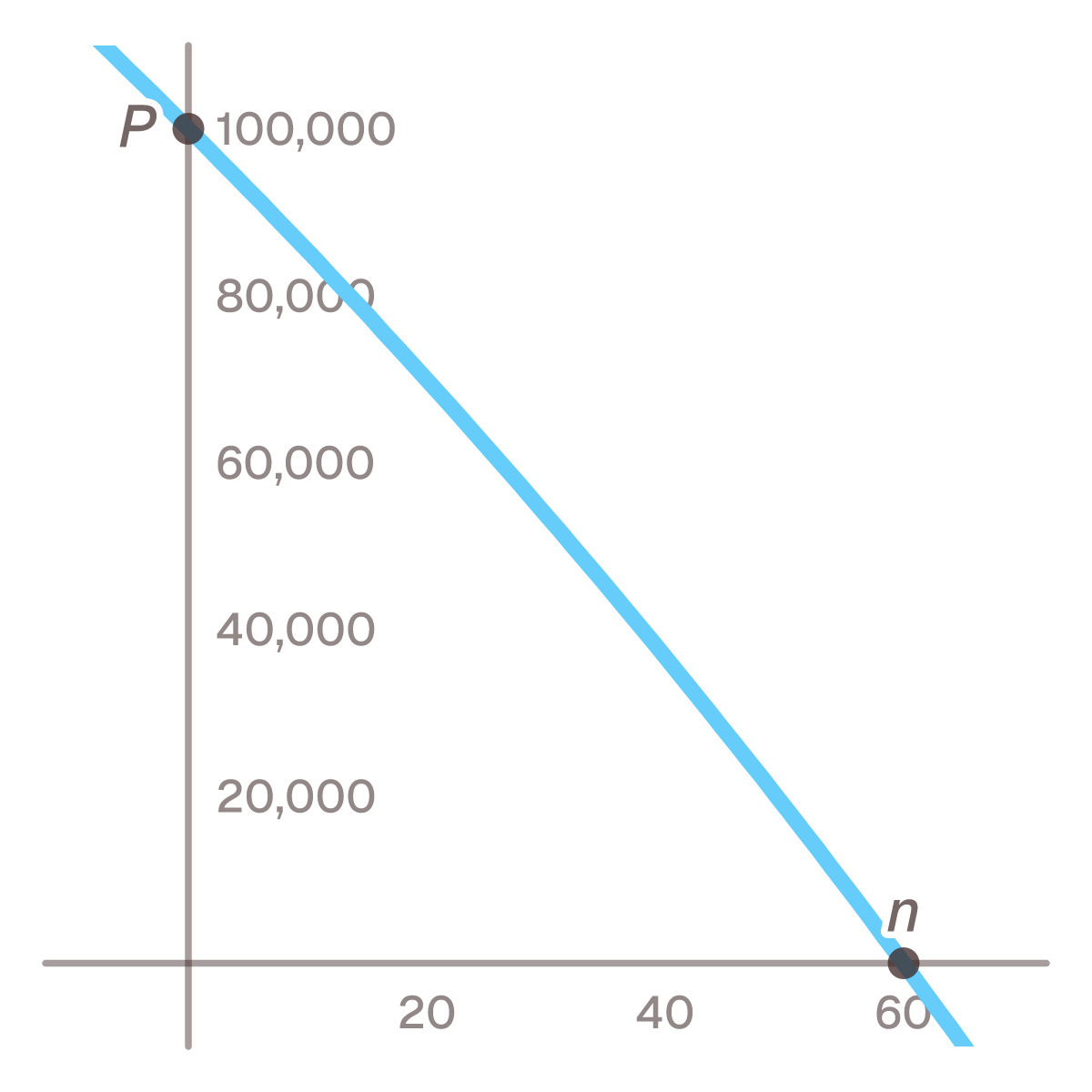
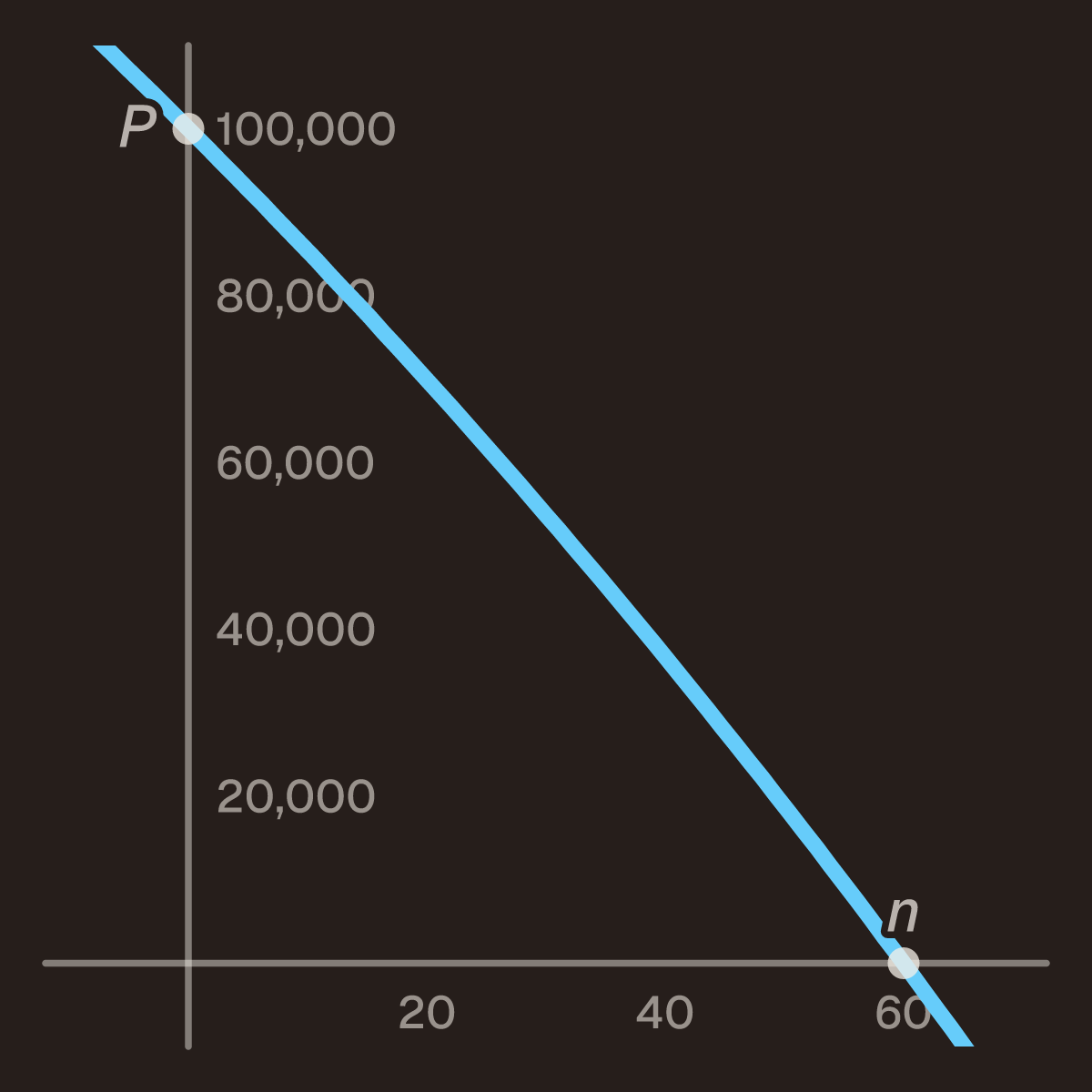
- A = P · r · (1 + r)ⁿ / ((1 + r)ⁿ − 1)
The rate r is per period, not per year. That is a common mistake with this formula. On a loan with
a 4% nominal annual rate paid monthly, r = 0.04/12 ≈ 0.003333 and n is the number of months. Putting in
0.04 and 30 gives an answer wrong by a factor of twelve.
A worked example
2,000,000 over 30 years at a 4% nominal annual rate. Then r = 0.04/12 and n = 360:
A = 2,000,000 · 0.003333 · 1.003333³⁶⁰ / (1.003333³⁶⁰ − 1) ≈ 9,548 a month
In the first month the interest is 2,000,000 · 0.003333 = 6,667, so 9,548 − 6,667 ≈ 2,882 goes to
principal. Next month the balance is smaller, so the interest is smaller and the principal portion is
larger. The payment is the same all the way through; what moves is the split. In total 9,548 · 360 ≈
3,437,000 is paid, of which roughly 1,437,000 is interest.
Derivation
The annuity formula is not a definition but something that follows, and what it follows from is a
geometric series.
Each payment A is made at its own point in time, and a payment t periods away is worth A/(1 + r)ᵗ
today. The loan is exactly the sum of the present values of all the payments:
- P = A/(1 + r) + A/(1 + r)² + … + A/(1 + r)ⁿ
- That is a geometric series with ratio 1/(1 + r). Its sum is A · (1 − (1 + r)⁻ⁿ)/r
- P = A · (1 − (1 + r)⁻ⁿ)/r
- A = P · r / (1 − (1 + r)⁻ⁿ)
- Multiply through by (1 + r)ⁿ: A = P · r · (1 + r)ⁿ / ((1 + r)ⁿ − 1)
Steps 4 and 5 are the same number. Many textbooks stop at step 4; the form with positive exponents is
easier to typeset and easier to work through by hand.
Annuity or straight amortization
Straight amortization means paying the same amount of principal every month with interest on top. On the
same loan the first month is 5,556 + 6,667 ≈ 12,222 — considerably more than the annuity’s 9,548 —
but the payment then falls every month, and the total interest is lower because the balance comes down
faster early on.
An annuity gives a predictable outgoing. Straight amortization gives, at the same rate and term, a lower
interest cost. That is the trade-off.
Working it out in practice
The formula gives the payment directly. To find the number of periods instead, it rearranges with a
logarithm, the same way compound interest does. To find the rate
there is no closed form at all — no line r = … can be written. It has to be searched for: you try
rates until the two sides of the formula meet. Picking r in the card at the top of this page is
exactly that, and it is also what a spreadsheet’s goal seek does.
Frequently asked questions
What if the rate is 0?
The formula cannot be used directly — the denominator becomes 0. But the limit is the obvious one:
with no interest the payment is P/n, the loan divided by the number of periods.
Are the payment and the principal repayment the same thing?
No. The payment is the interest plus the principal repayment. The principal repayment is the part that
reduces the balance — the payment minus that period’s interest on the remaining balance. In an annuity
loan the payment is constant and the principal portion grows.
Does it give the effective interest rate?
No. This formula assumes a nominal rate applied per period. An effective rate includes fees and
arrangement costs, has to be searched for numerically, and cannot be read off this line.