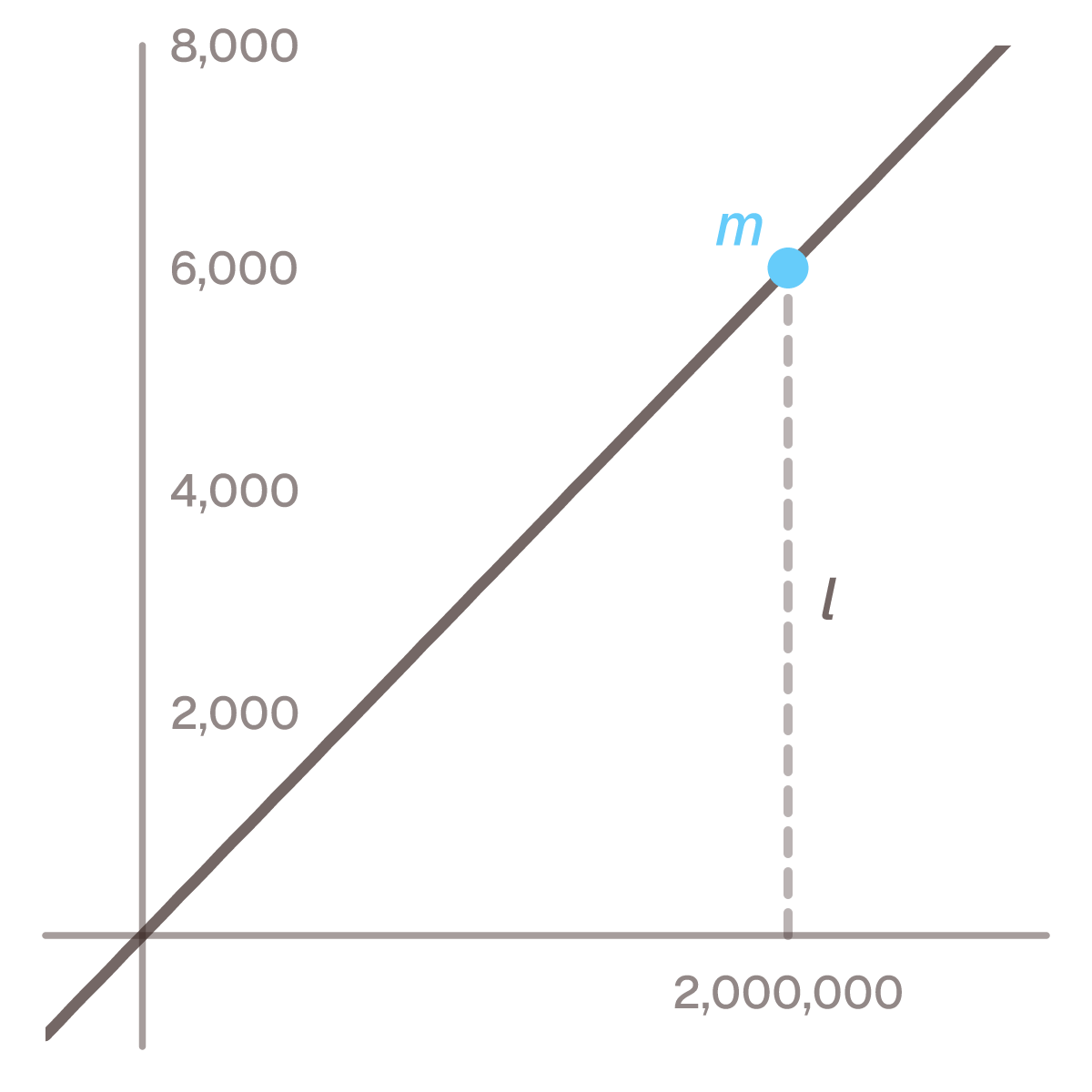
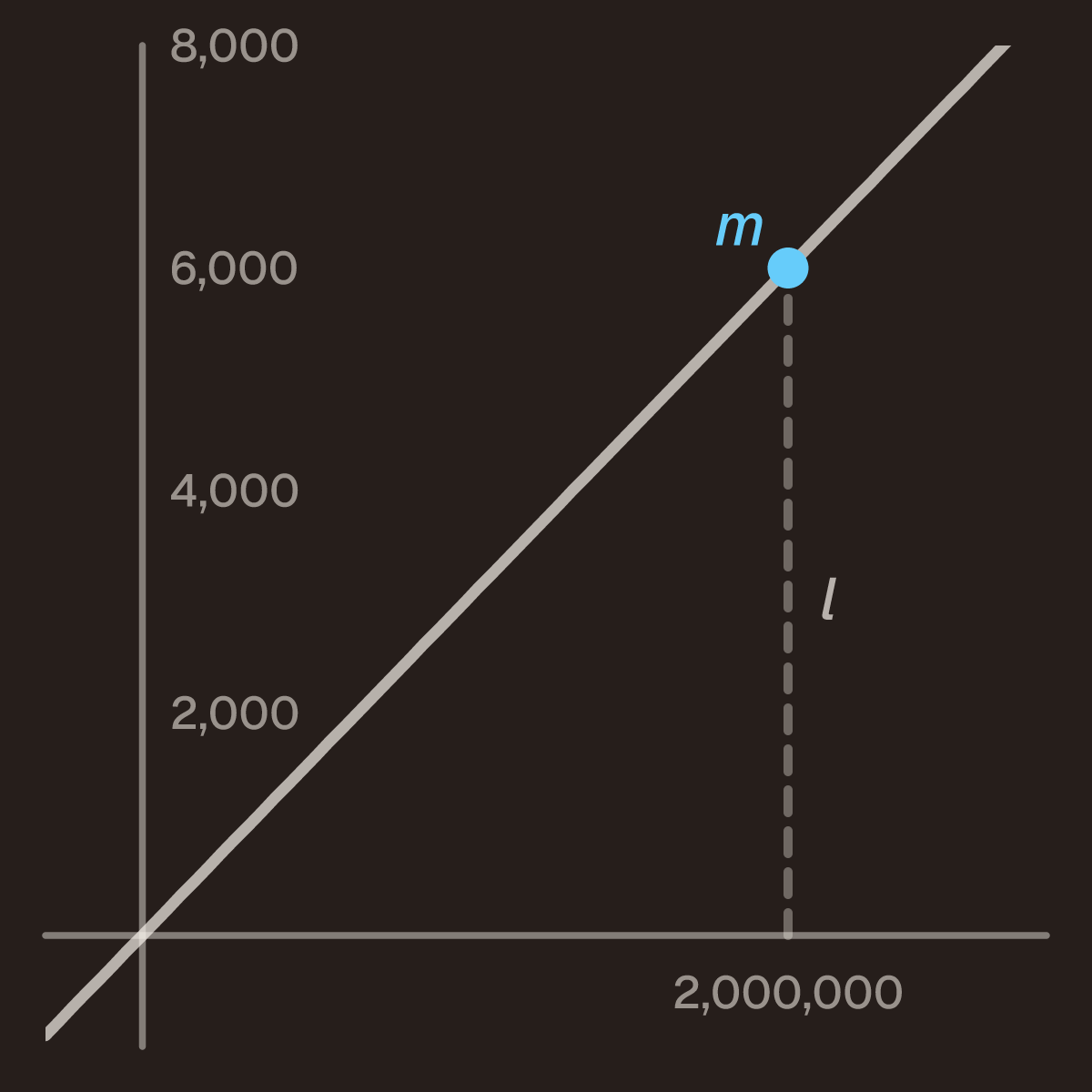
m equals (2,000,000 times 3.6) divided by 1,200, equals 7,200,000 divided by 1,200, equals 6,000
Working3 steps
m
=
2,000,000·3.61,200
=
7,200,0001,200
=
6,000
Practice questions
You are given
l=1800000
r=4
What the formula says
m = l · r / 1200
where l is the debt, r the annual rate in per cent and m the interest for one month. A loan of
$2,000,000 at 3.6% therefore costs
2,000,000 · 3.6 / 1200 = $6,000 a month
It is a definition: it says what “3.6% a year, charged monthly” comes to in money.
Where the 1,200 comes from
Two conversions happen at once, and they multiply together:
From a year to a month: 3.6% a year is 3.6 / 12 = 0.3% a month.
From per cent to a fraction: 0.3% is 0.3 / 100 = 0.003.
Together that is r / 12 / 100, which is r / 1200. Divide by 100 alone and you have a year’s interest
believing it is a month’s — twelve times too much. Divide by 12 alone and the answer is a hundred times
too large. The 1,200 is those two steps rolled into one.
Three worked examples
The interest in money. $1,800,000 at 4.2%:
m = 1,800,000 · 4.2 / 1200 = $6,300 a month
The rate. You pay $3,500 a month on a debt of $1,200,000:
r = 1200 · 3,500 / 1,200,000 = 3.5%
The loan. How large a debt costs $5,000 a month at 3%?
l = 1200 · 5,000 / 3 = $2,000,000
What the formula leaves out
The repayment. Interest is only part of the monthly cost. The rest is the
amortization, and together they are what leaves the account.
That the debt is falling. The formula works on the debt right now. Repay every month and the
interest falls every month, so l is not the same number throughout.
Fees. A nominal rate is not an effective one. Arrangement and administration fees belong in the
effective rate, not here.
Tax. Whether interest is deductible, and at what rate, is a matter of where you live. It is not in
the formula, and a comparison that counts it on one side only is wrong in a predictable direction.
Common mistakes
Dividing by 100 and stopping. That gives a year’s interest in money. 2,000,000 · 3.6 / 100 is
$72,000 — a year, not a month.
Working from the original loan. After five years of repayments the debt is smaller, and the interest
with it.
Taking the interest for the monthly cost. Add the amortization.
Comparing a nominal rate with an effective one. They answer different questions, and the effective
rate is always the larger of the two when there are fees.
Frequently asked questions
Why 1,200 and not 12?
Because the rate is given in per cent. The 12 turns a year into a month, the 100 turns per cent into a
fraction, and both are needed. If the rate is already a fraction — 0.036 rather than 3.6% — then 12 is
enough on its own.
Is interest charged on what I borrowed or on what I owe?
On what you owe. That is why the interest cost falls over the life of a loan even when the rate stands
still, and why straight-line repayment costs less in total
interest than an annuity over the same term.
How do I get a weekly or a daily figure instead?
Change the 12. Interest for a week at an annual rate is l · r / 5200, and for a day it is
l · r / 36500 — 100 times 52 and 100 times 365. The structure is the same: a hundred for the per cent,
and however many periods there are in a year.
Looking for another letter? The formula solved for each one
Copy the code into your page where the formula card should appear. It loads from lovetocalc.com, so it stays current on its own — all we ask is that the credit line comes with it.