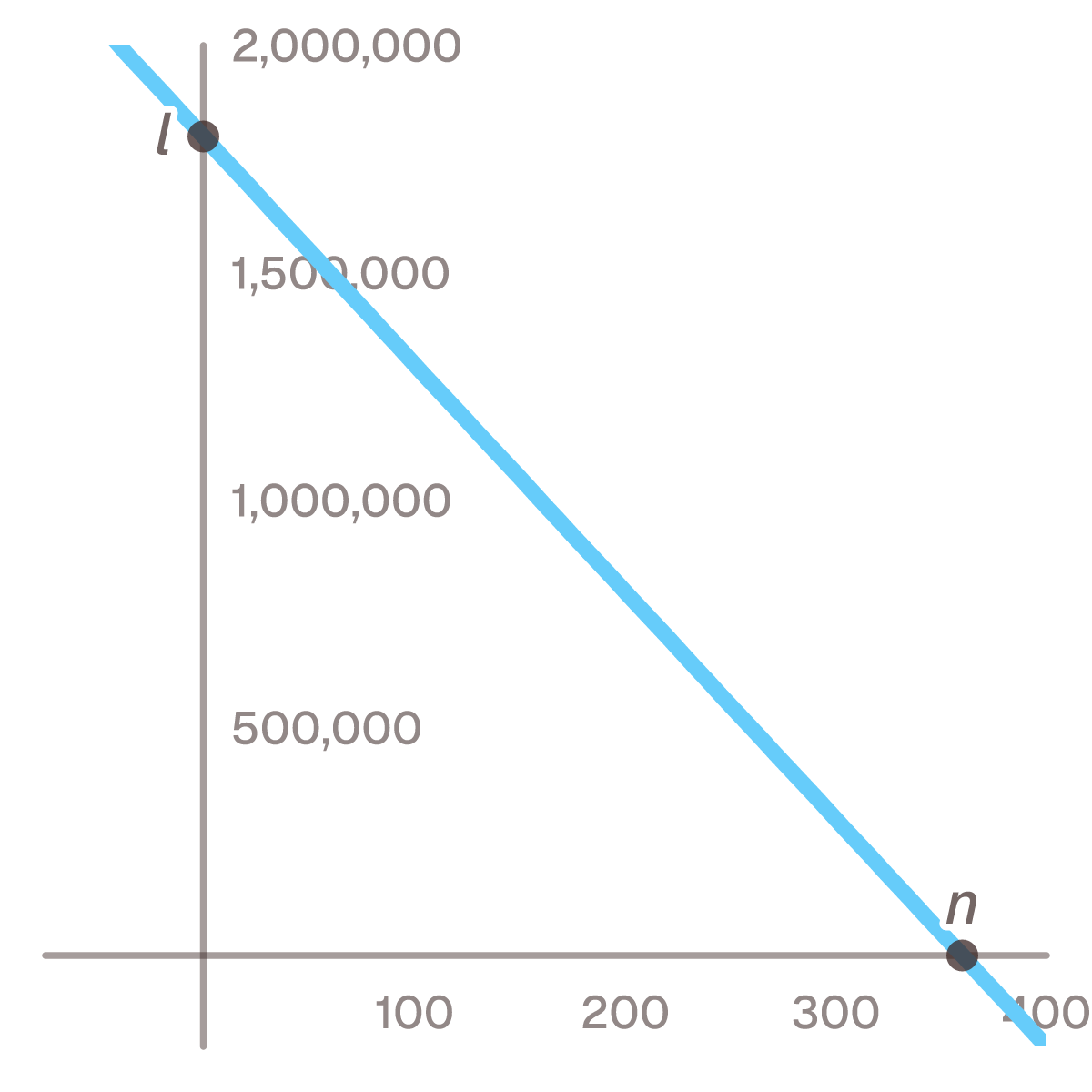
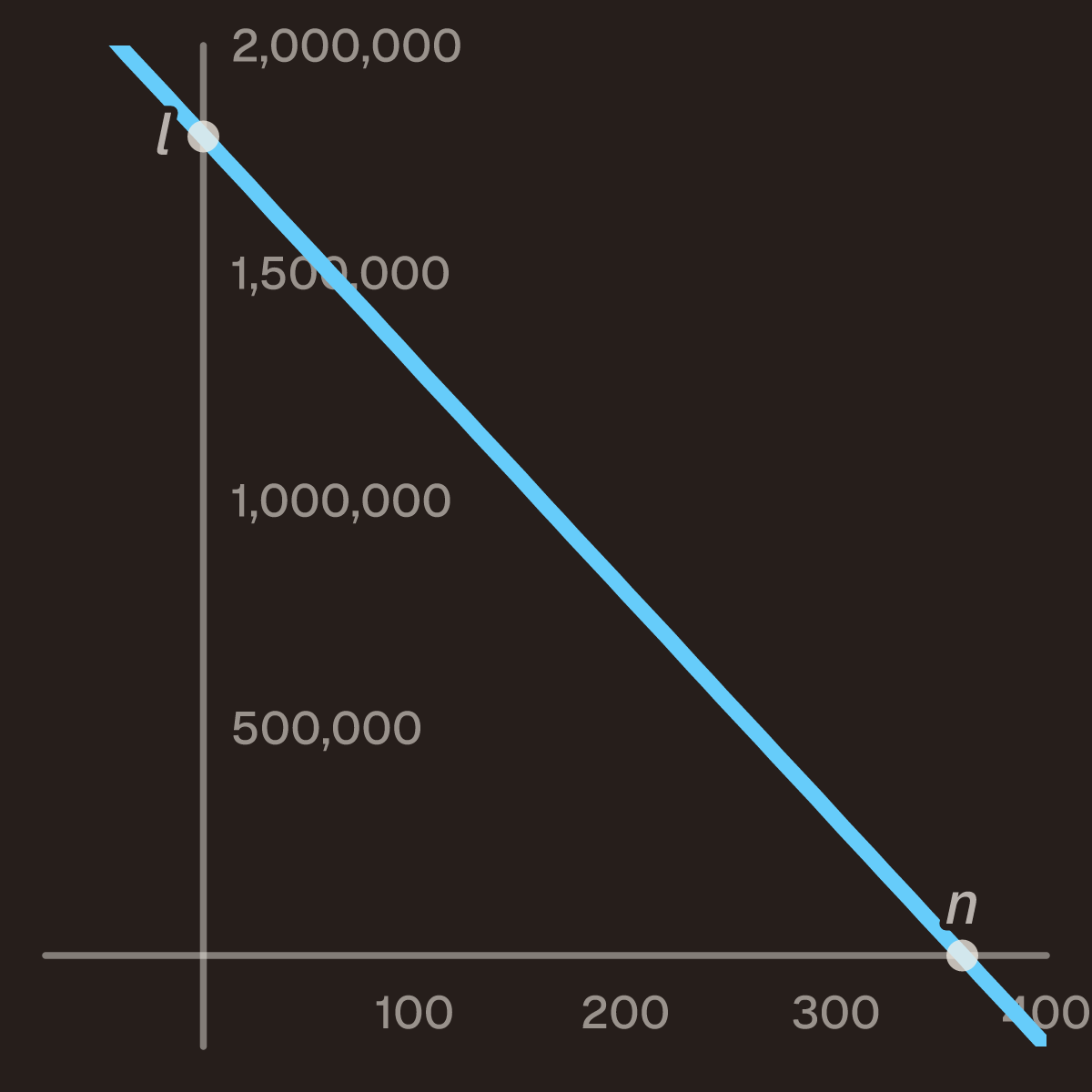
where l is the loan, n the number of payments and a the amount repaid each time. It is a
definition: it says what “straight-line amortization” means, and there is nothing underneath it to
prove. Borrow $1,800,000 and pay it off over 360 months and the amortization is 1,800,000 / 360 =
$5,000 a month, every month, from the first to the last.
What makes the page worth reading is the next sentence: $5,000 is not your monthly cost. On top of
the amortization you pay interest on what you still owe, and that debt shrinks by $5,000 a month. The
monthly cost is
and only the first half of that is constant.
A cost that falls
The same $1,800,000 loan, 360 months, 4% a year:
| Month |
Debt before the payment |
Amortization |
Interest |
Total due |
| 1 |
$1,800,000 |
$5,000 |
$6,000 |
$11,000 |
| 121 |
$1,200,000 |
$5,000 |
$4,000 |
$9,000 |
| 360 |
$5,000 |
$5,000 |
$17 |
$5,017 |
The interest in the table is the debt times the rate over 1,200 — a hundred for the per cent, twelve for
the months. So the first month is the most expensive one, and every month after it is cheaper than the
one before.
Over the thirty years: $1,800,000 repaid and $1,083,000 in interest. That total can be had without
the table, because the debt falls in a straight line: the average debt is (1,800,000 + 5,000) / 2 =
$902,500, and 902,500 · 0.04 · 30 = $1,083,000.
Straight line or annuity?
An annuity turns it around: there the total is the same every month,
and it is the split between interest and principal that moves. Same loan, same rate, same thirty years:
|
Straight line |
Annuity |
| First month |
$11,000 |
$8,593 |
| Last month |
$5,017 |
$8,593 |
| Total interest |
$1,083,000 |
$1,293,651 |
Straight-line repayment costs a little over $210,000 less in interest, for one reason: the debt is paid
down faster, and interest is charged on what is left. The price is that the early years are heavier. The
annuity buys a level monthly cost, and pays for it.
Common mistakes
- Taking the amortization for the monthly cost. The amortization is what goes to the debt. Interest
comes on top, and in the first month it can be larger than the amortization.
- Comparing the two methods on the first month. The annuity looks cheaper at the start and costs more
in total. Compare the sum over the whole term.
- Confusing
n with a number of years. If you pay monthly, n is a number of months. Thirty years is
360 payments, not 30.
- Charging interest on the original loan every month. That is what simple
interest on a single-repayment loan does. Here the debt falls, and the
interest falls with it.
Frequently asked questions
How long does it take to pay off a loan this way?
The loan divided by the amount repaid: n = l / a. Repay $4,000 a month on a $960,000 loan and it takes
960,000 / 4,000 = 240 months, or 20 years. The interest rate does not change the term at all — it only
changes what the term costs, which is the whole difference from an annuity.
What happens if I make an extra payment?
The debt drops immediately, and so does the interest on every month after it. With straight-line
repayment the term gets shorter: the amortization itself stays the same amount, so you finish earlier.
With an annuity the monthly payment is recalculated instead.
Is straight-line repayment always cheaper than an annuity?
At the same rate over the same term, yes — the debt falls faster and interest is charged on what is
left. That is not the same as it always being the better choice. The early years cost more, and a loan
you cannot keep up with is not cheap.