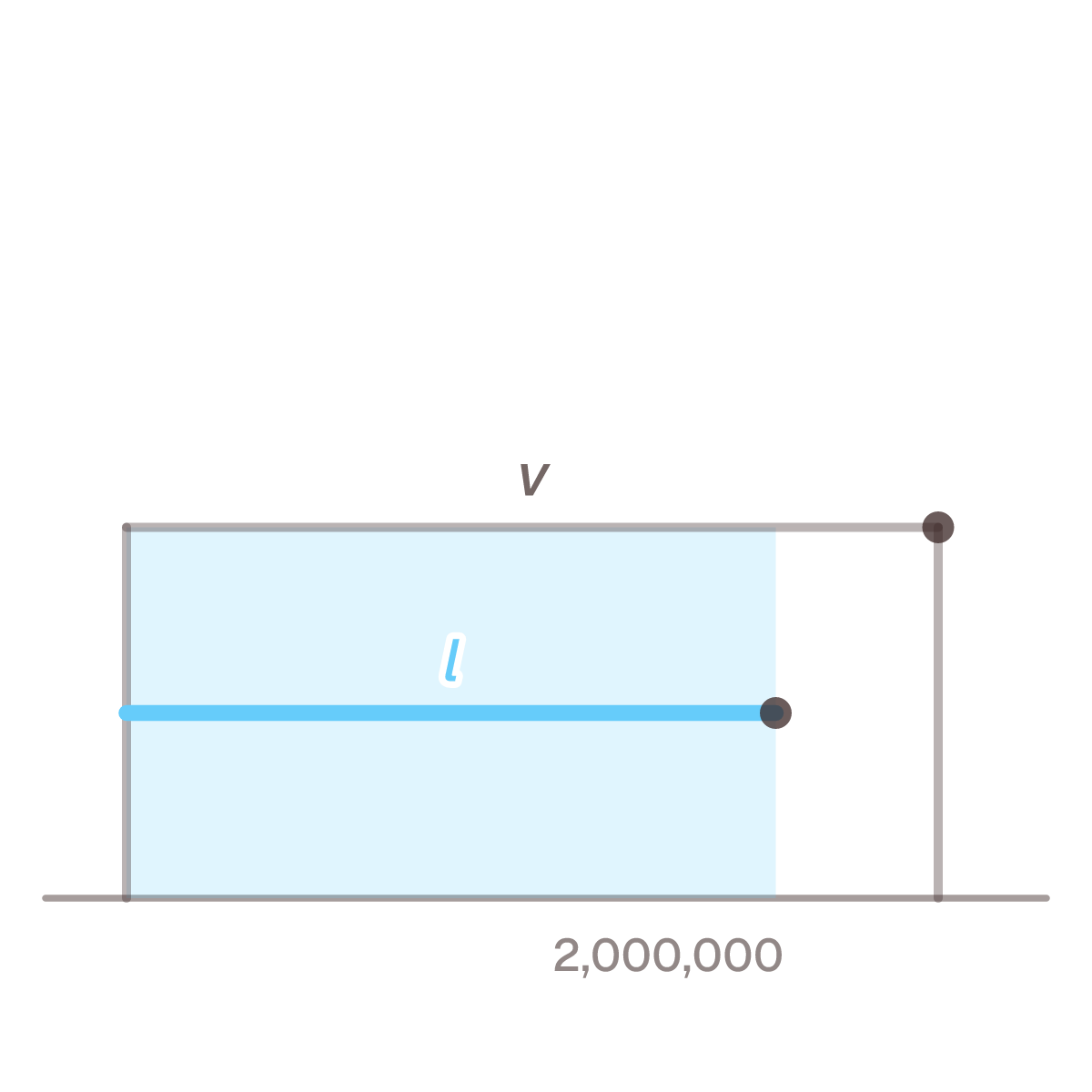
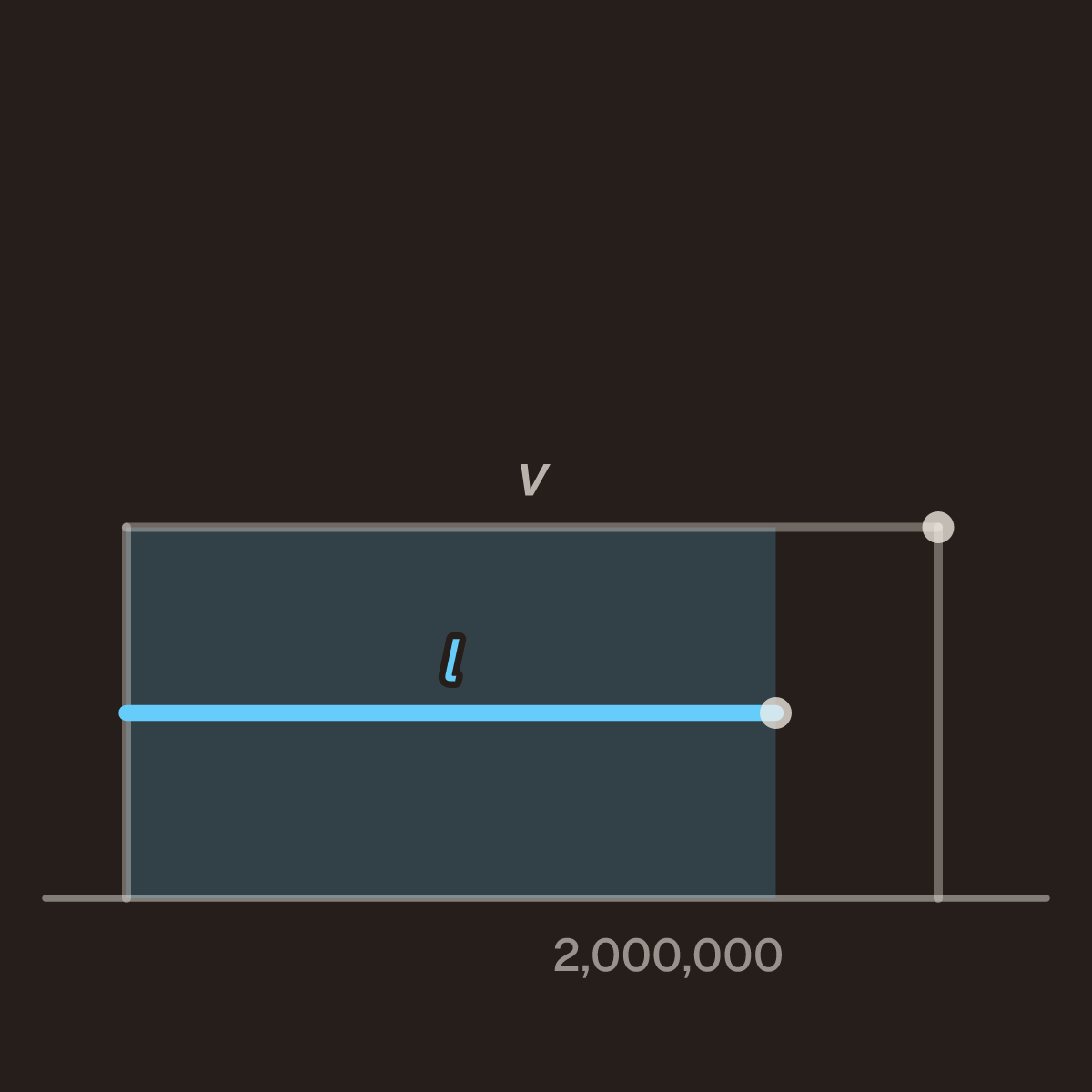
where l is the loan, v the value of the property and r the loan-to-value in per cent. Borrow
$2,400,000 against a home worth $3,000,000 and the ratio is
- 100 · 2,400,000 / 3,000,000 = 80%
It is a definition — the same arithmetic as a percentage of a
number, read with the percentage as the unknown. What is left is
the deposit: 80% borrowed is 20% paid up front.
Three worked examples
The ratio. $2,700,000 against a home worth $3,000,000:
- r = 100 · 2,700,000 / 3,000,000 = 90%
The loan. What loan is 70% of a property worth $3,500,000?
- l = 70 · 3,500,000 / 100 = $2,450,000
The value. What value makes a loan of $2,200,000 come to 55%?
- v = 100 · 2,200,000 / 55 = $4,000,000
The card at the top does all three — switch which quantity is unknown and the rearrangement is rewritten
under it.
The ratio and the deposit
The two are complements, and confusing them is expensive in both directions:
| Loan to value |
Deposit |
| 90% |
10% |
| 85% |
15% |
| 80% |
20% |
| 50% |
50% |
Lenders set a maximum loan-to-value, and in several countries so does the law, but the number itself is
not part of the formula — it depends on where the property is, what kind of loan it is, and when you are
asking. What the formula gives you is the ratio; what the limit is, the lender says.
Loan to value or debt to income?
They are easy to mix up, and they differ in the denominator:
|
Divided by |
The answer is |
| Loan to value |
the value of the property |
a percentage |
| Debt to income |
gross annual income |
a multiple |
Loan-to-value describes the property: how much of it is borrowed. Debt-to-income describes the household:
how heavy the debt is to carry. Two buyers borrowing the same amount for the same house have the same
loan-to-value; the debt-to-income ratio tells them apart if they earn different amounts.
Common mistakes
- Dividing by the loan instead of by the value. 2,400,000 out of 3,000,000 is 80%; the other way
round it is 125%. The value always goes under the line.
- Using a valuation rather than the price paid. Which of the two counts is a rule of the lender or
the country, not of the arithmetic. US mortgage lending usually takes the lower of the appraised value
and the price paid; Swedish law takes the market value at purchase.
- Reading the ratio as the deposit. 85% loan-to-value is a 15% deposit, not an 85% one.
- Forgetting the rest of the debt. Loan-to-value only counts what is secured on the property. A loan
taken out to fund the deposit does not show up here — it shows up in
debt to income.
Frequently asked questions
How large a deposit do I need?
100% minus the maximum loan-to-value you are offered. At a cap of 90% that is at least 10% of the
price — $300,000 on a $3,000,000 home. Note that the cap applies to the mortgage itself; how the deposit
is funded is a separate question, and money borrowed for it is still debt.
What happens to the ratio as I repay?
It falls, because the top of the fraction shrinks while the bottom stands still. A loan of $2,700,000 on
a $3,000,000 home is 90%; after $300,000 has been repaid it is 2,400,000 / 3,000,000 = 80%. Whether
your lender recalculates anything as a result is their rule, not the formula’s.
Does a rise in house prices lower my loan-to-value?
Arithmetically, yes — a larger denominator gives a smaller ratio. Whether a lender will act on it is a
different matter: many work from a valuation made at a point in time, and will not revisit it just
because the market has moved.