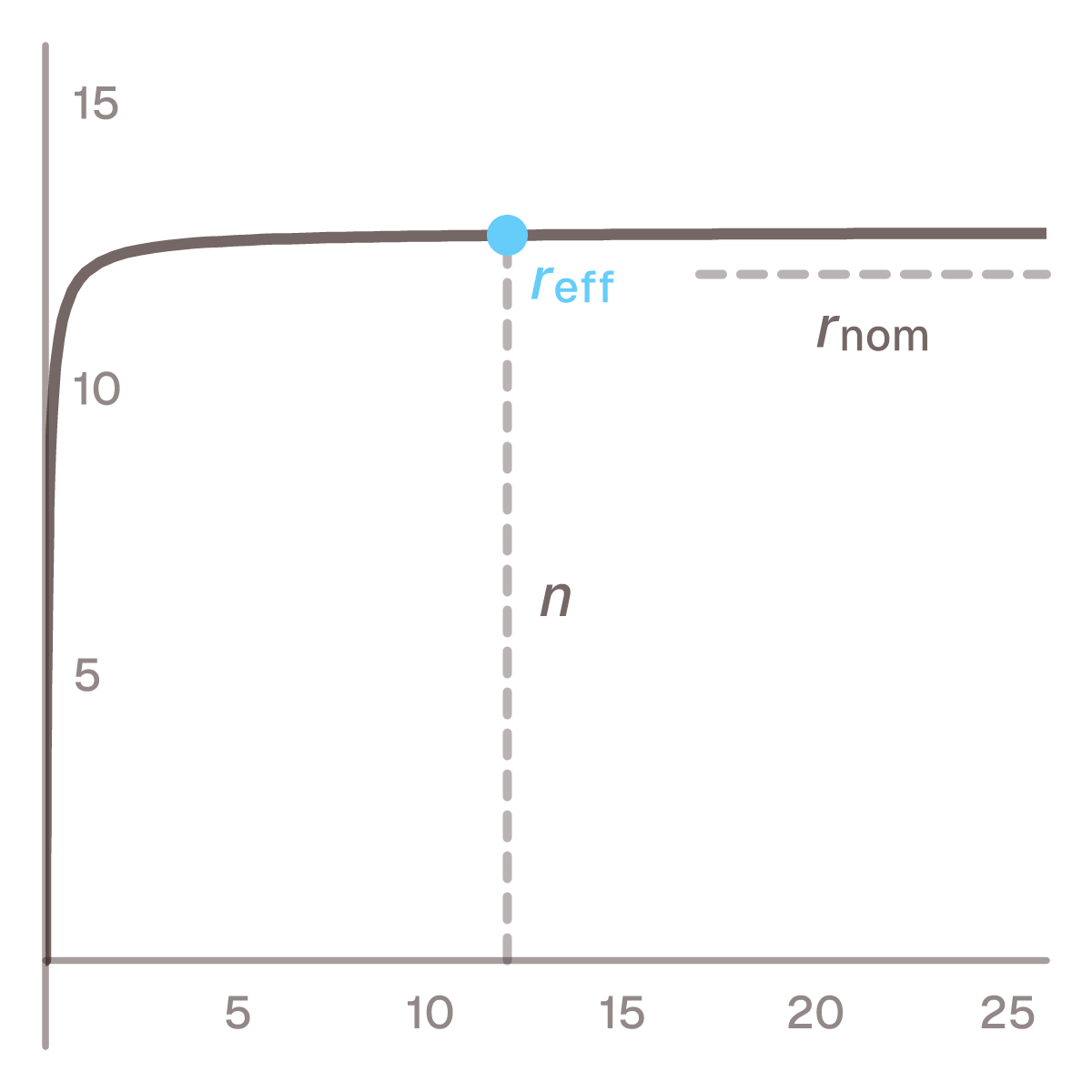
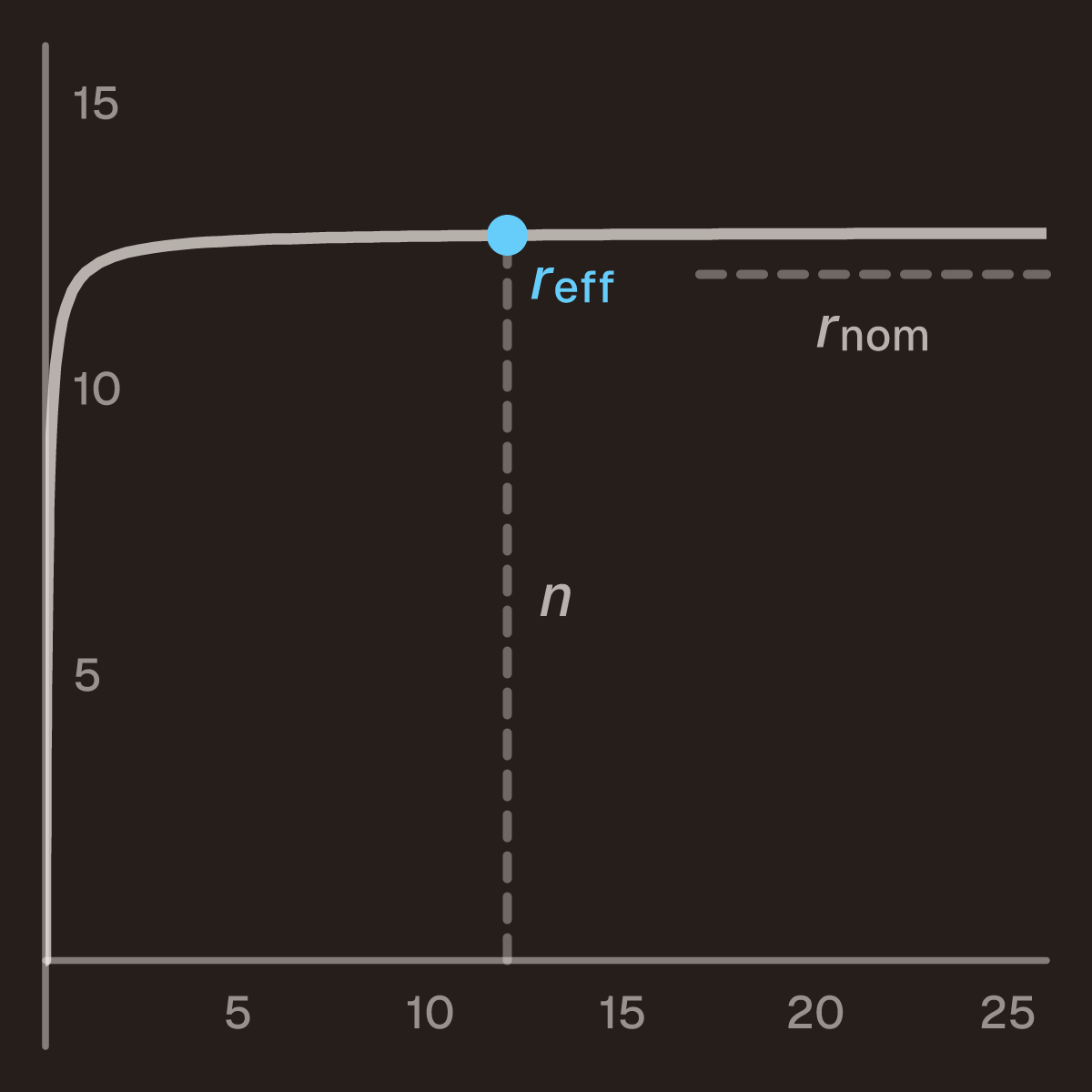
r eff equals 100 times ((1 plus (12 divided by (100 times 12))) to the power of 12 minus 1), equals 100 times ((1 plus (12 divided by 1,200)) to the power of 12 minus 1), equals 100 times ((1 plus 0.01) to the power of 12 minus 1), equals 100 times (1.01 to the power of 12 minus 1), is approximately 100 times (1.1268 minus 1), is approximately 100 times 0.1268, is approximately 12.6825
Working7 steps
reff
=
100((1+12100·12)12−1)
=
100((1+121,200)12−1)
=
100((1+0.01)12−1)
=
100(1.0112−1)
≈
100(1.1268−1)
≈
100·0.1268
≈
12.6825
What the formula says
r_eff = 100 · ((1 + r_nom / (100 · n))ⁿ − 1)
where r_nom is the nominal annual rate as a percentage, n how many times a year interest is added and
r_eff the effective annual rate, also as a percentage.
In the UK it is quoted as the AER, the annual equivalent rate.
The nominal rate is the number in the contract. If interest is added more than once a year it starts
earning interest of its own within the year, and what you actually pay or earn comes out a little higher.
The effective rate is that figure, expressed over a whole year.
Worked example
A 12% nominal rate compounded monthly, so n = 12:
12 / (100 · 12) = 0.01, one per cent a month
1.01¹² = 1.126825
100 · (1.126825 − 1) = 12.68%
How the answer depends on how often interest is added:
Compounded
n
Effective rate
once a year
1
12.00%
every six months
2
12.36%
quarterly
4
12.55%
monthly
12
12.68%
daily
365
12.75%
The more often interest is added, the larger the difference, but ever more slowly. Going from monthly to
daily adds only 0.07 percentage points.
The same shape as compound interest
The formula is compound interest over one year of n periods. What
differs is what is being solved for. Here n sits both in the exponent and inside the bracket, so no
algebra solves for it. Ask for n and the page finds it numerically instead, the same way it finds the
rate in the annuity formula.
Fees change the question
The effective rate or APR that a lender publishes also includes fees, and it is worked out from the whole
schedule of payments under rules of its own about what counts. That is a harder calculation than this
one, and the formula above does not give that figure. It only says what the interest itself works out to
when it is added several times a year. To see what fees cost in money, use the
total loan cost calculator.
Frequently asked questions
Is the effective rate always higher than the nominal one?
When interest is added more than once a year, yes. When it is added once a year they are equal: no
interest has time to earn interest of its own within the year.
How do I get the nominal rate back from the effective one?
Solve for r_nom: r_nom = 100 · n · ((1 + r_eff / 100)^(1/n) − 1). An effective rate of 12.68% compounded
monthly gives 12% back. The formula above solves for whichever letter you choose.
Looking for another letter? The formula solved for each one
Copy the code into your page where the formula card should appear. It loads from lovetocalc.com, so it stays current on its own — all we ask is that the credit line comes with it.