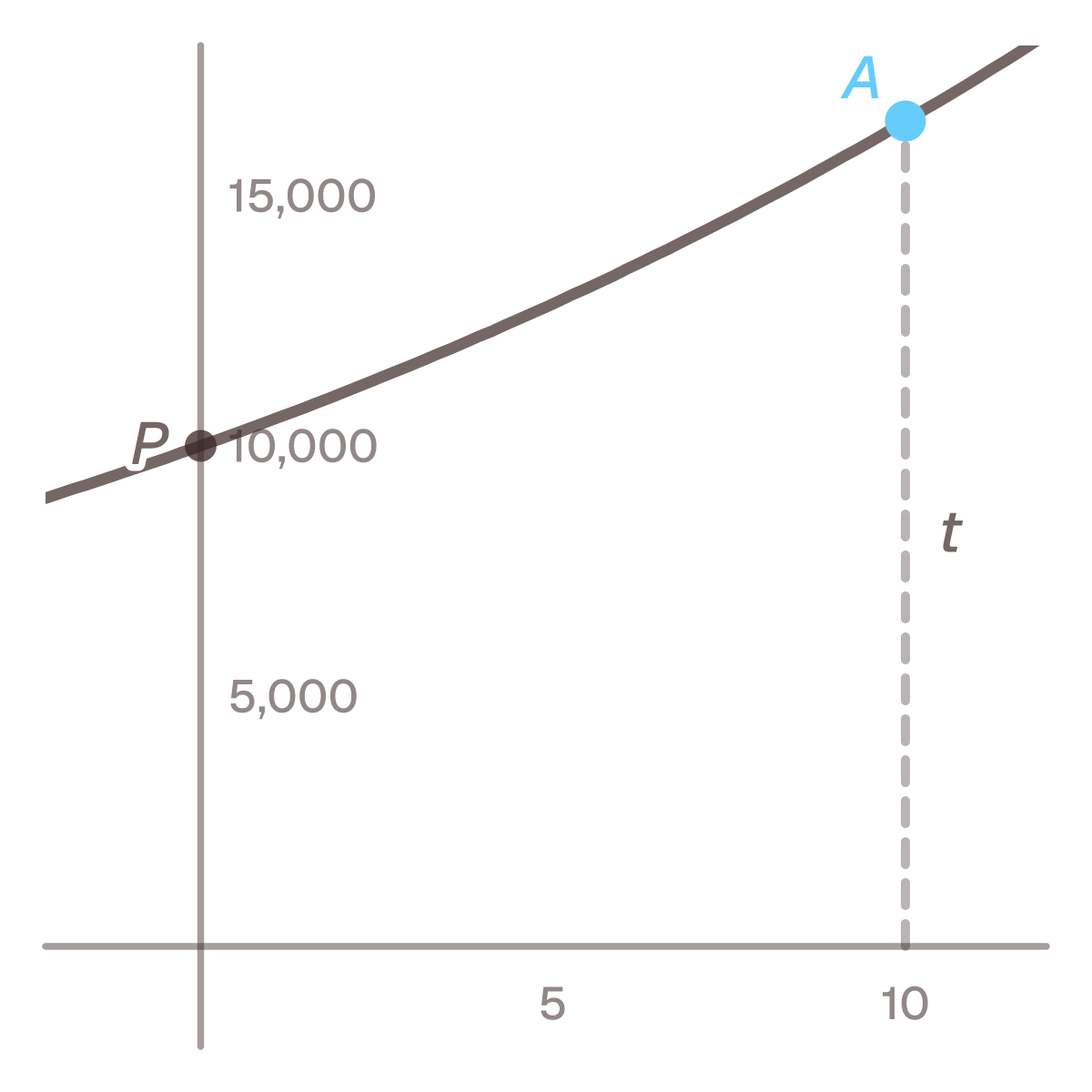
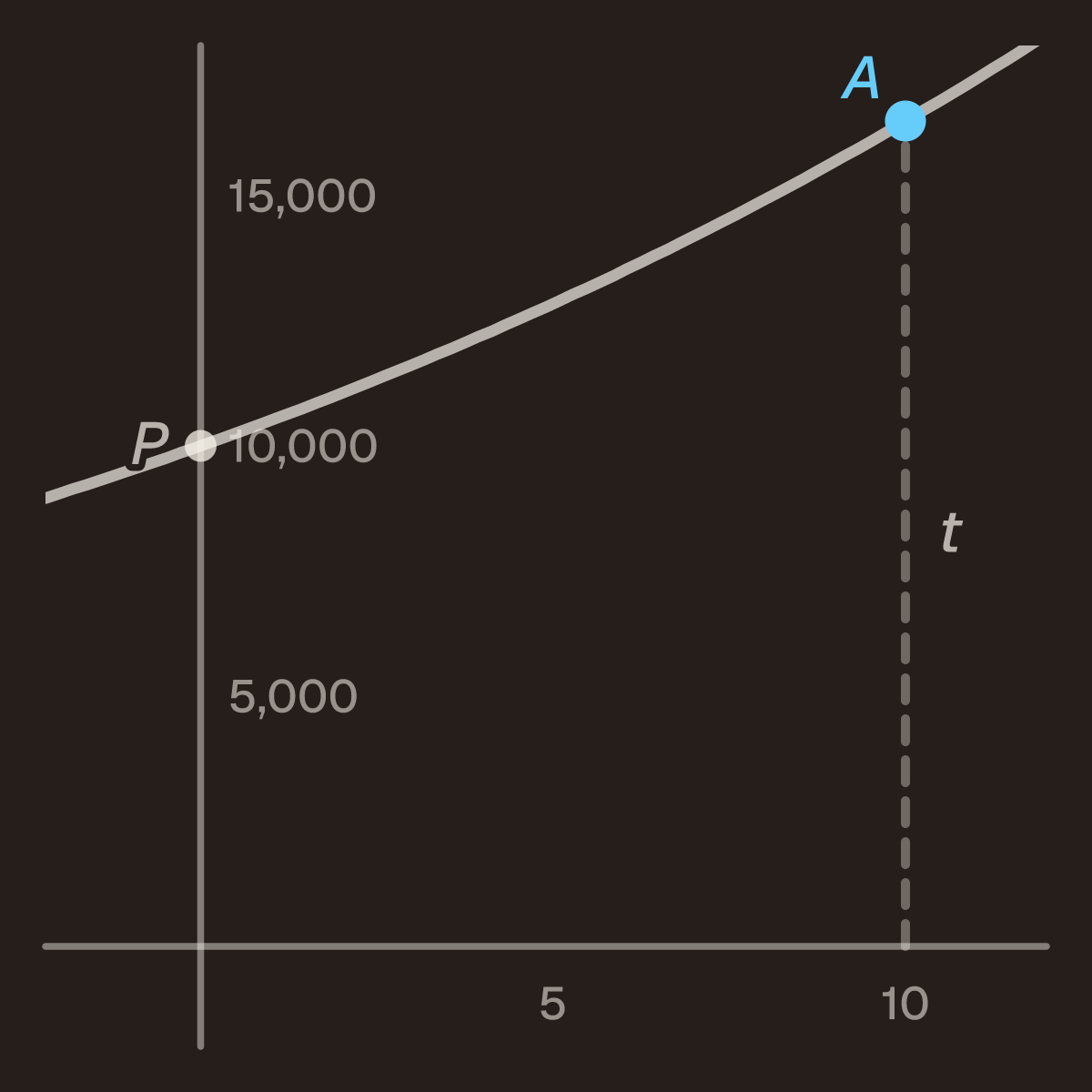
P is the starting amount, r the annual rate in per cent, t the number of years and e ≈ 2.71828 the base
of the natural logarithm.
10,000 at 5% for 10 years: A = 10,000 · e^(0.5) ≈ 16,487.21.
Why e, and why it is barely more than daily
Compound interest adds the interest n times a year at r/n each time. The more often it is added, the
more of it earns interest itself — but the gain shrinks with every step, and it does not grow without
limit. As n runs to infinity, (1 + r/n)ⁿ runs to eʳ. That limit is where the e in the formula comes from.
| Compounding |
10,000 at 5% after 10 years |
| Once a year |
16,288.95 |
| Monthly |
16,470.09 |
| Daily |
16,486.65 |
| Continuously |
16,487.21 |
Going from yearly to monthly is worth 181. Going from daily to continuous is worth 0.56. Continuous
compounding is the ceiling that ordinary compound interest
approaches, and daily is already almost there.
Where you meet it
Banks rarely pay it. It is the form finance and economics courses use because the exponential is easier
to work with than a power: it differentiates to itself, rates add instead of multiplying, and a rate
over half a year is simply half the rate. Option pricing, bond mathematics and population models are all
written this way.
Going the other way
The card solves for any of the four. Solving for the rate or the time uses the natural logarithm:
- t = 100 · ln(A/P) / r
- r = 100 · ln(A/P) / t
How long does it take to double at 5%? t = 100 · ln 2 / 5 ≈ 13.86 years. This is the exact
version of the rule of 70: 100 · ln 2 ≈ 69.3. See the doubling time.
The effective annual rate
5% compounded continuously gives the same result as e^(0.05) − 1 ≈ 5.127% compounded once a year.
That is the number to compare with an ordinary annual rate — the same idea as the
effective interest rate with n taken to infinity.
Common mistakes
- Putting in 5 instead of 0.05 in the exponent. e^(5·10) is a number with 22 digits. The card takes
the rate in per cent and divides by 100 for you; by hand, the exponent is rt with r as a fraction.
- Using e^(rt) for a loan that compounds monthly. The difference is small, but it is not zero, and a
contract states how often interest is added.
- Using log base 10 when solving for t. It has to be the natural logarithm, ln, because the base is e.
Questions people ask
Is continuous compounding the same as APY?
No. APY (or the effective annual rate) is what any compounding comes to over a year. For continuous
compounding it is e^(r) − 1 with r as a fraction.
Why is it written A = Pe^(rt) in textbooks?
Textbooks write r as a fraction, 0.05. This page takes it in per cent, as every page on interest here
does, so the formula carries the division by 100.