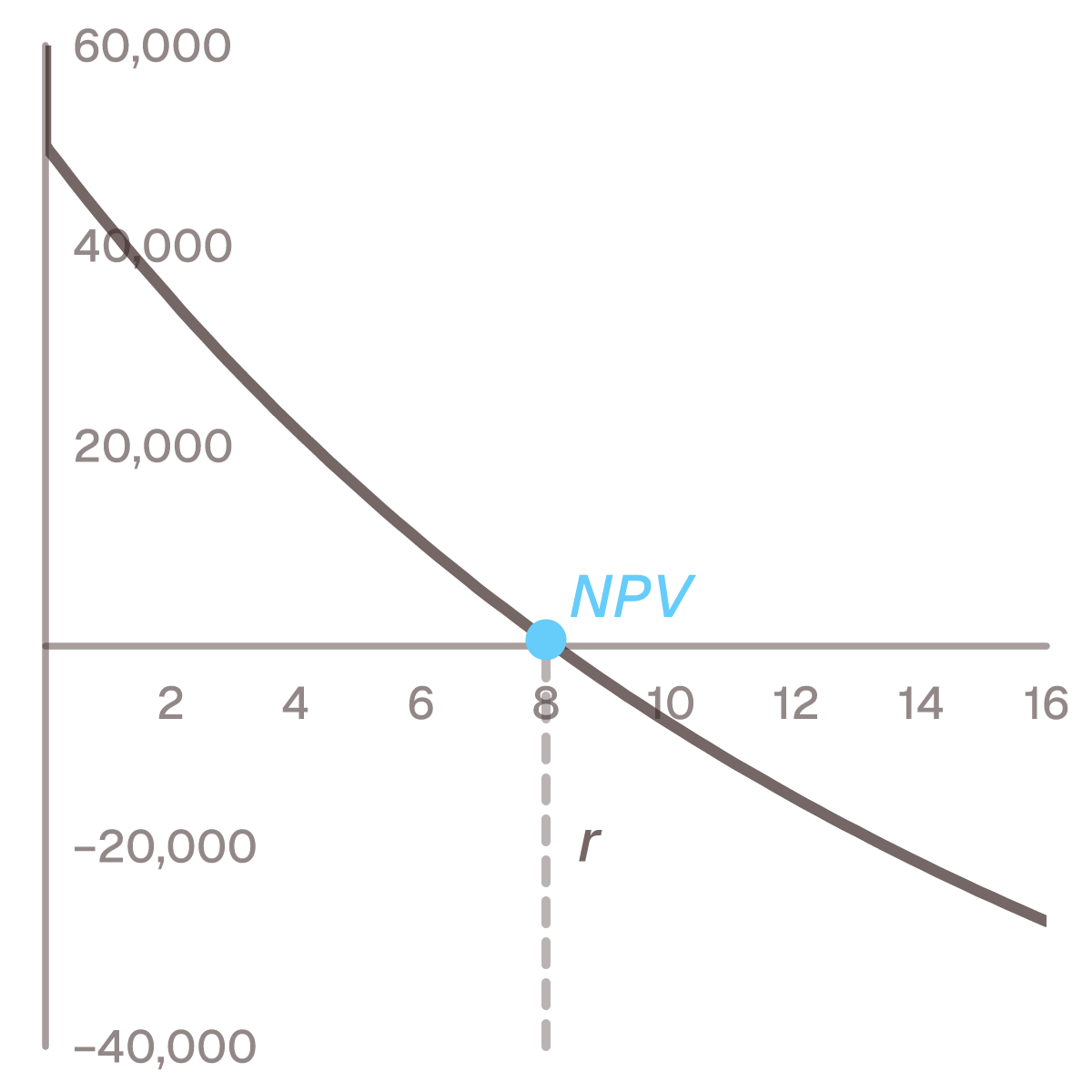
What an investment is worth today: every future cash flow discounted back to now, minus what it costs. Above zero it earns more than the discount rate; below, less.
NPV equals (15,000 times ((1 minus (1 plus (8 divided by 100)) to the power of (minus 10)) divided by (8 divided by 100))) minus 100,000, equals (15,000 times ((1 minus (1 plus 0.08) to the power of −10) divided by 0.08)) minus 100,000, equals (15,000 times ((1 minus 1.08 to the power of −10) divided by 0.08)) minus 100,000, is approximately (15,000 times ((1 minus 0.4632) divided by 0.08)) minus 100,000, is approximately (15,000 times (0.5368 divided by 0.08)) minus 100,000, is approximately (15,000 times 6.7101) minus 100,000, is approximately 100,651.221 minus 100,000, is approximately 651.221
Working8 steps
NPV
=
15,000·1−(1+8100)−108100−100,000
=
15,000·1−(1+0.08)−100.08−100,000
=
15,000·1−1.08−100.08−100,000
≈
15,000·1−0.46320.08−100,000
≈
15,000·0.53680.08−100,000
≈
15,000·6.7101−100,000
≈
100,651.221−100,000
≈
651.221
Practice questions
You are given
CF=25000
r=12
n=8
I=70000
Round to 0 decimals.
The formula
With the same cash flow every year:
NPV = CF · (1 − (1 + r)⁻ⁿ) / r − I
I is the investment made today, CF the cash flow each year for n years and r the discount rate — the
return the money could earn elsewhere. The card takes r in per cent.
Swedish textbooks write G for the investment and a for the yearly cash flow, and call the rate kalkylränta.
100,000 invested, 15,000 a year for 10 years, discount rate 8%:
Annuity factor: (1 − 1.08⁻¹⁰) / 0.08 = 6.7101.
Present value of the flows: 15,000 · 6.7101 = 100,651.22.
NPV = 100,651.22 − 100,000 = 651.22.
Positive: the project earns slightly more than 8%, so it is worth doing. Zero would mean it earns exactly
8%; negative, less.
The undiscounted sum is the wrong answer
Ten years of 15,000 is 150,000, and 150,000 − 100,000 = 50,000 looks like the profit. It is not. The
last 15,000 arrives in ten years, and at 8% it is worth only 6,948 today. Summed properly, the whole
series is worth 100,651 — the project barely clears its cost.
The rate decides the answer
Discount rate
Annuity factor
NPV
6%
7.3601
10,401.31
8%
6.7101
651.22
10%
6.1446
−7,831.49
12%
5.6502
−15,246.65
Somewhere between 8% and 10% the NPV passes zero. That rate is the project’s
internal rate of return — 8.14% here.
The factor is the annuity formula turned around: a loan
of 100,651 at 8% over ten years is paid off by exactly 15,000 a year. And letting n grow without end
turns it into the perpetuity 1/r.
Which rate to use
The company’s WACC for an ordinary project; a higher rate
for a riskier one. For a private person, the interest on the loan that pays for it, or the return the money
would earn otherwise.
Common mistakes
Not discounting. See above.
The rate as a whole number in the power. 1.08⁻¹⁰, not 8⁻¹⁰.
Forgetting the investment. The present value of the flows alone is 100,651; the NPV is what is left
after paying for the project.
Comparing projects of different size by NPV alone. A bigger project can have a bigger NPV and still
earn a lower rate.
Questions people ask
What if the cash flows differ from year to year?
Discount each one on its own, CFₜ / (1 + r)ᵗ, and add them up. The formula here is the shortcut for equal
flows.
NPV or IRR — which is better?
NPV, when the two disagree: it measures the value added in money, and it does not break down when cash
flows change sign more than once.
Looking for another letter? The formula solved for each one
Copy the code into your page where the formula card should appear. It loads from lovetocalc.com, so it stays current on its own — all we ask is that the credit line comes with it.