Infinite geometric series
The relation
S
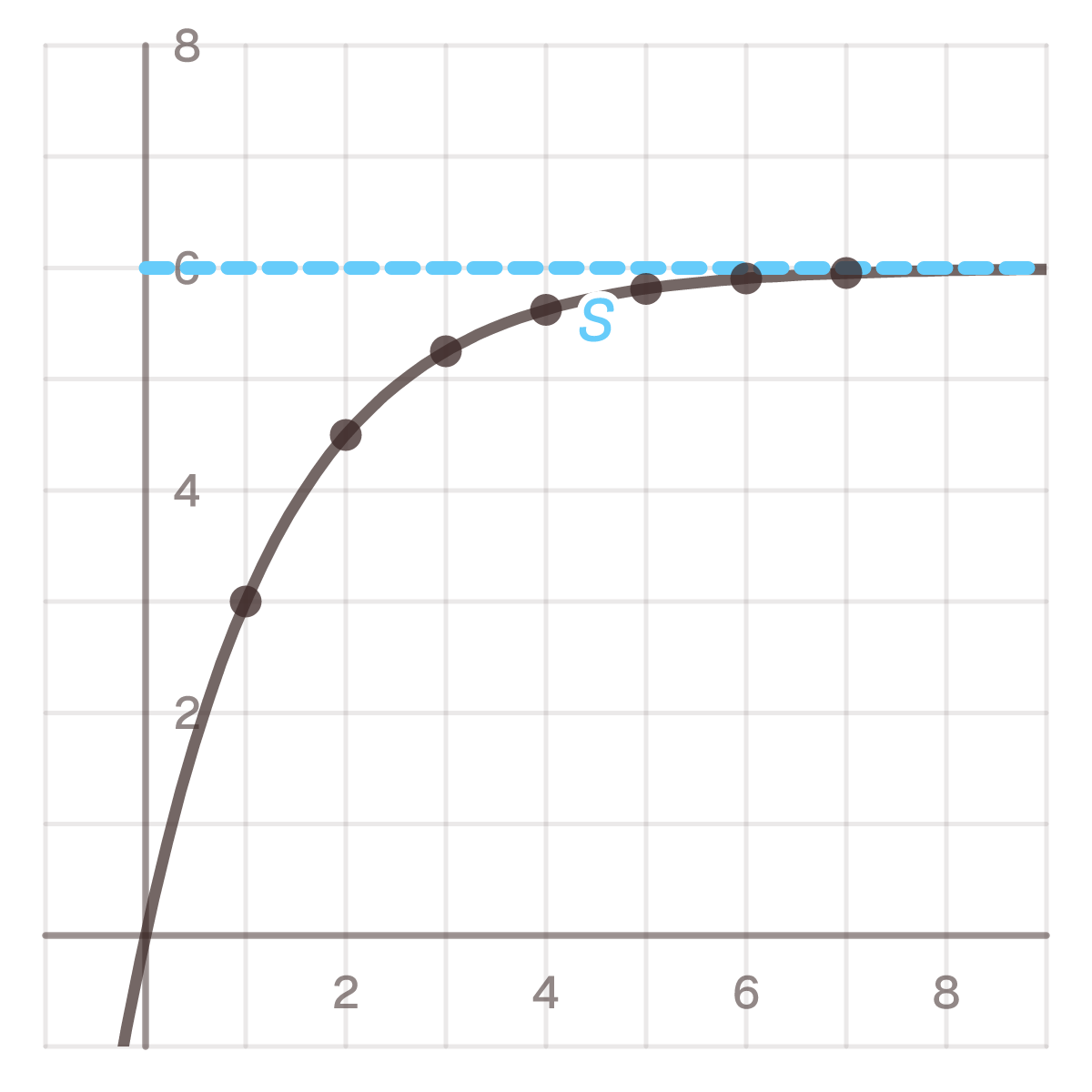
A geometric series with a ratio between −1 and 1 adds up to a finite number, however many terms it has.
Solve for
S=6
S equals 3 divided by (1 minus 0.5), equals 3 divided by 0.5, equals 6
Den här sidan finns på svenska. Byt till svenska
Theorem — what does that mean?
A sum with infinitely many terms that still lands on a number. It works, but only when the terms shrink fast enough.
In Swedish: Oändlig geometrisk serie
S
A geometric series with a ratio between −1 and 1 adds up to a finite number, however many terms it has.
S=6
S equals 3 divided by (1 minus 0.5), equals 3 divided by 0.5, equals 6
You are given
The series 3 + 1.5 + 0.75 + 0.375 + … goes on forever and adds up to 3 / (1 − 0.5) = 6. Add the terms and watch: 3, then 4.5, then 5.25, then 5.625 — closer and closer to 6, and never past it.
Compare it with the finite sum, which is
a₁(kⁿ − 1)/(k − 1). The only difference is that kⁿ has gone.
That is what happens as n grows. With a ratio of a half, k¹⁰ is about a thousandth, k²⁰ a millionth, k¹⁰⁰ a number with thirty zeros after the point. The term never becomes exactly zero, but it becomes smaller than any number you care to name — and then there is no room left between the partial sums and the limit.
Here a term disappears because it approaches zero rather than because it cancels against something. The formula rests on a limit, even though the arithmetic is simpler than on most of the pages around it.
| Ratio | The terms | The sum |
|---|---|---|
| k = 0.5 | 3, 1.5, 0.75, … | 6 |
| k = −0.5 | 3, −1.5, 0.75, … | 2 |
| k = 1 | 3, 3, 3, … | grows without bound |
| k = 2 | 3, 6, 12, … | grows without bound |
Outside the interval the terms stop shrinking and the sum has no limit. The dangerous part is that the formula answers anyway: a₁/(1 − k) with k = 2 gives −3, a tidy negative number for a series of nothing but positive terms. Check the ratio first, every time.
0.999… = 1. Write the number as 0.9 + 0.09 + 0.009 + …, so a₁ = 0.9 and k = 0.1. The sum is 0.9 / 0.9 = 1. Not “almost 1” — the series is the number, and the number is 1.
A recurring decimal as a fraction. 0.272727… is 0.27 + 0.0027 + …, with a₁ = 0.27 and k = 0.01. The sum is 0.27 / 0.99 = 3/11.
Backwards. A series starting at 4 that adds up to 16 has a ratio of k = 1 − 4/16 = 0.75.
Is 0.999… really equal to 1?
Yes, and it is not an approximation. The series 0.9 + 0.09 + … has a ratio of 0.1, so it sits inside
the condition, and it adds up to exactly 1. Two decimal expansions can name the same number.
What happens at k = 1 exactly?
Every term is as big as the first, and the sum grows without bound. The formula would divide by zero.
Does it work with a negative ratio?
Yes, as long as the ratio is above −1. The terms alternate in sign and the partial sums jump above and
below the limit, but they still close in on it. 3 − 1.5 + 0.75 − … adds up to 2.
| Solve for | Rearranged | With the numbers | Comes to |
|---|---|---|---|
| a₁ | S(1 | 6(1 | 3 |
| k | 1 | 1 | 0.5 |
| S | a₁1 | 31 | 6 |
Last reviewed October 6, 2026 ·How pages are reviewed
Indices and seriesAll formulas
Copy the code into your page where the formula card should appear. It loads from lovetocalc.com, so it stays current on its own — all we ask is that the credit line comes with it.