What the theorem says
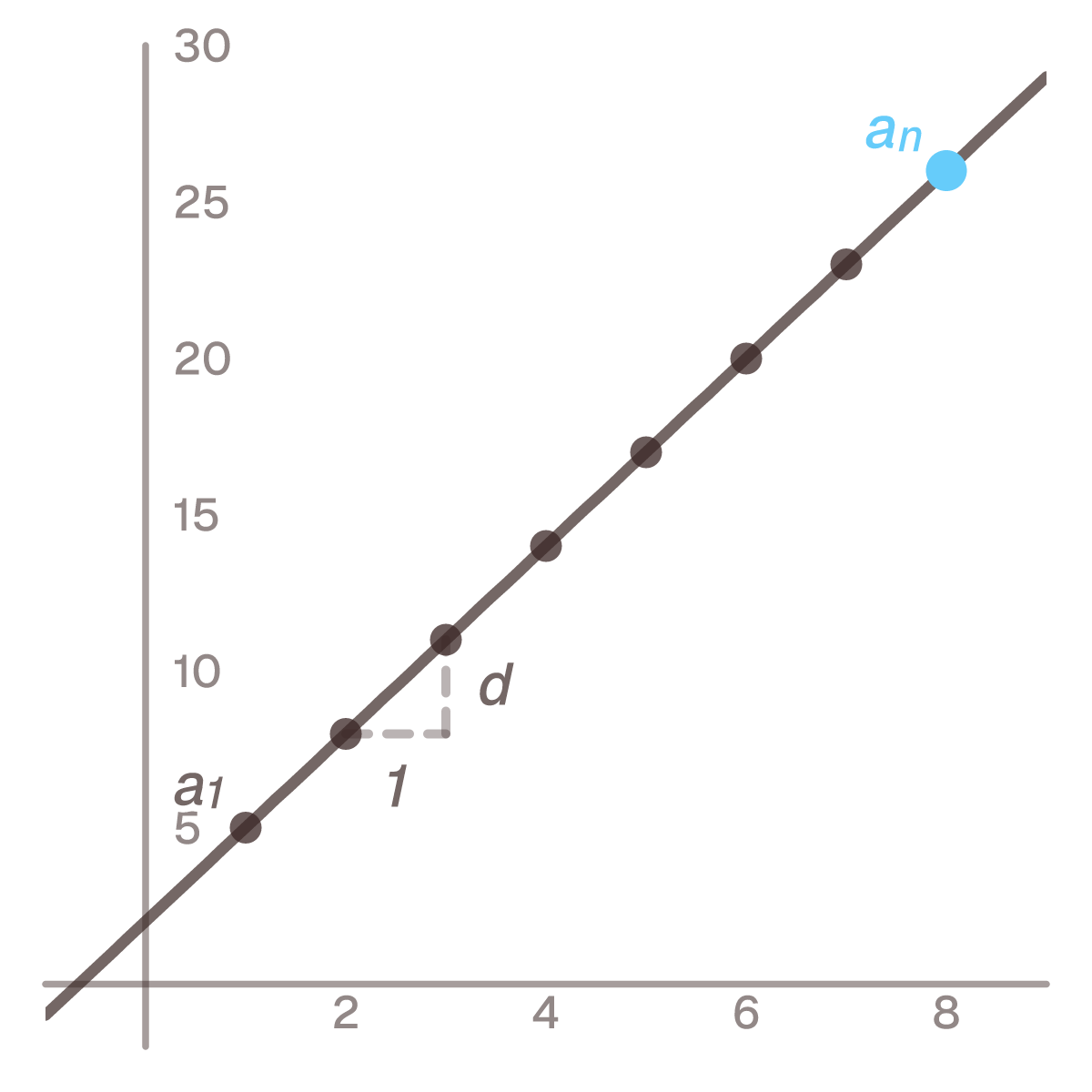
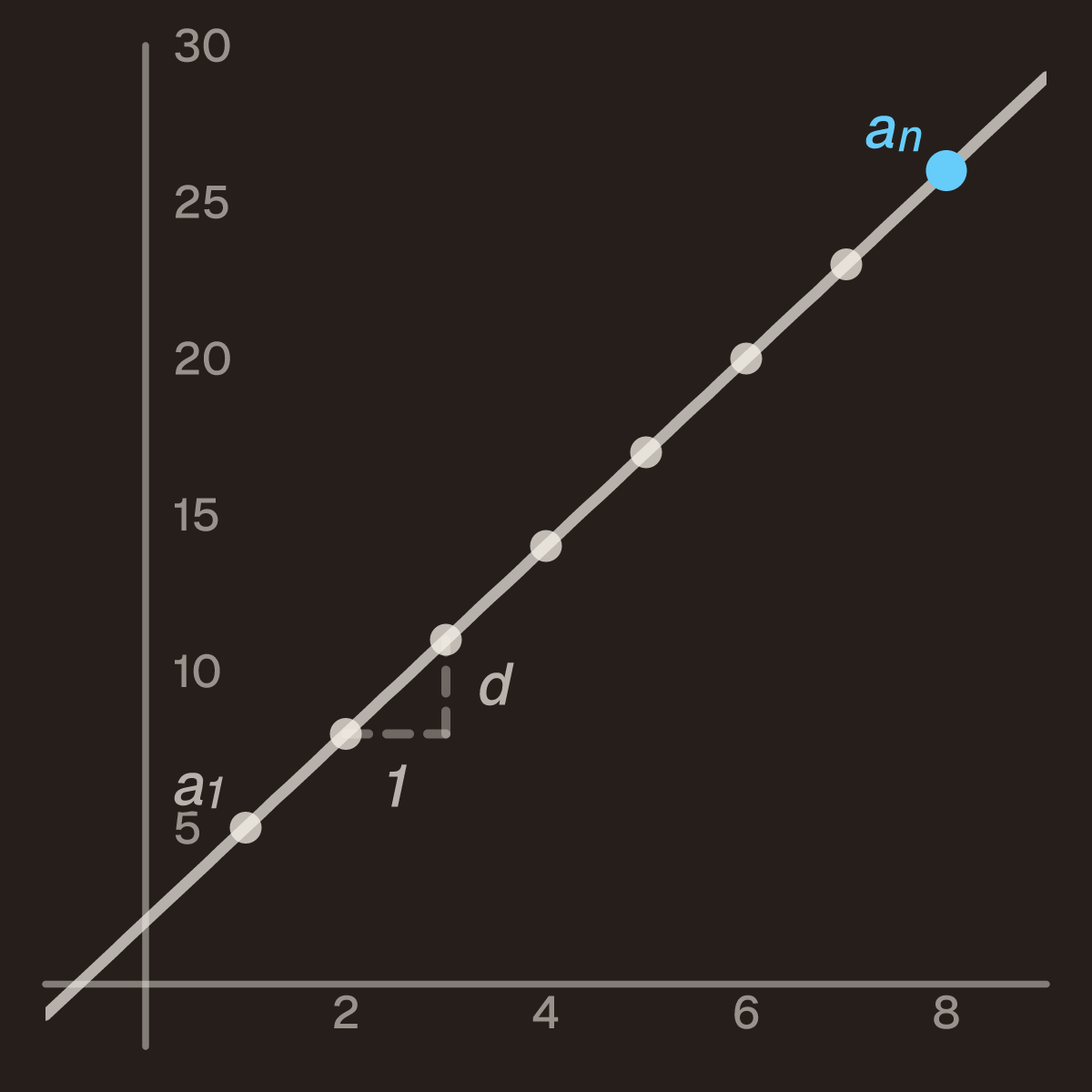
a₁ is the first term, d the common difference — what gets added at each step — and n the position
in the sequence. The sequence 5, 8, 11, 14, … has a₁ = 5 and d = 3, so the eighth term is
5 + 7 · 3 = 26.
Count it: 5, 8, 11, 14, 17, 20, 23, 26. Eight terms, seven steps.
Why it says n − 1 and not n
This is where a common mistake lives, and the explanation is a single sentence: the first term has not
taken a step yet.
| Position |
Steps taken |
Term |
| 1 |
0 |
5 |
| 2 |
1 |
8 |
| 3 |
2 |
11 |
| 8 |
7 |
26 |
The position counts terms, the factor counts gaps, and eight fence posts have seven gaps between them.
The same offset appears in geometric sequence,
where it sits in an exponent instead of a factor.
Finding the difference and the position
The formula turns round both ways, and both rearrangements are the same two lines.
The common difference: subtract the first term and divide by the number of steps. A sequence starting
at 4 whose eleventh term is 40 has d = (40 − 4) / 10 = 3.6.
The position: subtract the first term, divide by the difference, add one. Where in 5, 8, 11, … does
98 appear? (98 − 5) / 3 + 1 = 31 + 1 = 32. If the division does not come out even, the number is not
in the sequence at all — 99 gives 31.33, and that is the answer “no”.
Common mistakes
- Multiplying by n instead of n − 1. The eighth term of 5, 8, 11, … is 26, not 29. The check takes
three seconds: put n = 1 in and see whether the first term comes back.
- Forgetting that the difference may be negative. 20, 17, 14, … is a perfectly good arithmetic
sequence with d = −3. The formula works with either sign.
- Assuming the sequence is arithmetic. Check several differences, not just one. 2, 4, 8 has a difference
of 2 and then 4 — it is geometric, not arithmetic, and this formula then gives a wrong answer.
- Confusing the sequence with its sum. aₙ is one term. If you want all of them added up, it is
the arithmetic series you are after.
Common questions
How do I tell whether a sequence is arithmetic?
Subtract each term from the next. If you get the same number all the way along, the sequence is
arithmetic and that number is the common difference. If the ratio between terms is constant instead,
it is geometric.
Can the terms be decimals?
Yes. Nothing in the formula requires whole numbers — not the first term, not the difference, not the
answer. Only the position n has to be a positive whole number, because it counts terms.
What is the recursive formula for the same sequence?
aₙ = aₙ₋₁ + d, that is, “the previous term plus the difference”. It is shorter to write and worse to
calculate with: for the hundredth term you have to work through ninety-nine steps, which the formula
above avoids.