What the theorem says
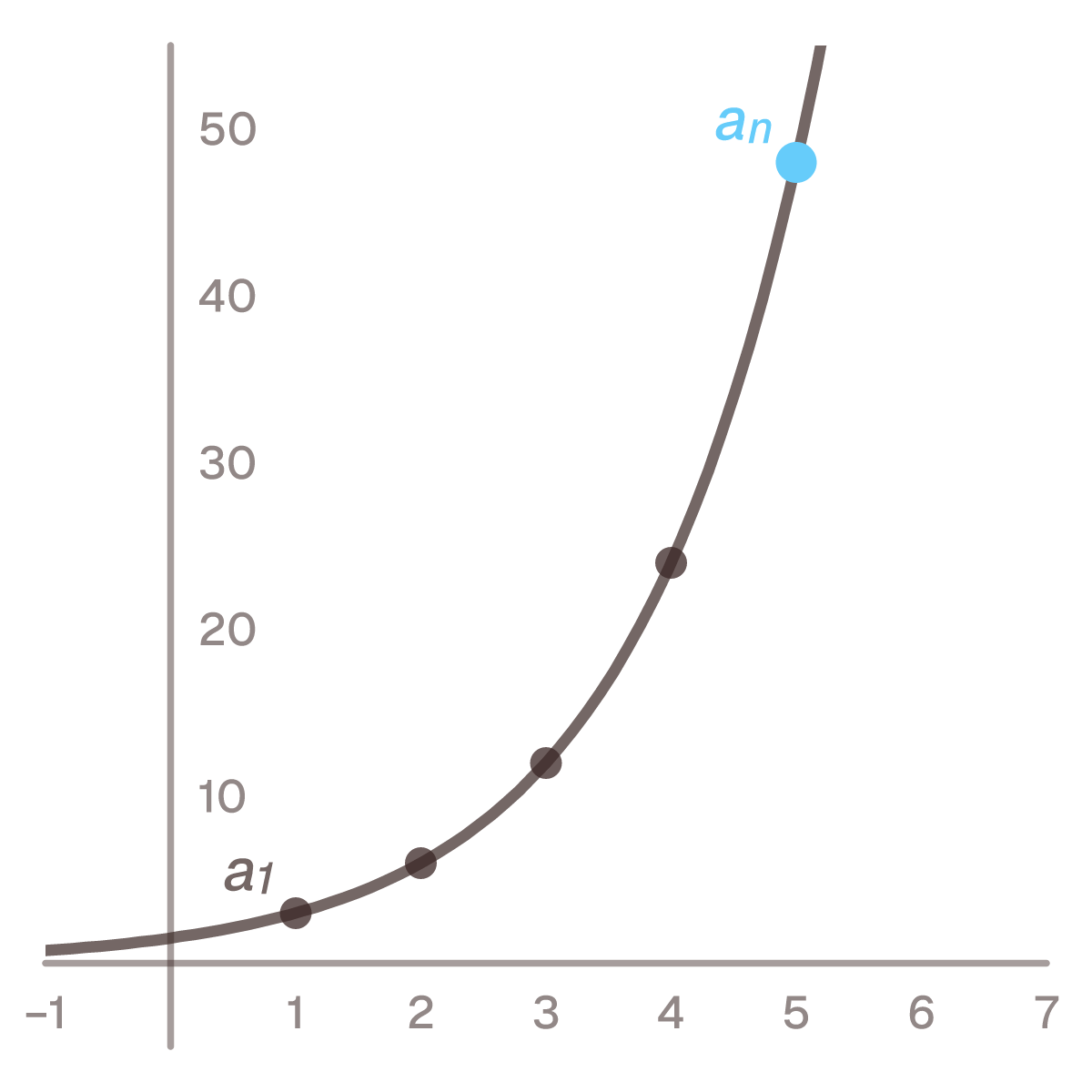
a₁ is the first term, k the common ratio — what you multiply by at each step — and n the position
in the sequence. The sequence 3, 6, 12, 24, 48 has a₁ = 3 and k = 2, so the fifth term is 3 · 2⁴ = 48.
Count it: five terms, four doublings.
Why the exponent is n − 1
For the same reason as in the
arithmetic sequence: the first term has not
been multiplied by anything yet.
| Position |
Multiplications done |
Term |
| 1 |
0 |
3 · 2⁰ = 3 |
| 2 |
1 |
3 · 2¹ = 6 |
| 3 |
2 |
3 · 2² = 12 |
| 5 |
4 |
3 · 2⁴ = 48 |
The check is the same: put n = 1 in and see whether the first term comes back. If you get a₁ · k, the
exponent is wrong.
Finding the ratio and the position
The ratio is the ratio between neighbours: divide any term by the one before it. 3, 6, 12 gives
6/3 = 2 and 12/6 = 2, so k = 2. If you only have the ends, take a root: from a first term of 5 to a fifth
term of 405, k = ⁴√(405/5) = ⁴√81 = 3.
The position needs a logarithm, because the unknown sits in an exponent. Where in 3, 6, 12, … does
1,536 appear? From aₙ/a₁ = kⁿ⁻¹,
- n = ln(1,536 / 3) / ln 2 + 1 = ln 512 / ln 2 + 1 = 9 + 1 = 10
It is the same move as on
the logarithm of a power, and the
card does it for you.
Common mistakes
- Using n as the exponent. The fifth term of 3, 6, 12, … is 48, not 96. Test it with n = 1.
- Mixing up ratio and difference. An arithmetic sequence adds d, a geometric one multiplies by
k. 2, 4, 6 and 2, 4, 8 look alike over three terms, but the twentieth term is 40 in one and 1,048,576
in the other.
- Thinking a ratio below 1 does not count. 100, 50, 25, … is geometric with k = 0.5. The sequence
falls, as with half-life.
- Missing that a negative ratio alternates. With k = −2 the sequence is 3, −6, 12, −24: every other
term negative. The formula handles it, but the card cannot solve for a negative ratio from two terms,
because the answer would then depend on whether the position is odd or even.
Common questions
How do I tell whether a sequence is geometric?
Divide each term by the one before. If the ratio is the same all the way along, the sequence is
geometric. If it is the difference that stays constant, it is arithmetic instead.
Can the ratio be 1?
Yes, but then the sequence is just the same number over and over. The formula gives the right answer,
though the way back closes: every term is equal, so no particular position can be found.
What is the difference from exponential growth?
None, in substance. A geometric sequence is exponential growth measured in whole steps, and
exponential growth is the same thing
with the exponent free to be anything. What shows is the n − 1 in the exponent,
which comes from counting from the first term rather than from zero.