What the theorem says
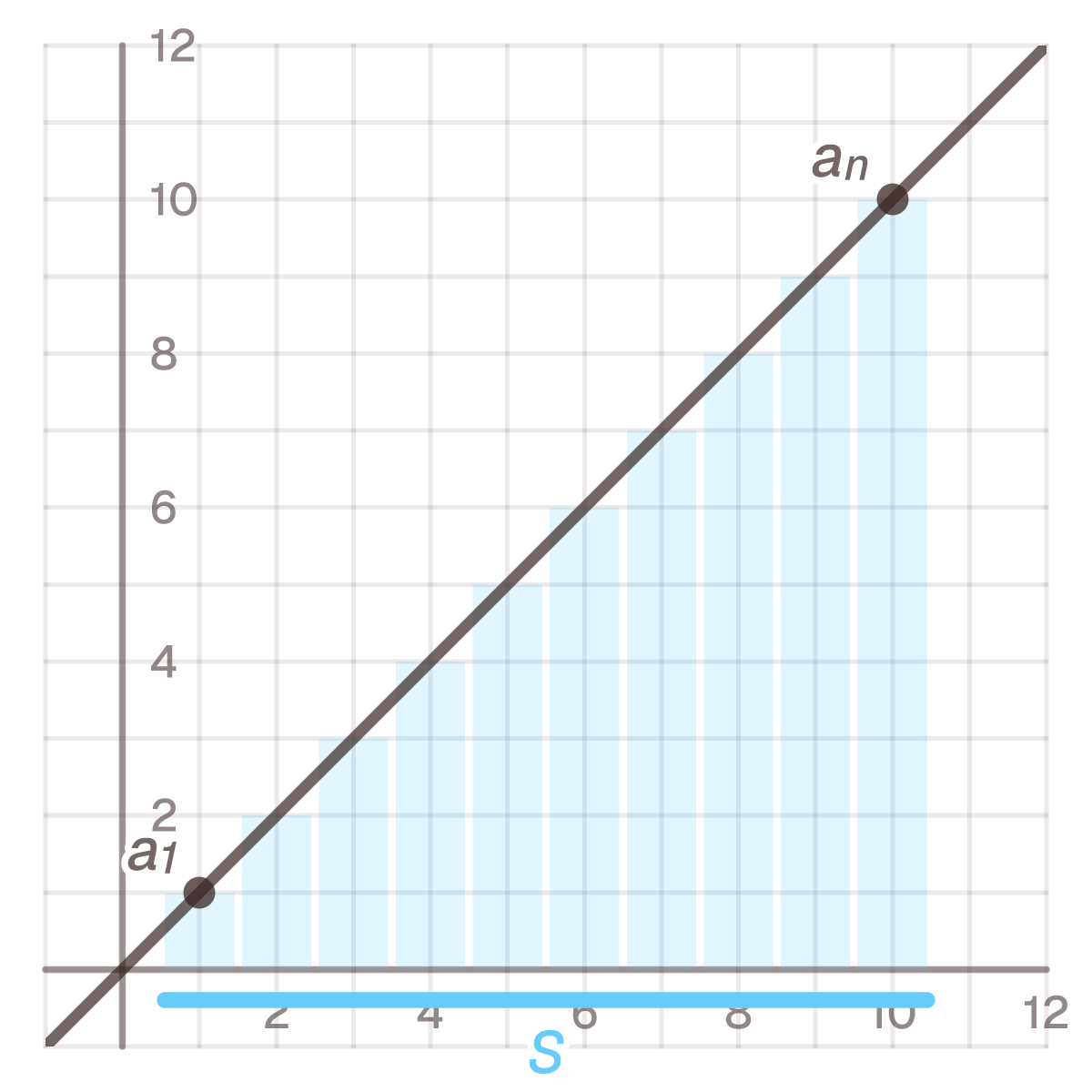
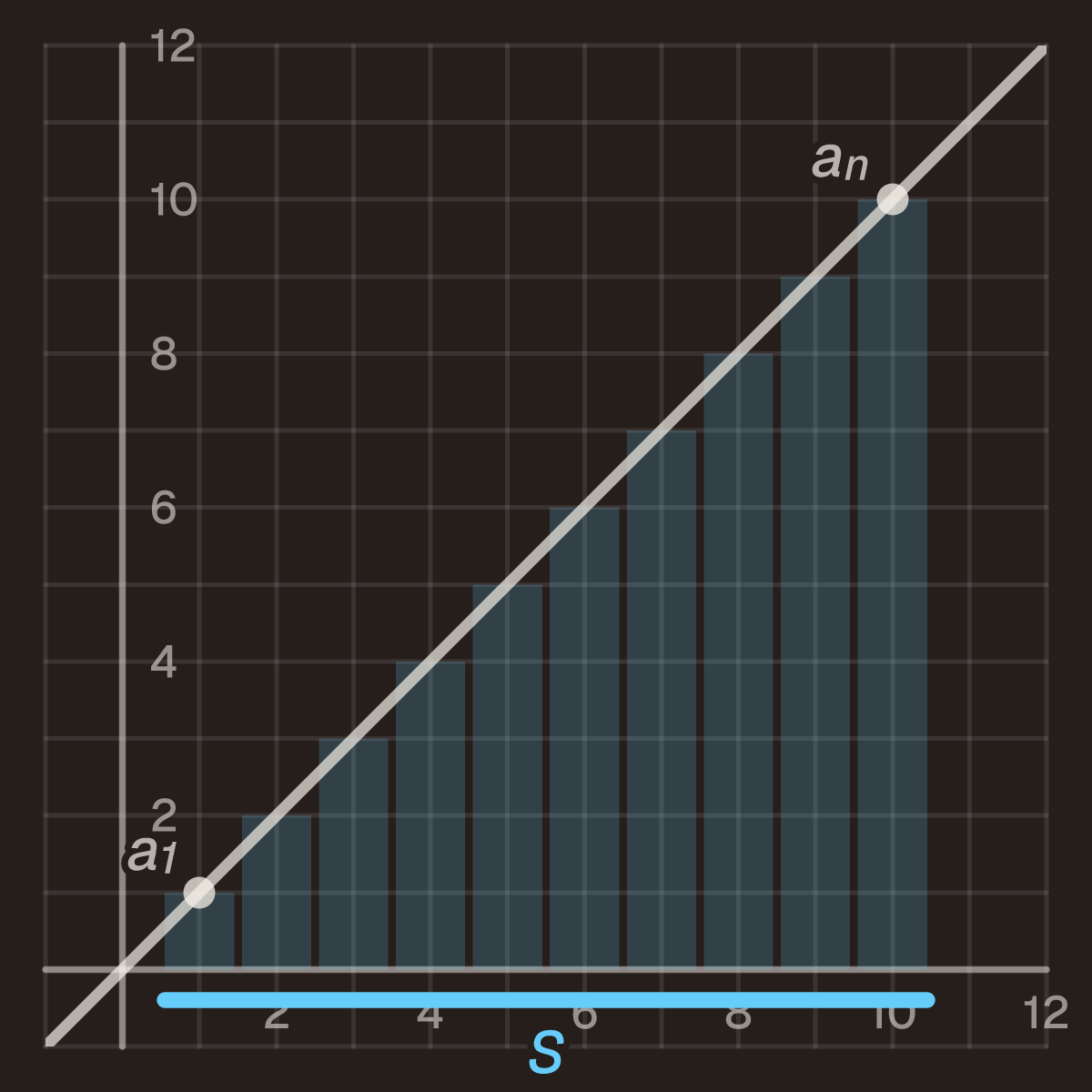
n is the number of terms, a₁ the first and aₙ the last. So 1 + 2 + … + 10 comes to
10 · (1 + 10) / 2 = 55, which you can check by adding them up.
The expression (a₁ + aₙ)/2 is the average of the two ends. The formula says: the number of terms
times the average term.
Write the sequence forwards and backwards, one under the other:
|
|
|
|
|
|
|
| 1 |
2 |
3 |
… |
8 |
9 |
10 |
| 10 |
9 |
8 |
… |
3 |
2 |
1 |
| 11 |
11 |
11 |
… |
11 |
11 |
11 |
Every column adds up to 11, and that is no accident: a step up in the top row is a step down in the
bottom one. Ten columns give 110, and that is the sum twice — hence the division by 2.
The story goes that Gauss found this as a schoolboy, when the class was set to add the numbers from 1 to
100 and he answered 5,050 almost at once. Whether or not it happened, the trick is the same:
100 · 101 / 2.
Worked examples
1 + 2 + … + 100. n = 100, a₁ = 1, aₙ = 100. The sum is 100 · 101 / 2 = 5,050.
Every even number from 2 to 60. The terms are 2, 4, …, 60, so n = 30. The sum is
30 · (2 + 60) / 2 = 930.
When the last term is missing, take it from
the arithmetic sequence first. Twelve terms
starting at 5 with a difference of 5 end at 5 + 11 · 5 = 60, and the sum is 12 · 65 / 2 = 390.
Common mistakes
- Forgetting to divide by 2. The answer comes out exactly twice too big. The quick check: the sum has
to lie between
n · a₁ and n · aₙ.
- Counting the terms wrong. The numbers 2, 4, …, 60 are thirty of them, not sixty. The count is
(last − first)/difference + 1, with the same plus one as in the term formula.
- Using it on a sequence that is not arithmetic. 3 + 6 + 12 + 24 grows by a factor, not by a term.
That sum is geometric and has a formula
of its own.
- Putting a₁ and aₙ in the wrong order. It happens not to matter here — the sum is symmetric in the
ends — but it does matter in the difference formula, so get used to the order anyway.
Common questions
Does the formula work when the number of terms is odd?
Yes. With an odd n the pairs do not come out even, but the middle term is exactly the average of the
ends, so it carries its own half. 1 + 2 + 3 = 3 · 4 / 2 = 6, which is right.
What if the common difference is negative?
Nothing in particular. 20 + 17 + 14 + 11 = 4 · (20 + 11) / 2 = 62. The formula uses only the ends and
the count, so the direction the sequence runs makes no difference.
Is there a version with the difference instead of the last term?
Yes: S = n(2a₁ + (n − 1)d)/2, which is the same formula with aₙ written out. This page uses the ends
because both of them show up in the question, and because that form can be checked in your head.