A series where each term is the last one times the same number
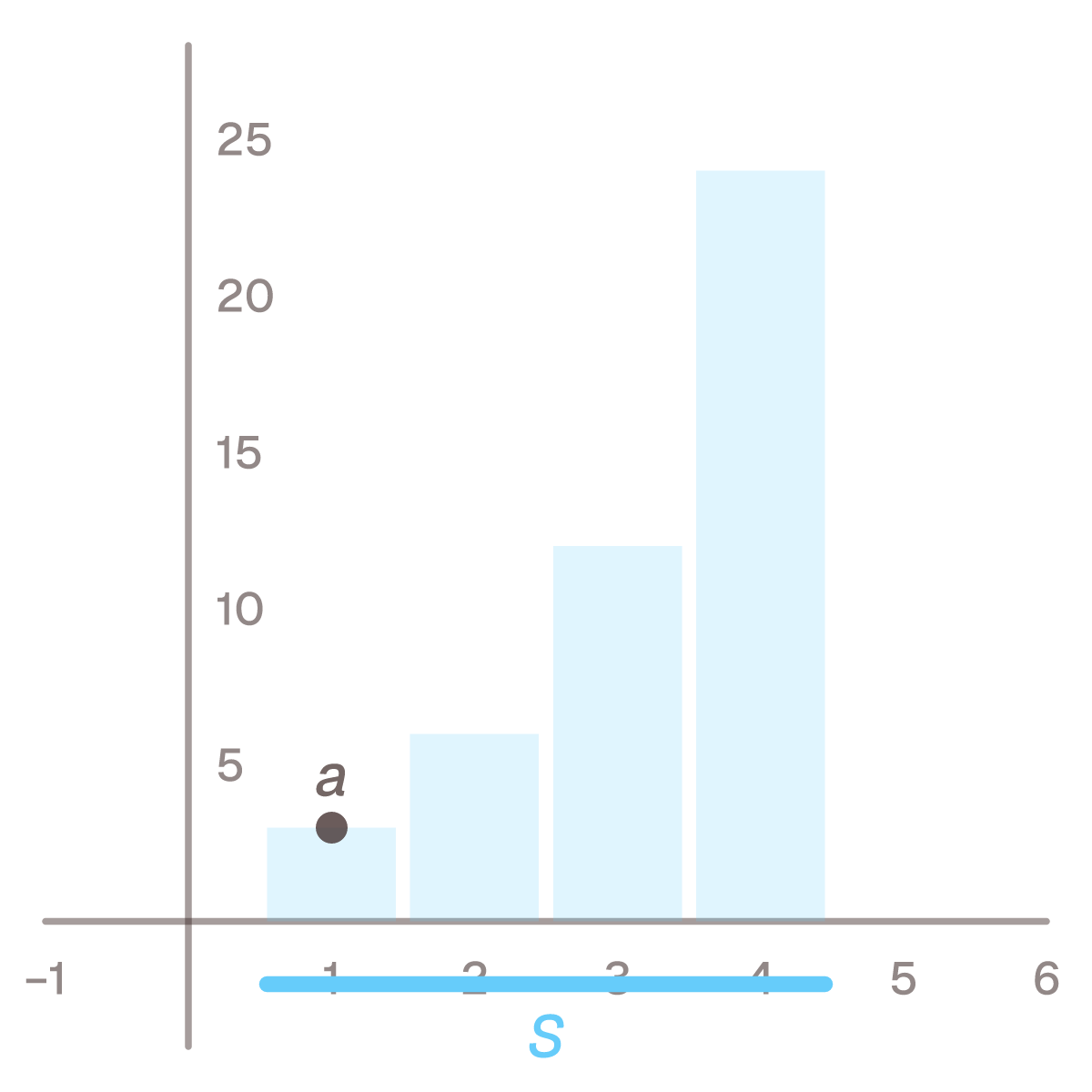
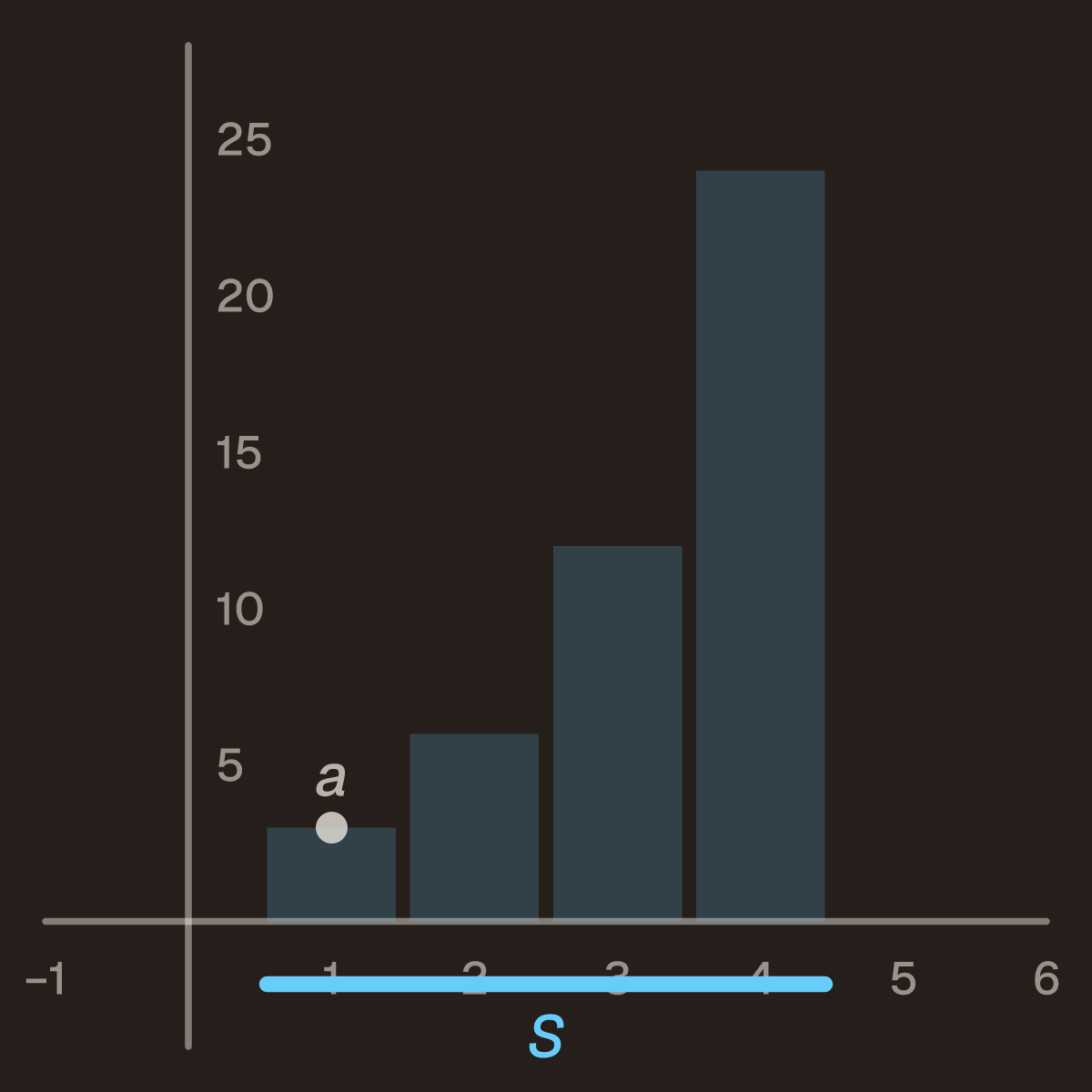
3 + 6 + 12 + 24 is a geometric series. Each term is the one before it times 2, and that number is called
the common ratio, written r. Four terms are easy enough to add by hand; 120 terms are not, and
that is what the formula is for:
- S = a · (rⁿ − 1) / (r − 1)
where a is the first term, r the common ratio, n the number of terms and S the sum. Check it
against the example: 3 · (2⁴ − 1) / (2 − 1) = 3 · 15 / 1 = 45, and 3 + 6 + 12 + 24 = 45.
n is the number of terms, not the exponent in the last one. Four terms at a ratio of 2
end on a · r³, not on a · r⁴.
It is not a definition but something that can be shown, and the proof runs to three lines. Write the
sum out:
- S = a + ar + ar² + … + arⁿ⁻¹
Multiply the whole line by r. Every term shifts one place to the right:
- rS = ar + ar² + … + arⁿ⁻¹ + arⁿ
The two lines have everything but two terms in common. Subtract the first from the second and the whole
middle disappears:
Take S out on the left and a out on the right — S(r − 1) = a(rⁿ − 1) — and divide by r − 1.
There is the formula. That last step is also where the condition comes from: it divides by r − 1, so a
ratio of 1 is the one series the formula cannot describe. It does not need to, either — if every term is
the same, the sum is just a · n.
Worked examples
Ten doublings. 1 + 2 + 4 + … + 512 is ten terms with a = 1 and r = 2:
1 · (2¹⁰ − 1) / (2 − 1) = 1,023, one less than 2¹⁰ = 1,024.
A series going down. 100 + 50 + 25 + 12.5 + 6.25 has a ratio of 0.5:
100 · (0.5⁵ − 1) / (0.5 − 1) = 100 · (−0.96875) / (−0.5) = 193.75. Two minus signs cancelling, and
a sum that stays below 200.
Saving every month. $1,000 a month for ten years, returning 0.5% a month, is a geometric series
with a = 1,000, r = 1.005 and n = 120: 1,000 · (1.005¹²⁰ − 1) / 0.005 ≈ $163,879. You paid
in $120,000, so just under $44,000 is return. Here r − 1 is exactly the monthly rate, which is why the
denominator of the savings formula looks the way it does.
The other three questions
The card at the top of the page solves for whichever of the four quantities you are missing:
| What you do not know |
How it is found |
| The sum |
S = a(rⁿ − 1)/(r − 1) |
| The first term |
a = S(r − 1)/(rⁿ − 1) |
| The number of terms |
n = ln(1 + S(r − 1)/a) / ln r |
| The common ratio |
cannot be rearranged for — it is searched for |
The number of terms needs a logarithm, for the same reason as in exponential
growth: n sits in an exponent. Rearrange until one side is rⁿ and
nothing else, take the logarithm, and n comes down as a factor.
The common ratio cannot be solved for at all. Written out, the formula is
S = a(1 + r + r² + … + rⁿ⁻¹), which is an equation of degree n − 1 in r. Cubics and quartics have
solution formulas, but they are different formulas, and above the quartic there is no general formula in
radicals. So the
card searches for the ratio instead, narrowing in until both sides meet — the same thing a spreadsheet
calls goal seek.
Common mistakes
- Confusing
n with the exponent in the last term. With n terms the series ends on arⁿ⁻¹. Count
the terms, not the powers.
- Setting the ratio to 1. The formula then divides by zero. The sum of
n equal terms is
a · n, and that needs no formula.
- Mixing it up with the infinite sum.
a/(1 − r) is the sum of infinitely many terms and only works
when −1 < r < 1. This formula adds up exactly n of them.
- Expecting a ratio between 0 and 1 to give a negative sum. Both the numerator and the denominator
come out negative and the signs cancel. With a positive first term the sum is positive, just smaller than
you might guess.
- Putting the rate in as the ratio. In the savings example the ratio is 1.005, not 0.005. It is the
change factor that goes in, not the change.
Questions people ask
What happens if the ratio is 1?
The formula cannot be used, because it divides by r − 1. But the question is not a hard one: if the
ratio is 1 every term is the same, and the sum of n equal terms is a · n. The card on this page says
so rather than printing a number.
What is the sum of infinitely many terms?
If the ratio is between −1 and 1, rⁿ shrinks towards zero as n grows, and the sum approaches
a / (1 − r). The example above, 100 + 50 + 25 + …, therefore has a limit of 100 / 0.5 = 200 — the sum
gets as close to 200 as you like without ever reaching it. Outside that range the terms grow and the sum
has no limit at all.
How is this different from an arithmetic series?
A geometric series multiplies by the same number each step; an arithmetic one adds the same
number. 2, 4, 8, 16 is geometric with a ratio of 2; 2, 4, 6, 8 is arithmetic with a difference of 2. It is
the same distinction as between exponential and linear growth, and the two have different sum formulas.