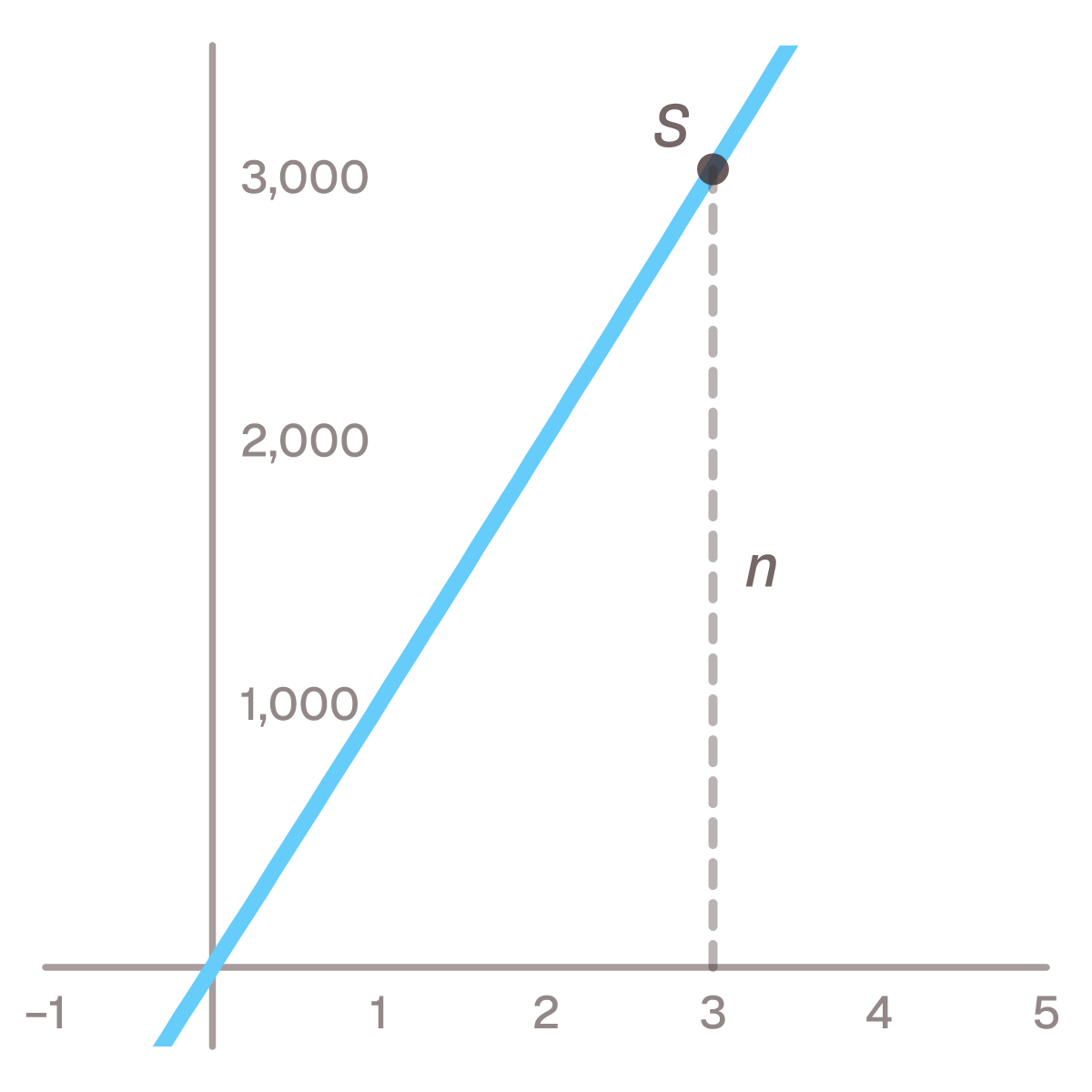
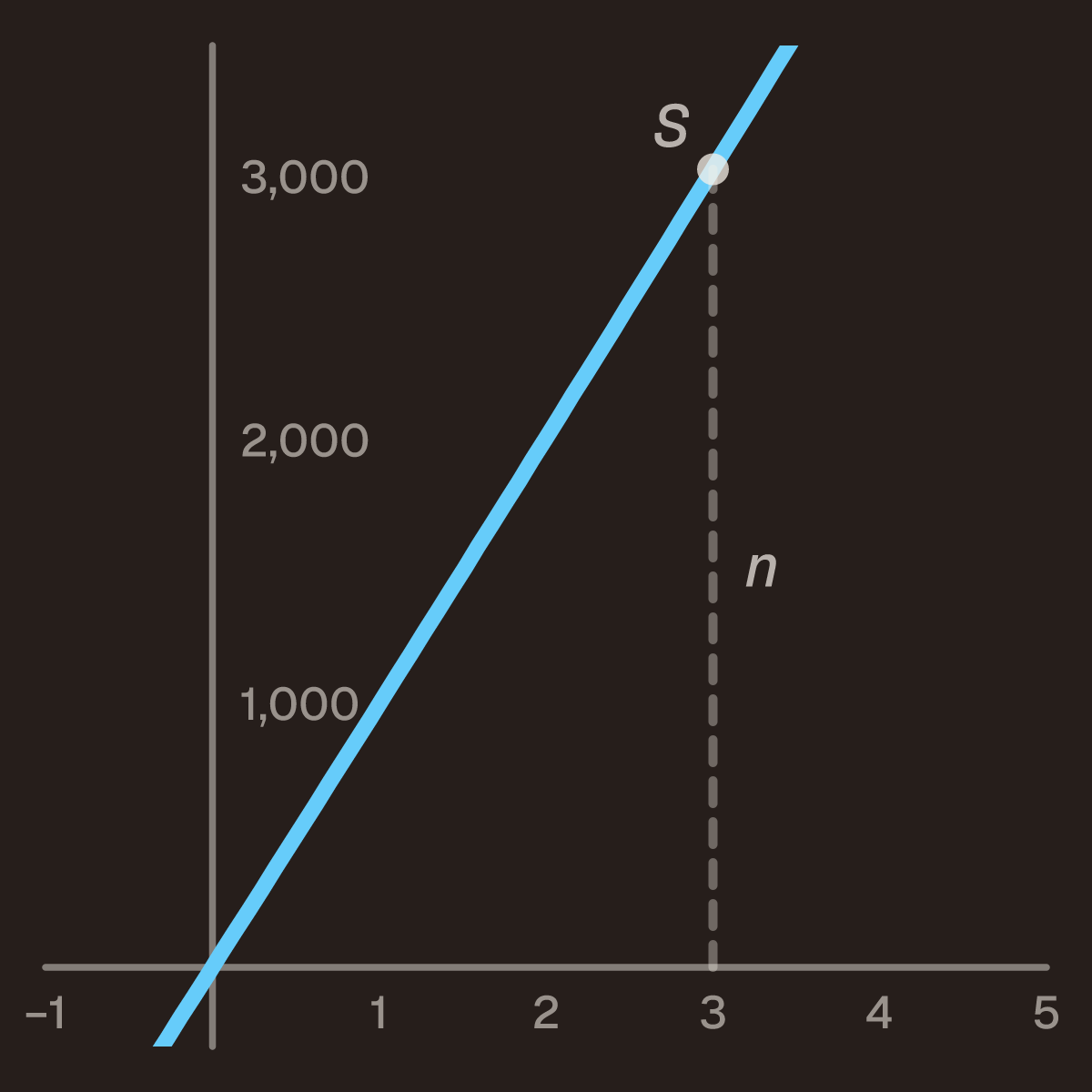
“I want $300,000 in ten years. How much do I have to put in each month?” Dividing 300,000 by 120 months
gives $2,500, but that answer ignores the fact that the first deposits have almost ten years to grow.
The formula counts them:
- a = S · r / ((1 + r)ⁿ − 1)
where a is the monthly deposit, S the amount you want to reach, r the return per month and
n the number of months. Deposits are assumed to land at the end of each month, so the last one does
not grow at all.
Money set aside this way for a known future cost is called a sinking fund.
It is the same line as a geometric series with a ratio of
1 + r, turned to face the question actually being asked. The denominator is r rather than r − 1
only because the subtraction has already happened: the ratio of a saving plan is one plus its rate.
The monthly return from an annual one
n counts months, so r has to be the return per month. If 6% a year is an effective annual return,
the way a fund’s performance over a year is stated, the monthly return is not 0.5% but
- r = 1.06^(1/12) − 1 ≈ 0.4868%
because each month’s return grows in its turn. If 6% is instead a nominal rate that the bank adds every
month, 0.5% is right. The difference looks small and is not: at 0.5% a month the example below comes out
at $1,831 a month, and at 0.4868% at $1,846. Fifteen dollars a
month for ten years is $1,800, and that is on a modest plan. The
savings goal calculator does the conversion for you — there you type in
the annual rate.
Worked examples
Three months, which you can check by hand. $1,000 a month for three months at 1% a month. The
first deposit grows twice and becomes $1,020.10, the second once and becomes $1,010, the third not at
all. The total is $3,030.10, and the formula says 1,000 = 3,030.10 · 0.01 / (1.01³ − 1) — the same
numbers from the other end.
$300,000 in ten years. Assuming a 6% effective annual return, so r ≈ 0.0048676 and n = 120:
- a = 300,000 · 0.0048676 / (1.0048676¹²⁰ − 1) ≈ $1,846 a month
You pay in $221,575 of your own money; the rest, just under $80,000, is return. Compare that with the
$2,500 a month a plain division would have told you.
The other way round. $2,000 a month for twenty years on the same assumption comes to
2,000 · (1.0048676²⁴⁰ − 1) / 0.0048676 ≈ $906,877, of which $480,000 is money paid in.
The other three questions
The card at the top of the page solves for whichever of the four quantities you are missing:
| What you do not know |
How it is found |
| The monthly deposit |
a = S · r / ((1 + r)ⁿ − 1) |
| The amount reached |
S = a · ((1 + r)ⁿ − 1) / r |
| The number of months |
n = ln(1 + S · r / a) / ln(1 + r) |
| The return |
cannot be rearranged for — it is searched for |
The number of months needs a logarithm, because n sits in an exponent. At $2,000 a month and 6%
a year, $300,000 takes about 113 months — nine years and five months.
The return cannot be solved for. Written out, the formula is an equation of degree n − 1 in r,
and n is whatever you typed — a card needs one expression that works for every n, and no such
expression exists. So the card searches for the rate instead, narrowing in until both sides meet.
Common mistakes
- Dividing an effective annual return by twelve. 6% a year, effective, is 0.4868% a month, not
0.5%. It is the
change factor that gets the twelfth root, not the percentage that gets
divided.
- Counting
n in years. n is the number of deposits. Ten years is 120.
- Forgetting the money you already have. This formula starts from zero. If you already hold capital,
let it grow on its own and take the result off the target first — that is what the
savings goal calculator does.
- Assuming the target always exceeds what you pay in. It does, but only while the return is
positive. If the target is below
a · n there is no rate that reaches it, and the card says so
instead of producing a negative number.
- Using a return before tax and fees. The formula works on the return you feed it. What is left
after tax and fund charges is a separate question, and it decides which
r you should type.
Questions people ask
What if the return is 0?
Then the formula cannot be used — it divides by r. But the question becomes trivial too: with no return
at all the monthly deposit is the target divided by the number of months, 300,000 / 120 = $2,500. The
card on this page says so rather than calculating.
Does the formula count money I have already saved?
No. It starts from zero. If you already hold capital, let it grow on its own — P · (1 + r)ⁿ, which is
compound interest — and subtract the result from the target before
using the formula. The savings goal calculator takes it as its own field.
Does it matter whether I pay in at the start or the end of the month?
Yes, but less than you would think. The formula here assumes the end of the month. Paying in at the start
gives every deposit one more month to grow, and the whole total comes out (1 + r) times larger — at
0.4868% a month, about half a per cent more. On $300,000 that is a little over $1,400.