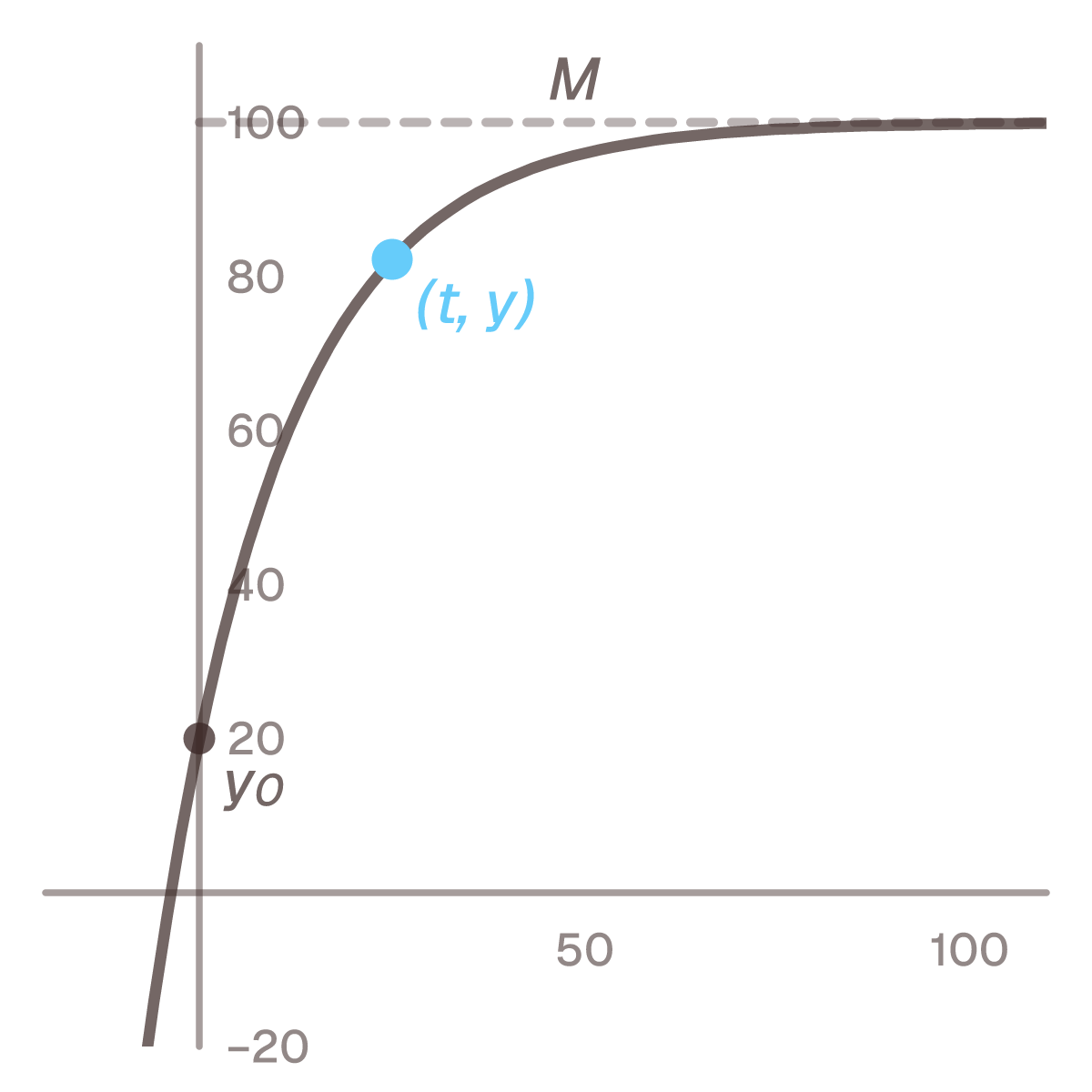
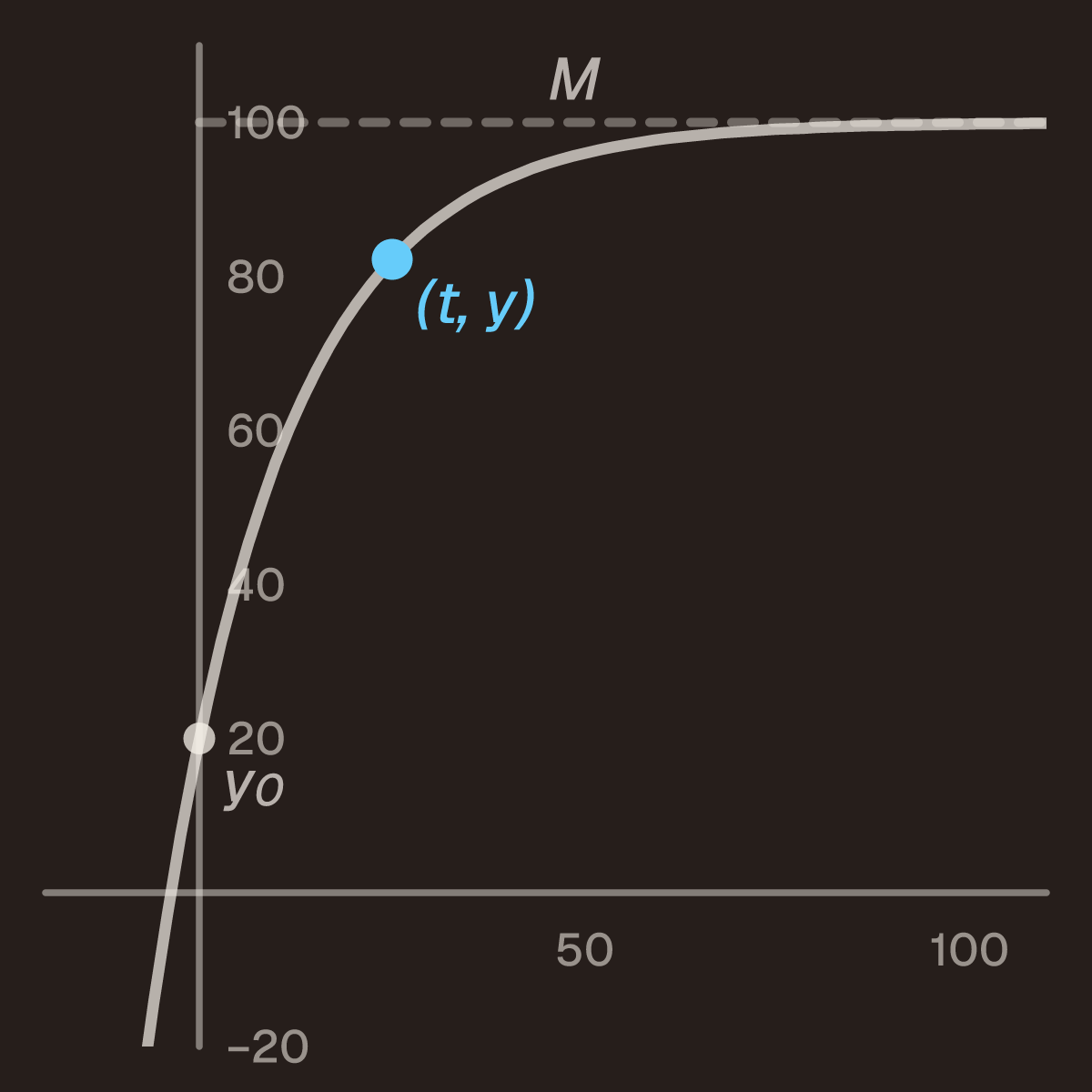
y = M − (M − y₀) · e^(−kt)
Holds when k > 0.
- y is the amount at time t.
- M is the limit the amount closes in on.
- y₀ is the amount at the start.
- k is the rate, per unit of t.
The way to read it is through the gap to the limit. Moving M to the other side gives
- M − y = (M − y₀) · e^(−kt)
so the gap M − y starts at M − y₀ and shrinks by the same factor in every equal stretch of time, like
exponential decay. The amount is what is left when the gap is taken away from M.
The start can be on either side of the limit. If y₀ is below M the amount rises towards M, and if y₀ is
above M it falls towards M. The formula is the same.
The curve in numbers
M = 100, y₀ = 20 and k = 0.06:
| t |
y |
Gap M − y |
| 0 |
20 |
80 |
| 10 |
56.1 |
43.9 |
| 20 |
75.9 |
24.1 |
| 30 |
86.8 |
13.2 |
| 40 |
92.7 |
7.3 |
| 60 |
97.8 |
2.2 |
The gap halves every ln 2 / k, here about 11.6 units of time, wherever the curve is. Each stretch of 10 adds
less than the one before it, which is the difference from
exponential growth.
Worked examples
The amount after a given time. With M = 100, y₀ = 20 and k = 0.06, after t = 25:
y = 100 − 80 · e^(−0.06 · 25) = 100 − 80 · e^(−1.5) = 100 − 80 · 0.2231 ≈ 82.15.
The time to reach a value. When does the amount reach 90? Solve for t:
- M − y = (M − y₀) · e^(−kt)
- e^(−kt) = (M − y) / (M − y₀)
- t = −ln((M − y) / (M − y₀)) / k
so t = −ln(10 / 80) / 0.06 = ln 8 / 0.06 ≈ 34.7.
A start above the limit. As a model, a cup of coffee at 90 °C in a room held at 20 °C cools towards 20 °C
in this form, with k = 0.1 per minute. After 15 minutes
y = 20 + 70 · e^(−0.1 · 15) = 20 + 70 · 0.2231 ≈ 35.6 °C.
It reaches 30 °C when t = −ln((20 − 30) / (20 − 90)) / 0.1 = ln 7 / 0.1 ≈ 19.5 minutes. Both gaps are
negative here, and their quotient is positive, so the logarithm exists.
The mistake is to take the limit out of the bracket. M − y₀·e^(−kt) looks like the same curve, but at
t = 0 it gives M − y₀ = 80 instead of the starting amount 20. At t = 25 it gives 95.5 instead of 82.15. In
the correct formula the factor e^(−kt) multiplies the starting gap M − y₀, and at t = 0 it equals 1, so
M − (M − y₀) = y₀.
Common mistakes
- Multiplying y₀ by the exponential. The factor belongs to M − y₀, not to y₀.
- Subtracting from y₀ instead of M. The curve starts at y₀ and ends at M, not the other way round.
- A negative rate. With k < 0 the factor e^(−kt) grows, so the amount runs away from M. Bounded growth
needs k > 0.
- Asking for a value on the wrong side. The amount lies between y₀ and M at every time after the start.
A value above both, or equal to M, is never reached.
- Mixing units of time. If k is per minute, t is in minutes.
The differential equation behind it
The formula solves y′ = k(M − y): the rate of change is proportional to the gap to the limit. Differentiating
gives y′ = k(M − y₀) · e^(−kt), which is k times M − y. The equation y′ = ky, with the amount itself on the
right, is on the
differential equation y′ = ky
page.
Where to go next
Logistic growth levels off at a limit too,
but starts slowly. The exponential equation
page shows how the logarithm brings t down, and half-life
is the same shrinking gap with the limit at 0.
Common questions
Is it the same as exponential decay?
It is exponential decay of the gap M − y. With M = 0 the formula becomes y = y₀ · e^(−kt), which is
ordinary exponential decay of the amount itself.
How long until the amount is within 1% of the limit?
When the gap is 1% of the starting gap, e^(−kt) = 0.01, so t = ln 100 / k ≈ 4.6 / k. For k = 0.06 that is
about 77.
Why does the amount never reach M?
The gap is multiplied by e^(−kt), which is positive for every t, so the gap never becomes exactly 0. In
practice the difference soon becomes too small to measure.