What the formula says
A differential equation is an equation whose unknown is a function. This one says that y changes at a
rate proportional to y itself: the more there is, the faster it grows. k is the constant of
proportionality. When k > 0 it is growth, when k < 0 decay.
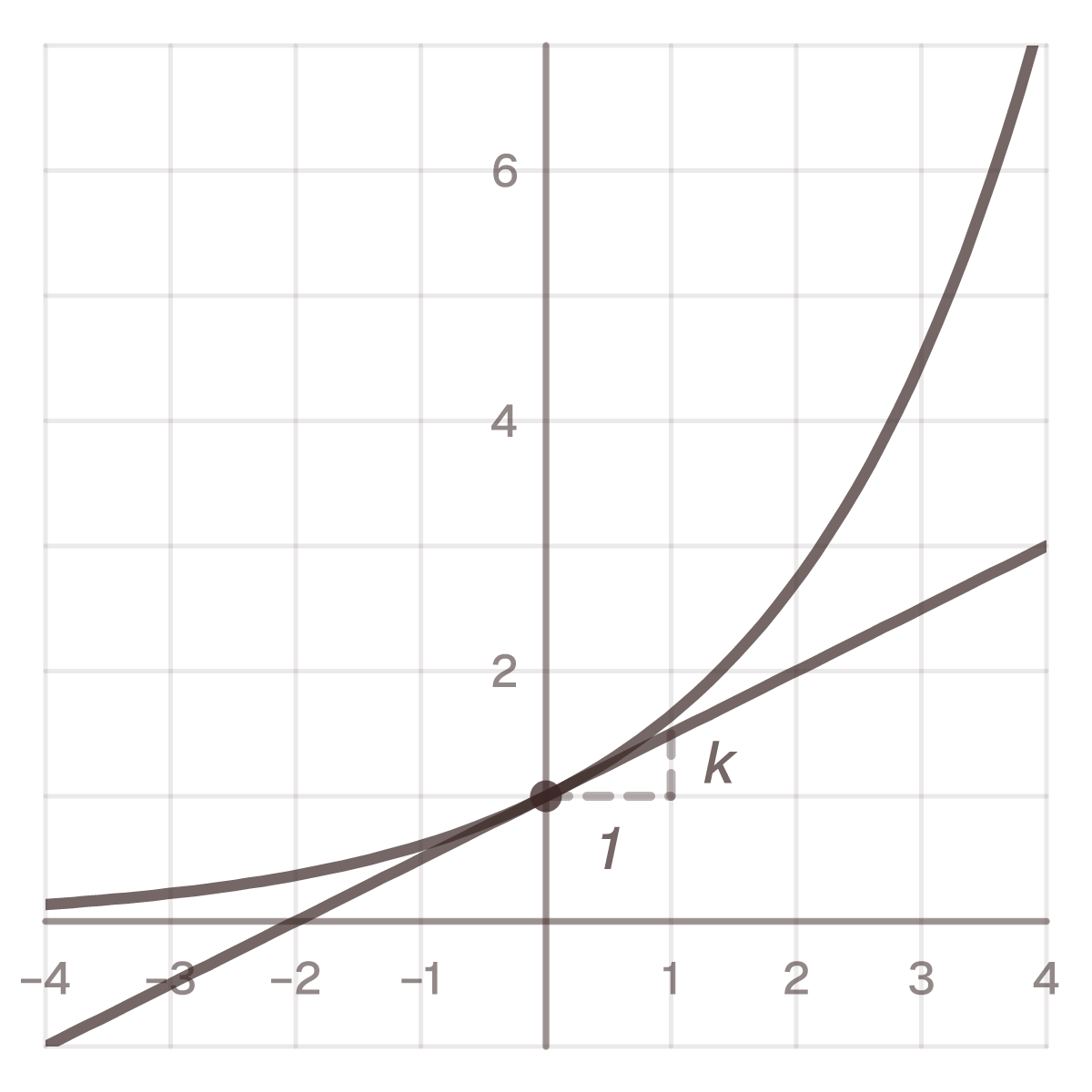
Every solution has the form y = C·eᵏˣ, where C is any constant — the value of y at x = 0. The equation is the definition of exponential change, and the solution is why e appears in it: eˣ is its own derivative.
Example. A bacterial culture grows so that y′ = 0.1y, with y in thousands and x in hours. At the start there are 200 thousand. Then C = 200, and y = 200e^(0.1x). After 5 hours: y(5) = 200e^(0.5) ≈ 330 thousand.
Verifying a solution
The course question is often not “solve” but “show that y = … is a solution”. Differentiate y, put y′ and y into the equation, and see whether the two sides agree.
- y = 5e^(0.3x). Then y′ = 1.5e^(0.3x), and 0.3y = 0.3 · 5e^(0.3x) = 1.5e^(0.3x). The sides agree, so y solves y′ = 0.3y.
- y = e^(2x) + 1. Then y′ = 2e^(2x), but 2y = 2e^(2x) + 2. The sides differ by 2, so y does not solve y′ = 2y. Adding a constant to a solution does not give a new solution; multiplying by one does.
That last point is a common mistake. The constant in y = Ceᵏˣ is a factor, not a term. Writing y = eᵏˣ + C — by analogy with the + C of an antiderivative — gives a function that looks right and does not solve the equation.
A second example: decay
A substance decays so that y′ = −0.2y, with 50 g at x = 0. Then y = 50e^(−0.2x). Half is left when e^(−0.2x) = 1/2, that is x = ln 2 / 0.2 ≈ 3.47. The half-life does not depend on how much there was to start with — that is a property of every solution of y′ = ky.
k and the growth factor are different numbers
| Model | Written as | Growth per unit of x |
|---|---|---|
| y′ = 0.1y | y = Ce^(0.1x) | factor e^(0.1) ≈ 1.105, so 10.5% |
| 10% per unit | y = C · 1.1ˣ | factor 1.1, so k = ln 1.1 ≈ 0.0953 |
A rate k = 0.1 is not 10% growth per unit. The two are linked by eᵏ = the growth factor. The exponential growth page writes the same functions with the growth factor instead.
Common mistakes
- y = eᵏˣ + C. The constant is a factor. Check by differentiating.
- Reading k as a percentage. k = 0.05 means e^(0.05) ≈ 1.051 per unit, not exactly 5%.
- Forgetting the starting value. C is y(0), and it is what an initial condition determines.
- The sign of k for decay. A decreasing quantity has k < 0; y′ = 0.2y with “decay” in the text is a misread.
Common questions
Why are all the solutions of the form Ceᵏˣ?
If y solves the equation, differentiate y·e^(−kx): the product rule gives (y′ − ky)e^(−kx) = 0. A
function with derivative 0 is a constant, so y·e^(−kx) = C and y = Ceᵏˣ. No other solutions exist.
What is the difference from y′ + ay = f(x)?
y′ = ky is the special case with nothing on the right-hand side. With a function on the right it becomes
a first-order linear differential equation,
solved with an integrating factor. With 0 on the right, y′ + ay = 0 is this equation with k = −a, and its
solutions are y = Ce^(−ax).