What the formula says
lim_(n→∞) (1 + 1/n)ⁿ = e
A limit is the value an expression closes in on as its variable goes towards something. lim reads “the
limit of”, and what is written underneath, here n → ∞, says where the variable goes. The formula is a
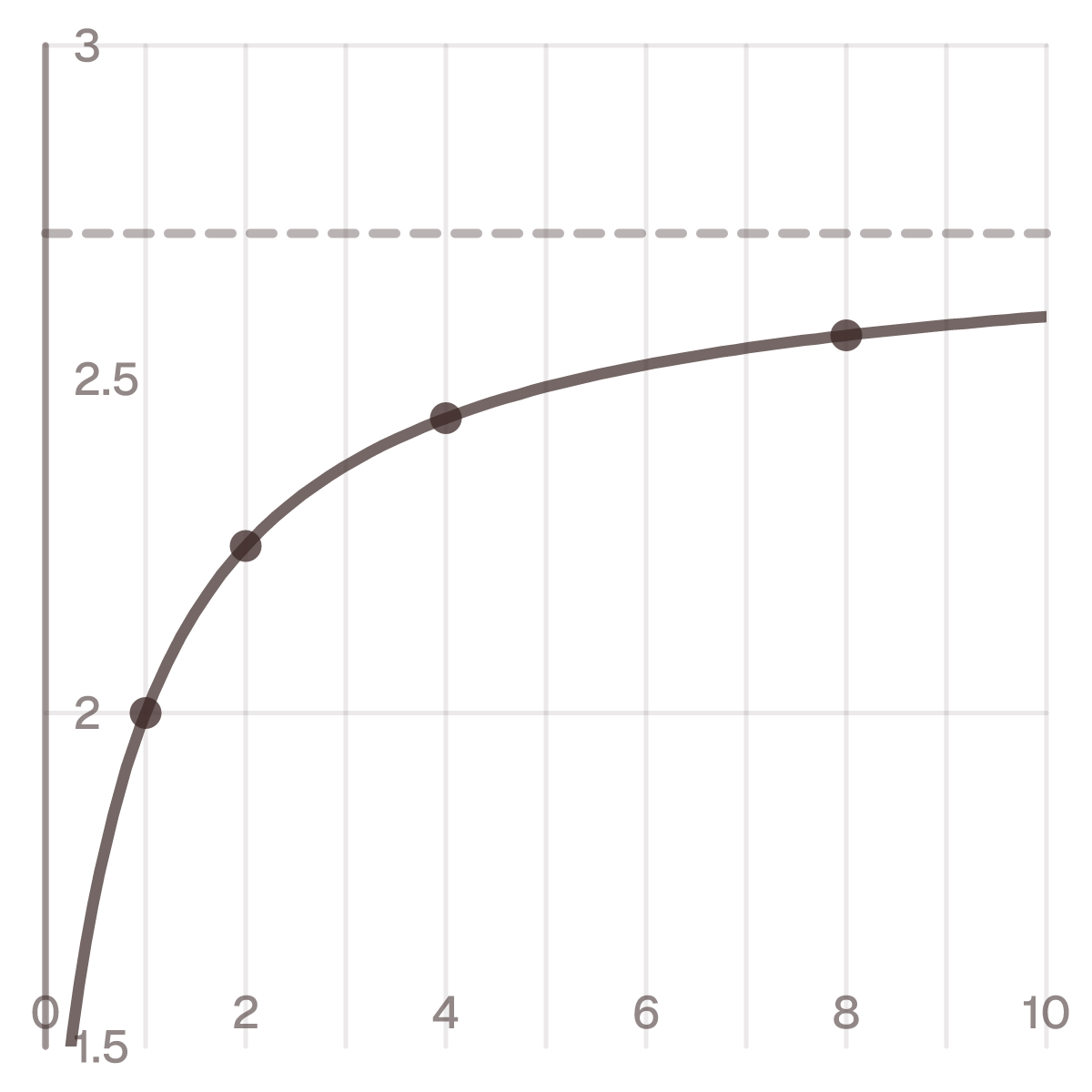
theorem and the example the number e is usually introduced with: as n grows without bound,
(1 + 1/n)ⁿ closes in on e = 2.71828…
The expression never has to equal its limit. (1 + 1/n)ⁿ is less than e for every n, but the gap can be made as small as you like by taking n large enough. That is what the limit means.
Worked examples
A table towards e.
| n | (1 + 1/n)ⁿ |
|---|---|
| 1 | 2 |
| 10 | 2.5937… |
| 100 | 2.7048… |
| 1,000 | 2.7169… |
| 1,000,000 | 2.7182805… |
The values keep growing but never pass e = 2.7182818…
Why it is compound interest. One dollar at 100% interest a year becomes 2 dollars if the interest is added once. Split the year into n periods at 1/n each and it becomes (1 + 1/n)ⁿ. Ever more frequent compounding never gives more than e ≈ 2.72 dollars.
A limit you can work out directly. lim_(x→3) (x² − 9)/(x − 3): putting in x = 3 gives 0/0, but (x² − 9)/(x − 3) = x + 3 for every x except 3, so the limit is 6. The same move gives the definition of the derivative.
Common mistakes
- Putting the value in and getting 0/0. 0/0 means the expression has to be rewritten before the limit can be seen. It does not mean the limit is missing or zero.
- Taking 1^∞ to be 1. 1 + 1/n goes to 1, but the exponent grows at the same time, and together they go to e. You cannot take the limit of the base and the exponent separately.
- Confusing the limit with the value. An expression can have a limit at a point where it is not defined, like (x² − 9)/(x − 3) at x = 3.
Common questions
What does n → ∞ mean?
That n grows without bound. ∞ is not a number you put in, but a way of saying that n becomes larger than
any number you could pick.
Can a limit fail to exist?
Yes. 1/x as x goes to 0 becomes as large as you like from the right and as negative as you like from the
left, so there is no limit.
Why does e matter so much?
Because eˣ is the function that is its own derivative, see the
derivative of e to the x. That makes it the basis of growth, decay and
continuous interest.