The rule in words
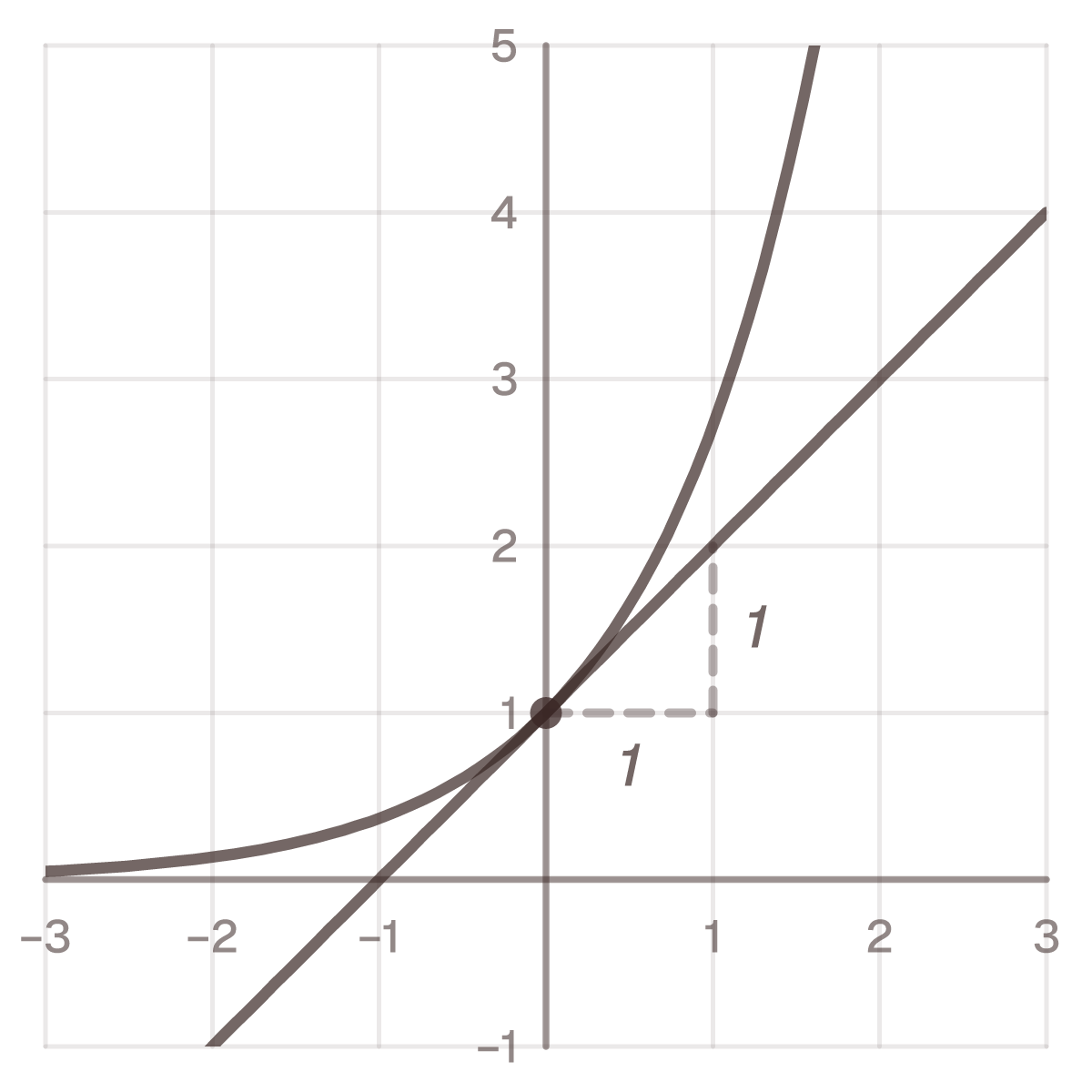
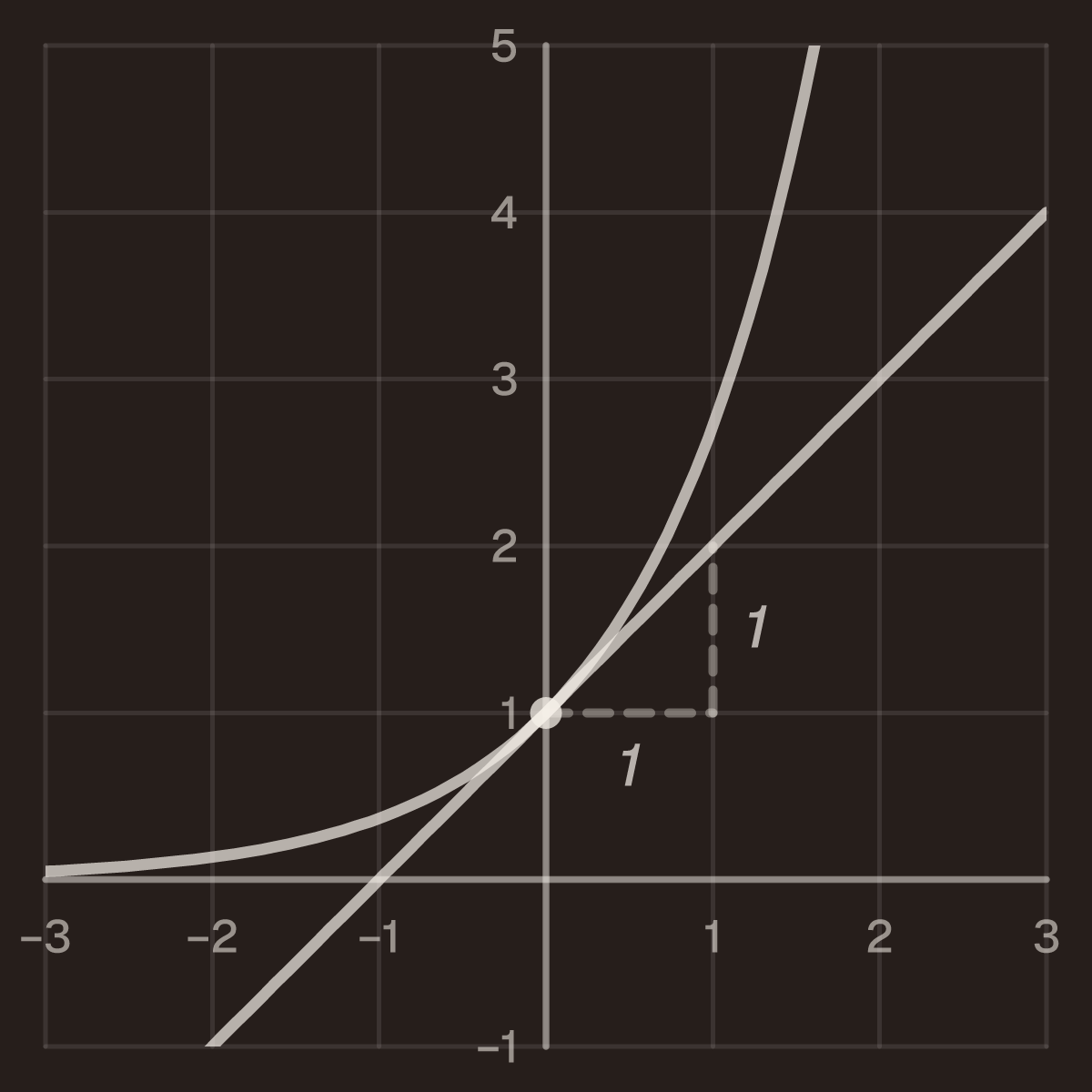
The derivative of eˣ is eˣ. Nothing comes down, nothing is subtracted, nothing changes. The function and its own rate of change are the same function, at every point.
That means something concrete: where eˣ has the value 5, the curve also has slope 5. Where it has the value 100, it climbs at 100. The higher the curve has got, the steeper it rises — which is exponential growth, written as a derivative.
Why e in particular
There are infinitely many exponential functions: 2ˣ, 3ˣ, 10ˣ. Every one of them has a derivative proportional to itself, but with a factor in front:
| Function | Derivative | The factor |
|---|---|---|
| 2ˣ | 2ˣ · ln 2 | about 0.693 |
| 3ˣ | 3ˣ · ln 3 | about 1.099 |
| 10ˣ | 10ˣ · ln 10 | about 2.303 |
| eˣ | eˣ · ln e | exactly 1 |
The factor grows with the base. At base 2 it is less than one, at base 3 it is more. Somewhere between them is a number where the factor is exactly one — and that number is e, about 2.71828.
So e can be defined as the base where the factor disappears. It is one of several equivalent definitions; another is the limit of (1 + 1/n)ⁿ.
Other bases
To differentiate aˣ for any other base, all you need is the factor:
d/dx aˣ = aˣ · ln a
So the derivative of 2ˣ is 2ˣ · ln 2, and the derivative of 10ˣ is 10ˣ · ln 10. The check is to set a = e: ln e = 1, and eˣ is what is left.
Worked examples
- The derivative of 3eˣ is 3eˣ. The constant comes along, just as in the power rule.
- The derivative of eˣ + x² is eˣ + 2x. A sum differentiates one term at a time.
- The derivative of x · eˣ is eˣ + x · eˣ, by the product rule. It can be written (1 + x)eˣ.
- The derivative of e²ˣ is 2e²ˣ. Here something sits inside the exponent, and the 2 comes out as a factor.
Common mistakes
- Using the power rule. xⁿ and eˣ look alike but are opposites: in the first, x is the base; in the second, x is the exponent. The power rule gives n·xⁿ⁻¹ and does not apply here.
- Thinking eˣ differentiates to x · eˣ⁻¹. That is the power rule applied in the wrong place. The exponent never changes when you differentiate eˣ.
- Forgetting the factor for other bases. The derivative of 2ˣ is not 2ˣ. Only e escapes the factor.
- Confusing eˣ with e. e is a number, and the derivative of a number is zero. eˣ is the function.
Common questions
What is the second derivative of eˣ?
eˣ. And the third, and all the rest. The function can be differentiated any number of times without
changing — the only function that does, apart from the zero function and constant multiples of eˣ.
What is the derivative of e⁻ˣ?
−e⁻ˣ. The minus sign in the exponent comes out as a factor in front. That is why e⁻ˣ decays as fast as
eˣ grows.
Is this connected to ln x?
Closely. eˣ and ln x are inverses of each other, and the
derivative of ln x is 1/x — the one result
the power rule can never produce. That both functions have such unusual derivatives is the same fact
seen from two sides.