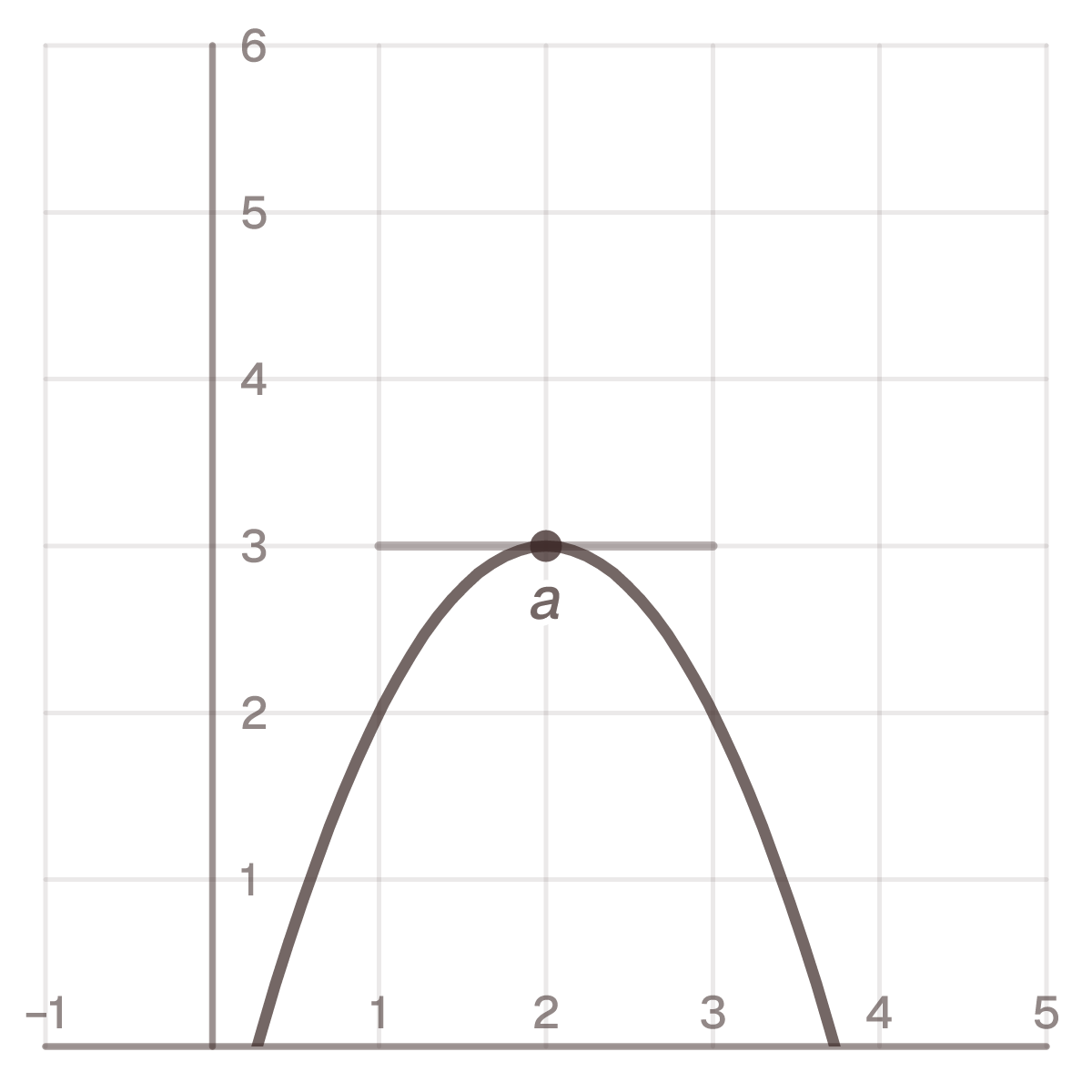
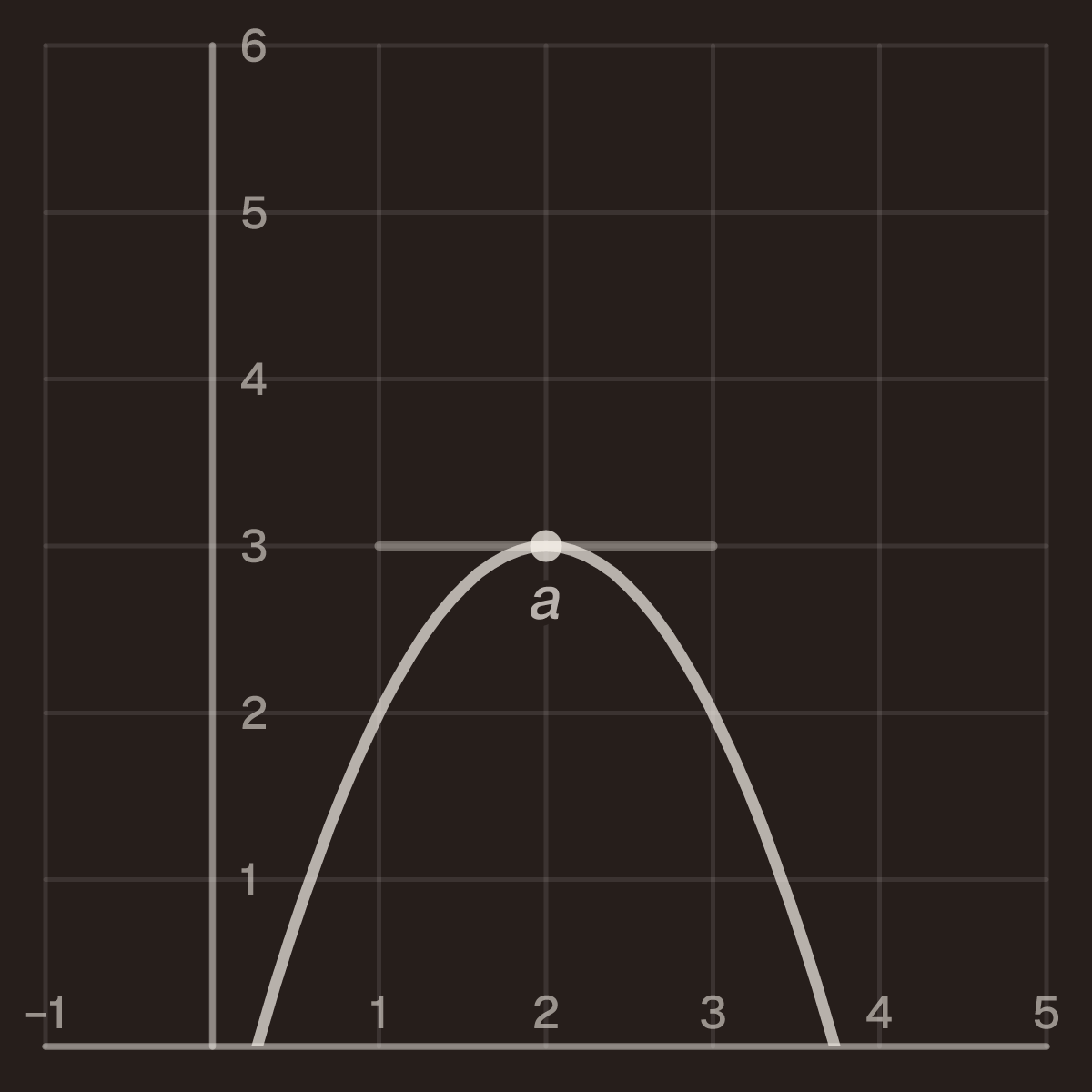
What the formula says
f′(a) = 0
A stationary point is a point x = a where the derivative is zero, that is, where the curve neither rises
nor falls. The formula is a definition. Every maximum and minimum inside an interval where the function is
differentiable is a stationary point, because the curve turns there and has a horizontal tangent. A
corner, such as the bottom of |x|, is an extreme point without being stationary.
The converse does not hold. A stationary point can be a maximum, a minimum or a point of inflection, where the curve levels off for a moment and then carries on the same way. Which it is, you decide with a sign table for f′, or with the second derivative.
Worked examples
A parabola. f(x) = x² − 4x.
- The derivative: f′(x) = 2x − 4.
- f′(x) = 0 gives 2x − 4 = 0, so x = 2.
- The second derivative is f″(x) = 2, positive, so the curve bends upwards and the point is a minimum.
- The value: f(2) = 4 − 8 = −4. The minimum point is (2, −4).
A point of inflection. f(x) = x³ has f′(x) = 3x², which is zero at x = 0. But f′ is positive on both sides: the curve rises before 0 and rises after. The point (0, 0) is stationary but neither a maximum nor a minimum.
Sine. The derivative cos x is zero at π/2 and 3π/2. At π/2, sin x = 1, a maximum. At 3π/2 it is −1, a minimum.
Common mistakes
- Solving f(x) = 0. That gives the zeros, where the curve crosses the x-axis. The extreme points come from f′(x) = 0.
- Calling every stationary point an extremum. x³ at 0 shows that f′ = 0 is not enough. Check the sign of f′ on both sides.
- Forgetting the endpoints. On a closed interval the largest or smallest value can sit at an endpoint, where the derivative need not be zero.
Common questions
How do you find the largest and smallest value of a function?
Solve f′(x) = 0 to find the stationary points. Work out the function’s value at each of them and at the
interval’s endpoints. The largest of those values is the largest value, the smallest is the smallest.
What is a stationary point of inflection?
A stationary point where the curve does not turn. The derivative is zero at the point but has the same
sign on both sides, so the graph levels off and then carries on the same way. x³ at the origin is the
standard example.
What is the difference between a local and a global maximum?
A local maximum is highest in its immediate surroundings. A global maximum is the highest of all the
values the function takes. A function can have several local maxima but only one largest value, and it
can sit at an endpoint rather than at a stationary point.
The graphing calculator marks the maxima and minima of what you plot, such as the minimum of x² − 4x.