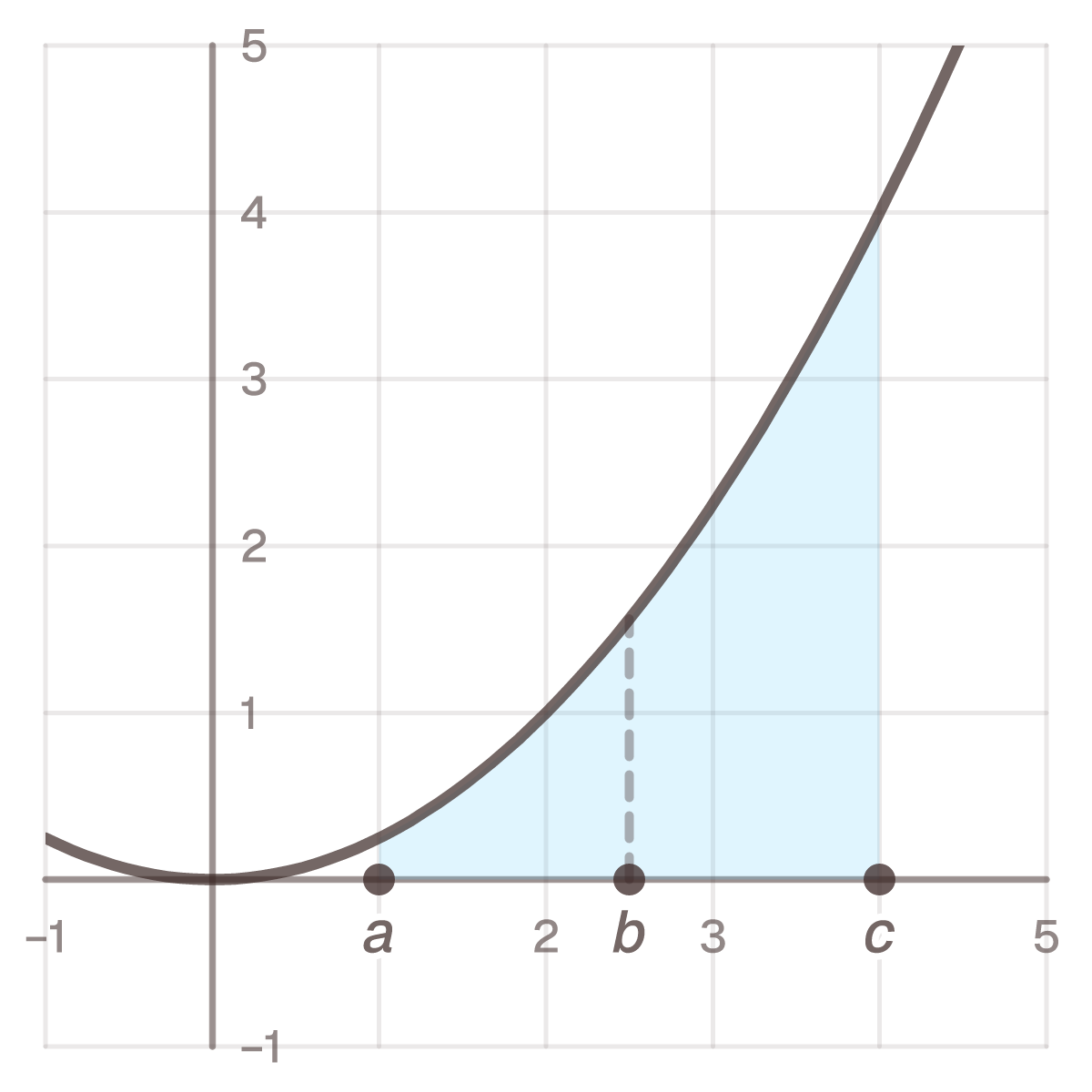
The rule
∫ₐᶜ f(x) dx = ∫ₐᵇ f(x) dx + ∫ᵇᶜ f(x) dx
Holds when f is integrable on the whole interval. The point b can be anywhere in [a, c], and it also works outside, as long as f is defined there.
Worked examples
Cutting in two. ∫₀³ x² dx = ∫₀¹ x² dx + ∫₁³ x² dx = 1/3 + 26/3 = 9.
A function with a kink. f(x) = |x − 1| is 1 − x left of 1 and x − 1 right of it. Cut at b = 1:
∫₀³ |x − 1| dx = ∫₀¹ (1 − x) dx + ∫₁³ (x − 1) dx = 1/2 + 2 = 5/2
A point outside. With b = 4: ∫₀⁴ x² dx + ∫₄³ x² dx = 64/3 − 37/3 = 9. The second integral is negative because its limits are reversed, see swapping the limits.
Where it is used
To integrate a function defined in pieces, and to find an area where the curve crosses the x-axis: split at the zero and take each part with its own sign. See the area under a curve.
Common mistakes
- Integrating straight through a kink or a jump with one formula for the whole interval.
- Forgetting the common point. The first piece ends at b and the second starts at b.
Common questions
Why does it hold?
With an antiderivative F: (F(b) − F(a)) + (F(c) − F(b)) = F(c) − F(a). The F(b) cancels.