What the formula says
f̄ = 1/(b − a) · ∫ₐᵇ f(x) dx
f̄ is the average value of the function f on the interval [a, b], also called its mean value. It
is a definition, and it works like the mean of a list:
the sum divided by how many there are. Here the sum is the integral and how many is the width of the
interval, b − a.
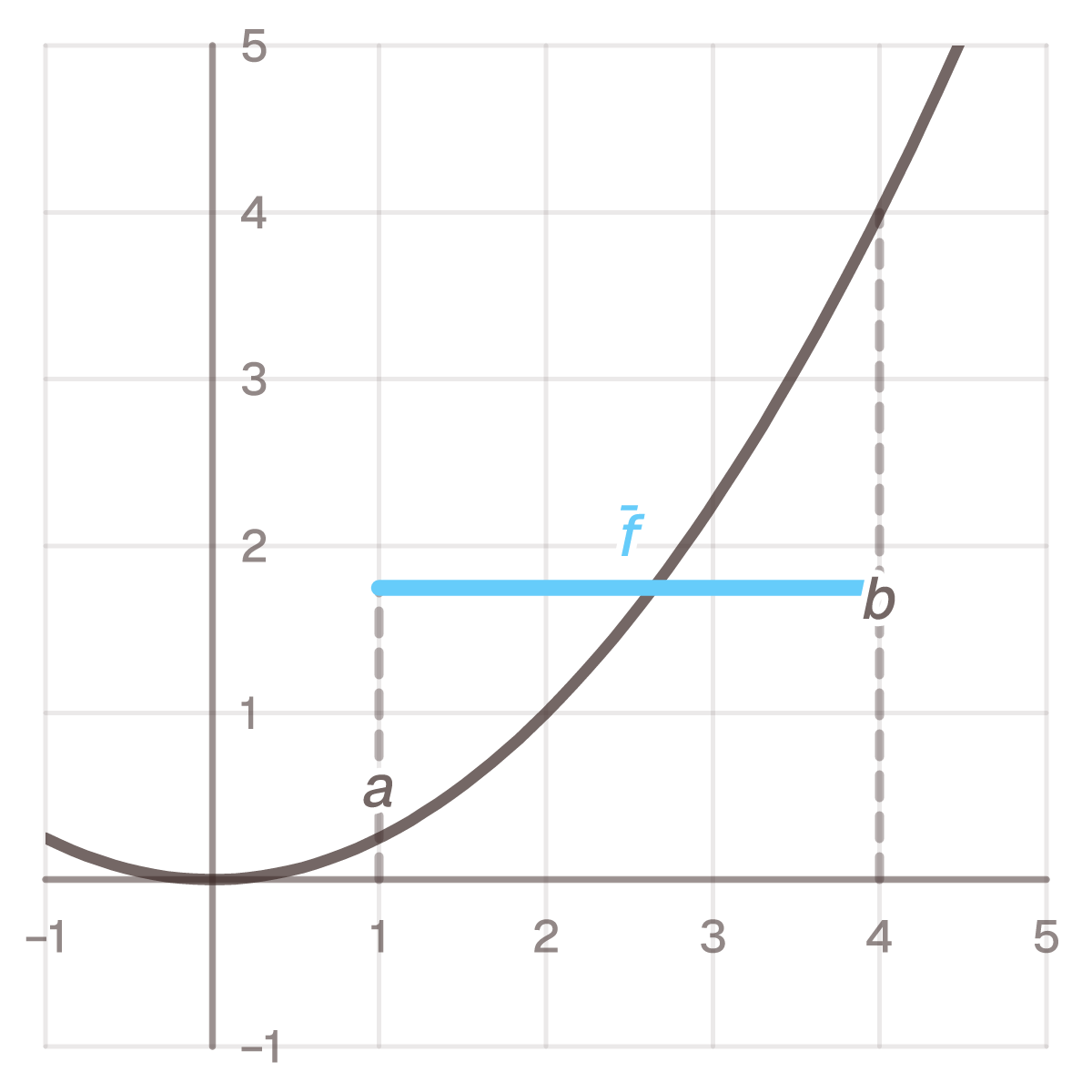
The picture is a rectangle. The rectangle on [a, b] with height f̄ has area f̄ · (b − a), the same as the area under the curve.
Worked example
f(x) = x²/4 on [1, 4].
- The integral: ∫₁⁴ x²/4 dx = [x³/12]₁⁴ = (64 − 1)/12 = 5.25.
- The width: b − a = 4 − 1 = 3.
- The average: f̄ = 5.25 / 3 = 1.75.
A check: f runs from f(1) = 0.25 to f(4) = 4, and 1.75 lies between them.
Three numbers called an average
It is easy to work out the wrong average, and all three give plausible numbers. For f(x) = x²/4 on [1, 4]:
| What is worked out | Working | Answer |
|---|---|---|
| The function’s average value | 1/3 · ∫₁⁴ x²/4 dx | 1.75 |
| The average of the end values | (f(1) + f(4))/2 = (0.25 + 4)/2 | 2.125 — wrong |
| The integral, not divided | ∫₁⁴ x²/4 dx | 5.25 — an area, not a height |
The average of the end values ignores everything between them. For a straight line it agrees, but not in general.
The average rate of change, (f(b) − f(a))/(b − a), is a fourth number: the average of the derivative f′, not of f. Here it is (4 − 0.25)/3 = 1.25.
A second example: sine over one arch
f(x) = sin x on [0, π]:
f̄ = 1/π · ∫₀^π sin x dx = 1/π · [−cos x]₀^π = 1/π · 2 = 2/π ≈ 0.637
The peak is 1 and the ends are 0, but the average is not ½: the curve stays near its peak for much of the way. Over a whole turn, [0, 2π], the average is 0, because the negative half cancels the positive.
The mean value theorem for integrals
If f is continuous on [a, b], there is at least one c in the interval where f(c) = f̄. The curve takes its average value somewhere. In the example above, c²/4 = 1.75 gives c = √7 ≈ 2.65, which lies in [1, 4].
Common mistakes
- Not dividing. The integral is an area. The average is a height.
- The average of the end values. (f(a) + f(b))/2 agrees for a straight line, but not in general.
- The wrong width. It is b − a, not b, unless a is 0.
- Mixing it up with the rate of change. (f(b) − f(a))/(b − a) is the average of f′.
Common questions
What is the average value of a function used for?
For anything that varies over time or distance and is to be summed up in one number: the average
power when the power varies, the average speed when the speed is given as a function, the average
temperature over a day.
Can the average value be negative?
Yes, when the integral is negative, that is, when the area below the x-axis is larger than the area
above it. Parts below the axis count as negative, exactly as in the integral.
How do I find the average when the integral is hard?
The integral calculator gives the integral, exactly when a rule applies and
as an approximation otherwise. Then divide by b − a.