What the formula says
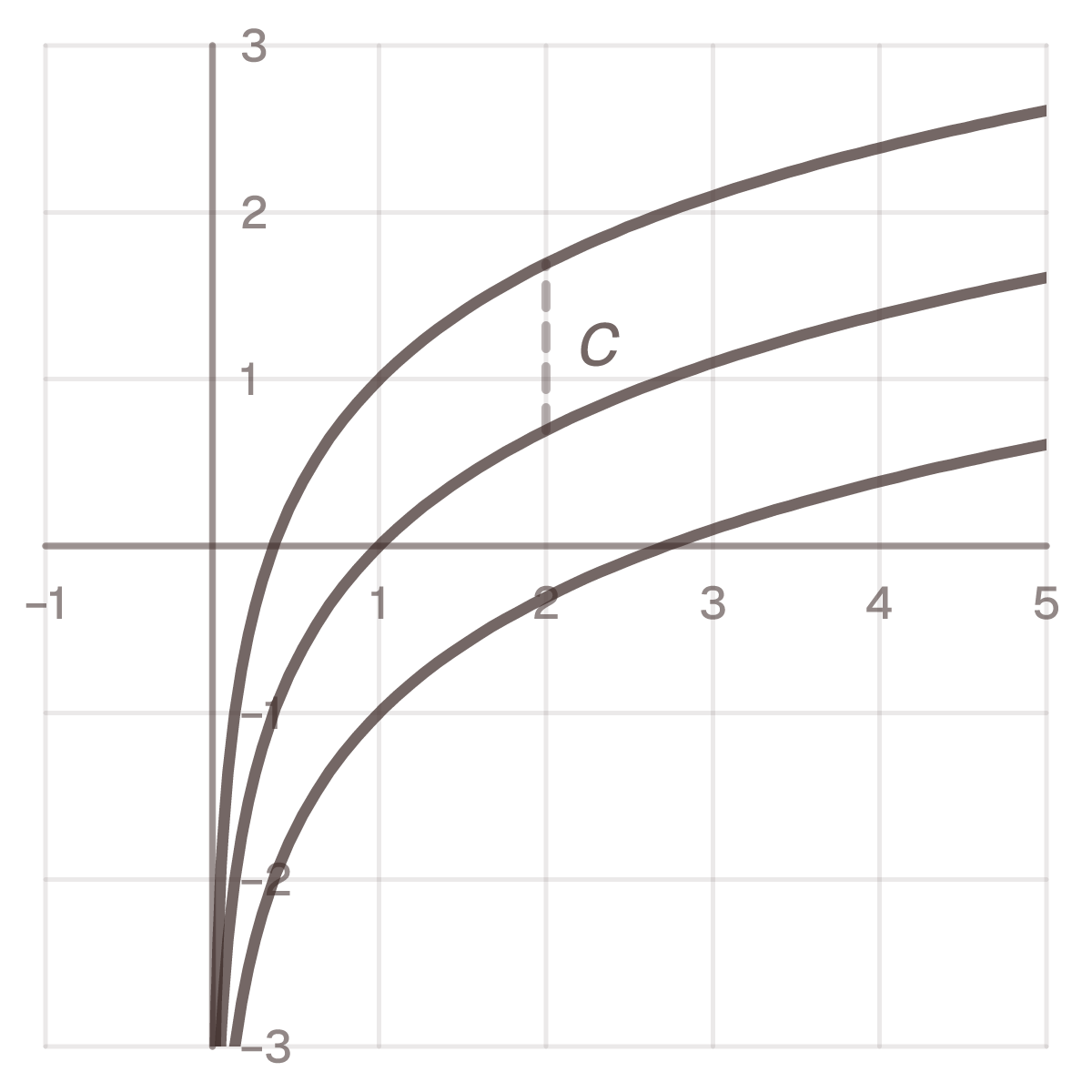
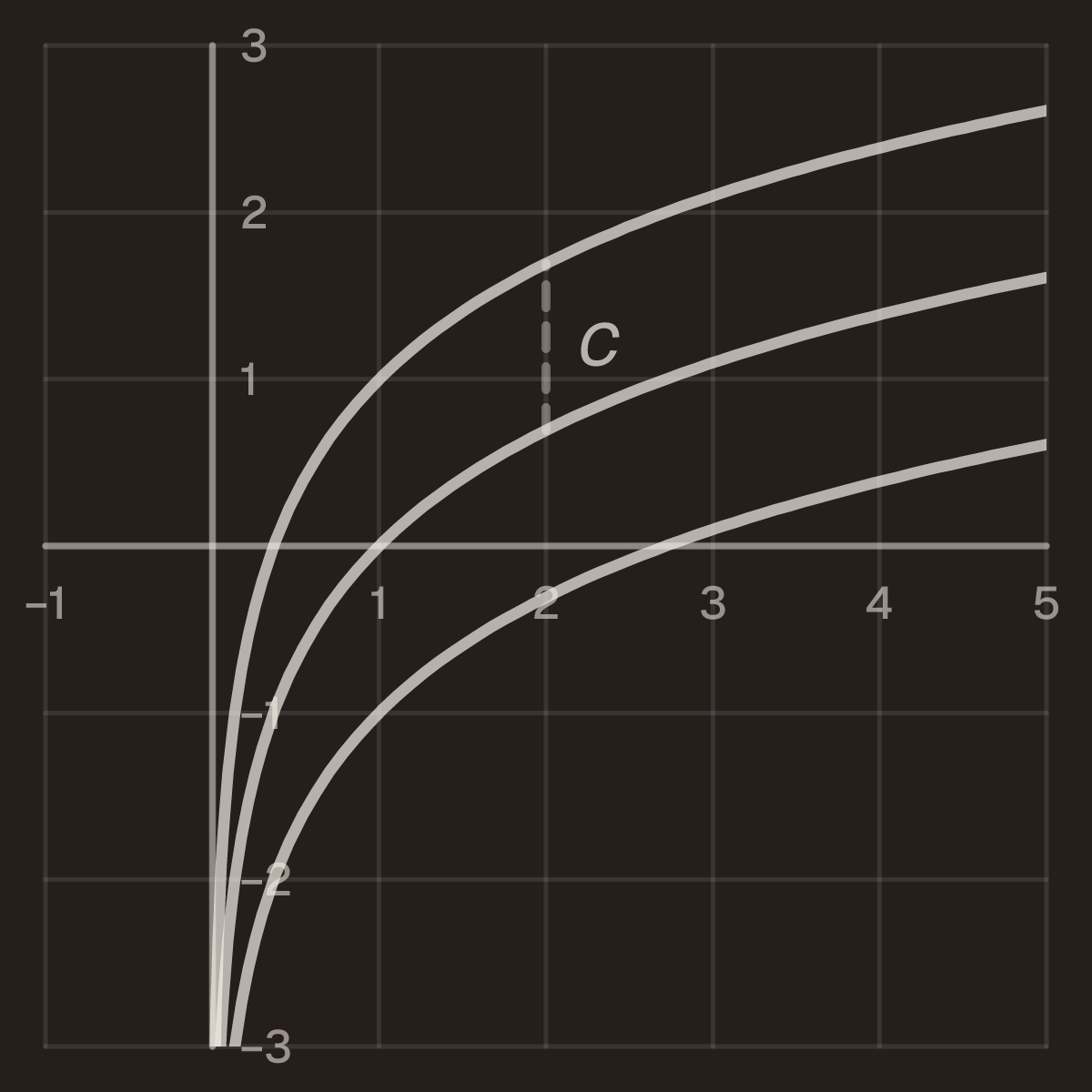
∫ 1/x dx = ln|x| + C, x ≠ 0
An antiderivative of 1/x is ln|x|, the natural logarithm of the absolute value of x, and C is the
constant of integration. The rule is a theorem: it is the derivative of
ln x read backwards, with bars added so that it
covers negative x too.
Example. ∫₁^e 1/x dx = ln e − ln 1 = 1 − 0 = 1.
Why the power rule stops here
1/x is x⁻¹, and the power rule for antiderivatives says: add one to the exponent and divide by the new exponent. Here that gives x⁰/0 — division by zero. No power of x has the derivative 1/x. The logarithm is the function that fills the gap.
Why the absolute value
1/x is defined for negative x, but ln x is not. ln|x| is: for x > 0 it is ln x, and for x < 0 it is ln(−x), whose derivative by the chain rule is (−1)/(−x) = 1/x. So ln|x| is an antiderivative on both sides of 0, and ln x only on one.
A second example, left of 0. The integral of 1/x from −3 to −1 is ln|−1| − ln|−3| = 0 − ln 3 = −ln 3 ≈ −1.10. The answer is negative, as it should be — 1/x is negative on the whole interval. Without the bars the same calculation reads ln(−1) − ln(−3), which has no value at all.
Never across 0
The integral of 1/x from −1 to 1 is not ln 1 − ln 1 = 0. 1/x has no value at 0 and is unbounded on both sides of it, so the integral does not exist. ln|x| + C is an antiderivative on (−∞, 0) and on (0, ∞) separately, and a definite integral can only use it inside one of them.
A few more
| ∫ | antiderivative |
|---|---|
| 1/x | ln|x| + C |
| 5/x | 5 ln|x| + C |
| 1/(2x + 1) | ln|2x + 1|/2 + C |
| x⁻² | −1/x + C (the power rule works here) |
Common mistakes
- Using the power rule. x⁰/0 means nothing. 1/x has a rule of its own.
- Dropping the bars. ln x + C is right for positive x only.
- Integrating across 0. The integral does not exist, however the antiderivative is written.
- Writing 1/x² as ln(x²). 1/x² is x⁻², and the ordinary power rule applies: −1/x + C.
Common questions
Why is ∫ 1/x dx not x⁰/0?
The power rule divides by n + 1, which is 0 when n = −1. The rule does not hold there, and the
logarithm takes over.
Is ln x + C wrong?
Not if x is known to be positive — many books write ln x when the problem only concerns x > 0. ln|x| is
the form that is true everywhere 1/x is defined.