What the conditions say
The curves y = f(x) and y = g(x) are tangent at x = a when both conditions hold:
- f(a) = g(a) — the curves pass through the same point.
- f′(a) = g′(a) — they have the same slope there.
They then share a tangent at that point.
That is two equations, and a problem about tangent curves is a system in two unknowns: usually the
point a and a constant in one of the functions.
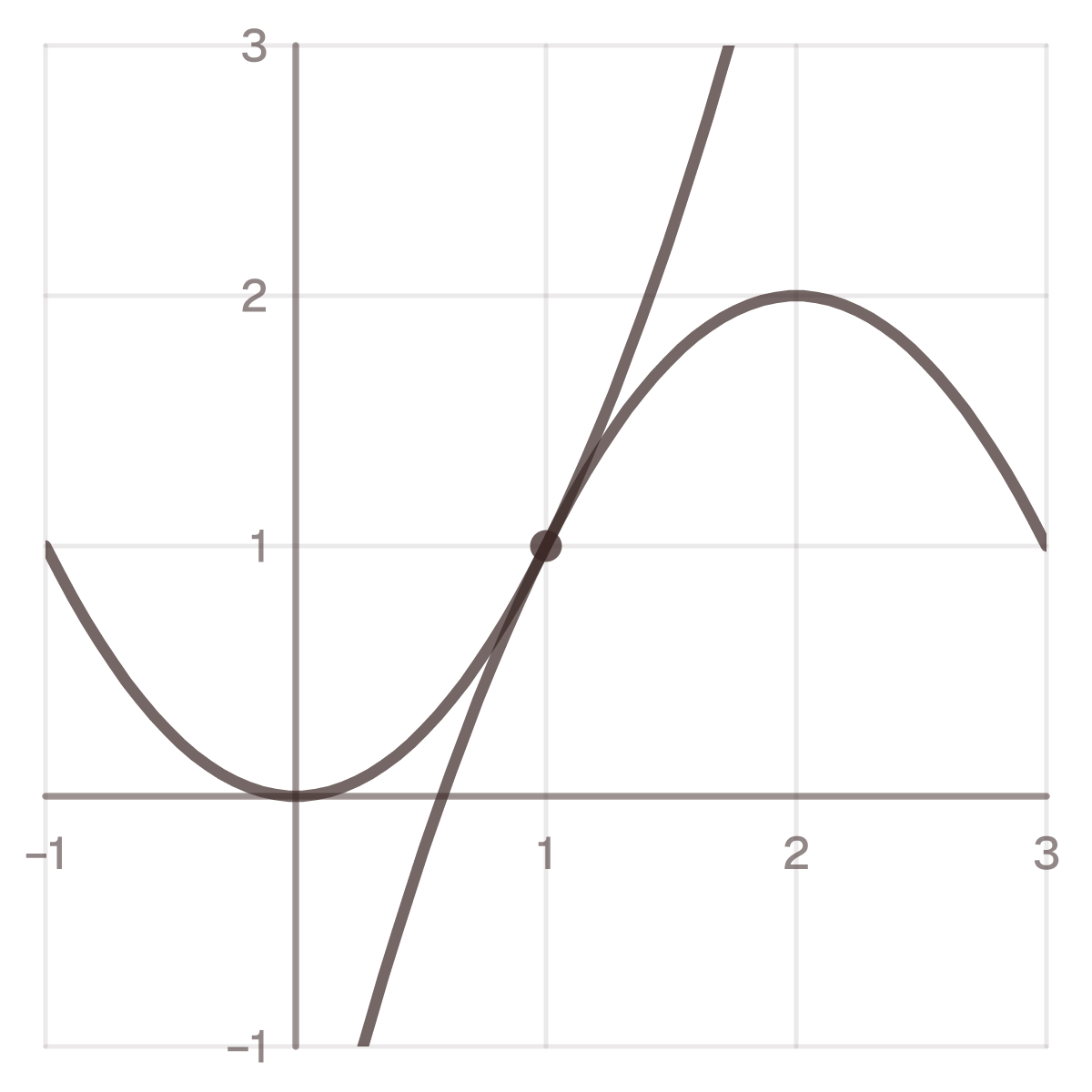
Example. The parabolas f(x) = x² and g(x) = −x² + 4x − 2 at x = 1: f(1) = 1 and g(1) = −1 + 4 − 2 = 1. The derivatives are f′(x) = 2x and g′(x) = −2x + 4, so f′(1) = 2 and g′(1) = 2. Both conditions hold, and the curves touch at the point (1, 1).
Worked example
Find k so that the curve y = x² + k is tangent to the line y = 2x.
- The same slope: the derivative of x² + k is 2x, and the line’s slope is 2. So 2a = 2, a = 1.
- The same value at a = 1: 1² + k = 2 · 1, so k = 1.
The curve y = x² + 1 touches the line y = 2x at the point (1, 2).
Why one condition is not enough
Each condition on its own gives answers that look reasonable:
| Condition | What it gives |
|---|---|
| Only f(a) = g(a) | points where the curves cross, at an angle too |
| Only f′(a) = g′(a) | points where the slopes agree, also where the curves are far apart |
| Both | points where the curves are tangent |
f(x) = x² and g(x) = x² + 3 have the same slope at every point but never meet. f(x) = x² and g(x) = x meet at x = 0 and x = 1 but cross there, with different slopes.
For polynomials there is a shortcut: the curves are tangent at a when f(x) − g(x) has a double root at a. For the parabolas above, f(x) − g(x) = 2x² − 4x + 2 = 2(x − 1)², with the double root 1.
A second example: two unknowns at once
For which k is the line y = kx tangent to the curve y = ln x?
Call the point of tangency a. The conditions are
- ln a = k·a (the same value)
- 1/a = k (the same slope)
Put k = 1/a into the first: ln a = 1, so a = e. Then k = 1/e ≈ 0.368. Here the conditions cannot be solved one at a time, as in the previous example; they have to be solved together.
Tangent curves can cross
Being tangent does not mean staying on one side. y = x³ and the x-axis, y = 0, meet both conditions at x = 0, since 0³ = 0 and 3 · 0² = 0. So the curve is tangent to the axis there, yet it passes from below the axis to above it. The point is a point of inflection.
A horizontal line y = c tangent to a curve touches it at a stationary point, where f′(a) = 0.
Common mistakes
- Only one condition. Crossing points and equal slopes are, each on their own, not tangency.
- Different points in the two conditions. Both have to hold at the same a.
- Differentiating the constant. The derivative of x² + k is 2x, and k is found from the value condition, not from the slope.
Common questions
Is tangency the same as a double root?
For polynomials, yes: f and g are tangent at a exactly when f(x) − g(x) has at least a double root at
a. For other functions, such as ln x, the two conditions are used directly.
Can two curves be tangent at more than one point?
Yes. y = sin x and y = 1 are tangent at x = π/2 + 2πn for every integer n.
How do I check the answer?
Draw both curves in the graphing calculator and zoom in on the point.
Tangent curves seem to merge as you zoom in; crossing curves do not.