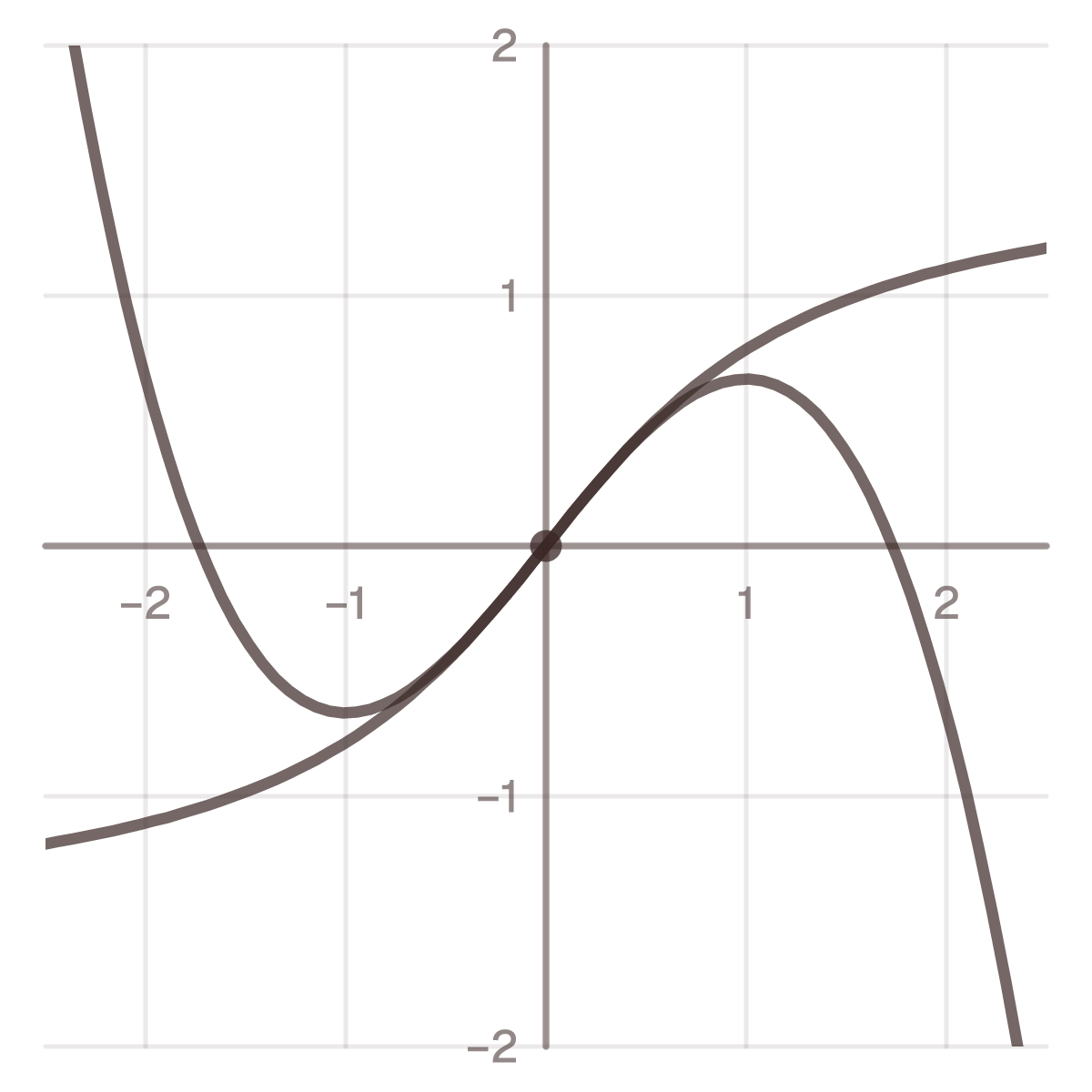
The expansion
- arctan x = Σk=0n (−1)k x2k+1/(2k + 1) + O(x2n+3) as x → 0
The derivative of arctan x is 1/(1 + x²) = 1 − x² + x⁴ − … + (−1)nx2n + O(x2n+2), a geometric series in −x². Integrating it term by term from 0 gives the expansion above, each power divided by its new exponent. Only odd powers appear, so after x2n+1 the next term that is not 0 is x2n+3, and the remainder is O(x2n+3).
Worked example: a limit
limx→0 (arctan x − x)/x³. With n = 1:
arctan x − x = −x³/3 + O(x⁵), so the quotient is −1/3 + O(x²) → −1/3.
A second example: arctan against sine
sin x − arctan x = (x − x³/6) − (x − x³/3) + O(x⁵) = x³/6 + O(x⁵). So limx→0 (sin x − arctan x)/x³ = 1/6: both curves follow the line y = x through the first power, and they part in the third.
Common mistakes
- Factorials. The coefficients are 1/3 and 1/5, not 1/3! and 1/5!. Those belong to sin x.
- Reading it at x = 1. Put in x = 1 and the series is π/4 = 1 − 1/3 + 1/5 − …, but that is a statement about the series converging, which holds for −1 ≤ x ≤ 1 and has to be shown separately. The O-term says nothing about x = 1.
- Degrees. arctan x is an angle in radians.
Related pages
Maclaurin series has the method, and standard limits the limits these expansions are used for.