The definition
- ∇f(x, y) = (∂f/∂x, ∂f/∂y)
∇ is read “nabla” or “del”, and grad f means the same thing. Each component is a partial derivative. For a function of three variables the vector has a third component, ∂f/∂z.
What it tells you
Two facts follow from the chain rule for two variables.
- The rate at which f changes in the direction of a unit vector u is the dot product ∇f · u. It is largest when u points along ∇f, and that largest rate is |∇f|.
- Along a level curve f(x, y) = c the value does not change, so ∇f is perpendicular to the level curve through the point.
Holds when f is differentiable at the point and ∇f is not the zero vector there. Where ∇f = 0, no direction is steepest; interior maxima and minima, and saddle points, are found among such points.
Worked example: x² + y² at (1, 1)
- ∇f = (2x, 2y) = (2, 2).
- |∇f| = √8 ≈ 2.83, the fastest rate of increase.
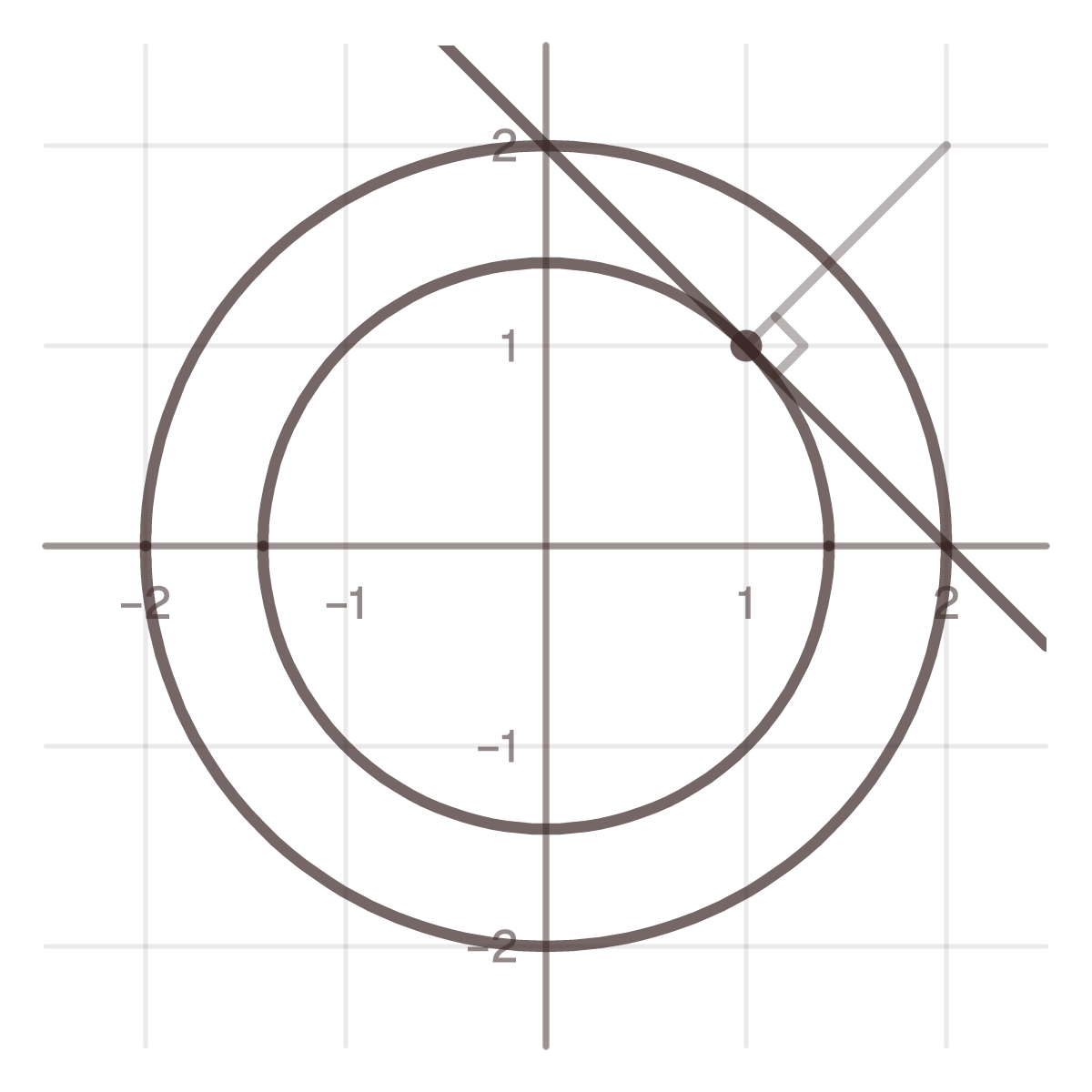
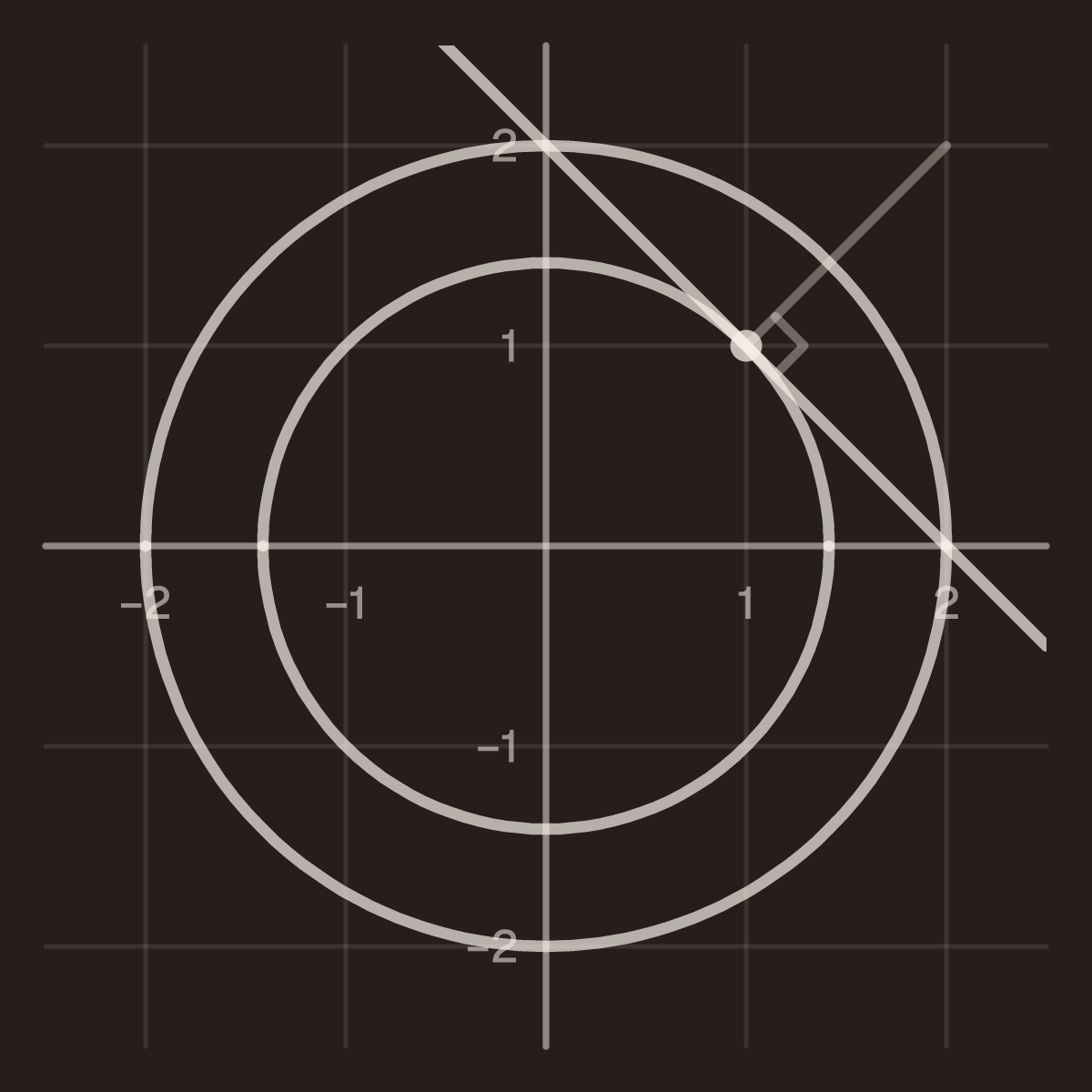
- The level curve through (1, 1) is the circle x² + y² = 2. The vector (2, 2) points straight out from its centre, at right angles to it, as the figure shows.
A second example: x³y² at (2, 3)
∇f = (3x²y², 2x³y) = (108, 48).
Common mistakes
- Treating the gradient as a number. ∇f is a vector. Its length |∇f| is the number.
- Forgetting the point. (2x, 2y) is a vector at every point: (2, 2) at (1, 1), (0, 6) at (0, 3).
- A direction that is not a unit vector. ∇f · v is the rate per unit of length only when |v| = 1.