The definition
lim f(x) = L as x → ∞ (or as x → −∞)
Then the line y = L is a horizontal asymptote of the curve y = f(x), on the right in the first case and on the left in the second. A function can have a different asymptote at each end, one, or none. The definition needs the limit to be a finite number, see limits.
Worked examples
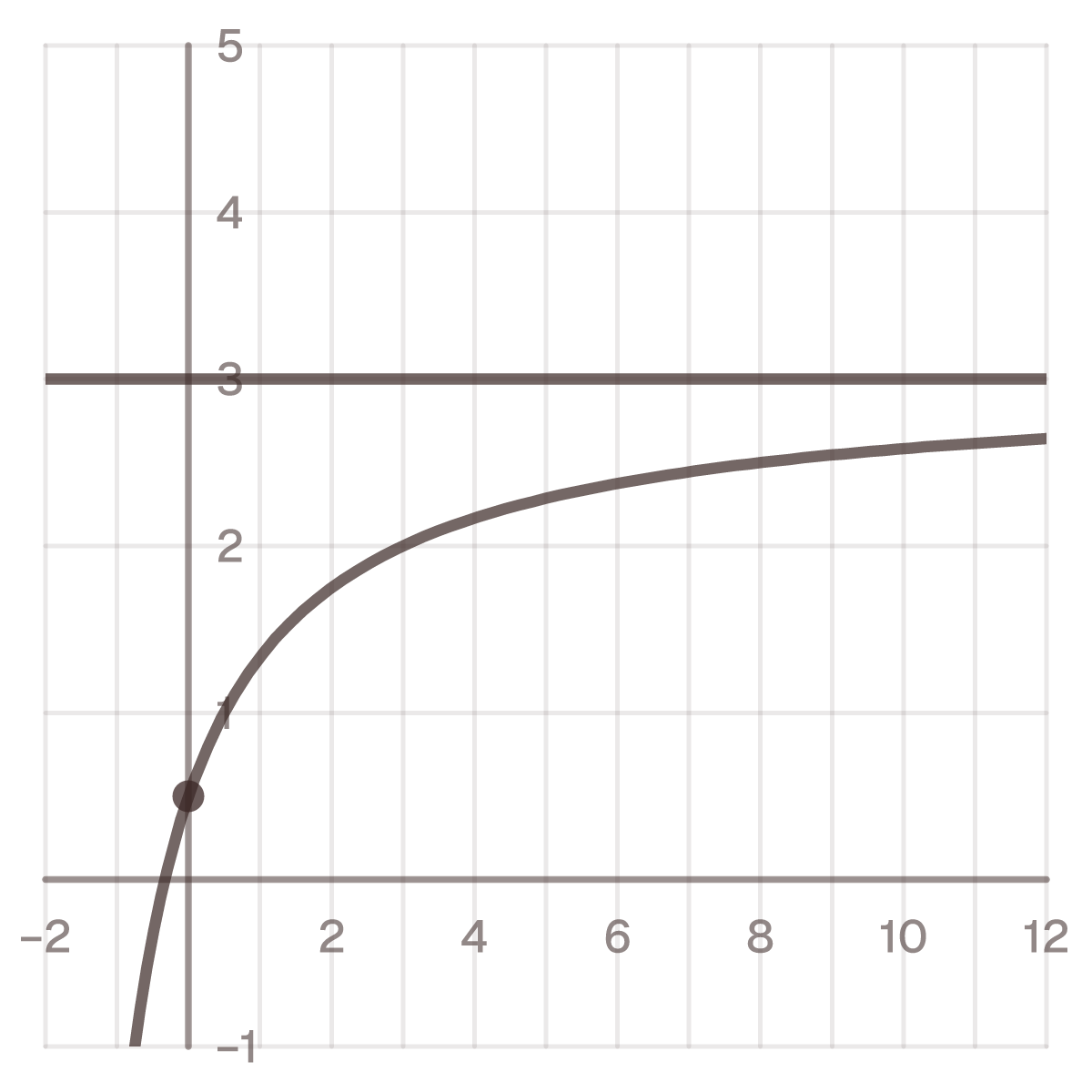
A fraction. f(x) = (3x + 1)/(x + 2). Divide the top and bottom by x:
f(x) = (3 + 1/x)/(1 + 2/x) → 3/1 = 3
so y = 3. The curve approaches it from below, since f(x) = 3 − 5/(x + 2).
1/x. 1/x → 0 as x → ∞ and as x → −∞, so y = 0 is an asymptote at both ends.
One end only. f(x) = 2 + e⁻ˣ → 2 as x → ∞, so y = 2 is an asymptote on the right. As x → −∞ the term e⁻ˣ grows without bound, so there is none on the left.
Common mistakes
- Mixing it up with a vertical asymptote. A horizontal asymptote comes from x going to infinity, a vertical asymptote from x going to a number.
- Stopping at one end. Check both x → ∞ and x → −∞.
- Thinking the curve cannot touch the line. It can cross it; the claim is only about the far ends.
- Counting a growing function. If f(x) → ∞ there is no horizontal asymptote, though there may be an oblique asymptote.
Common questions
How many horizontal asymptotes can there be?
At most two, one for each end, since a limit has only one value.