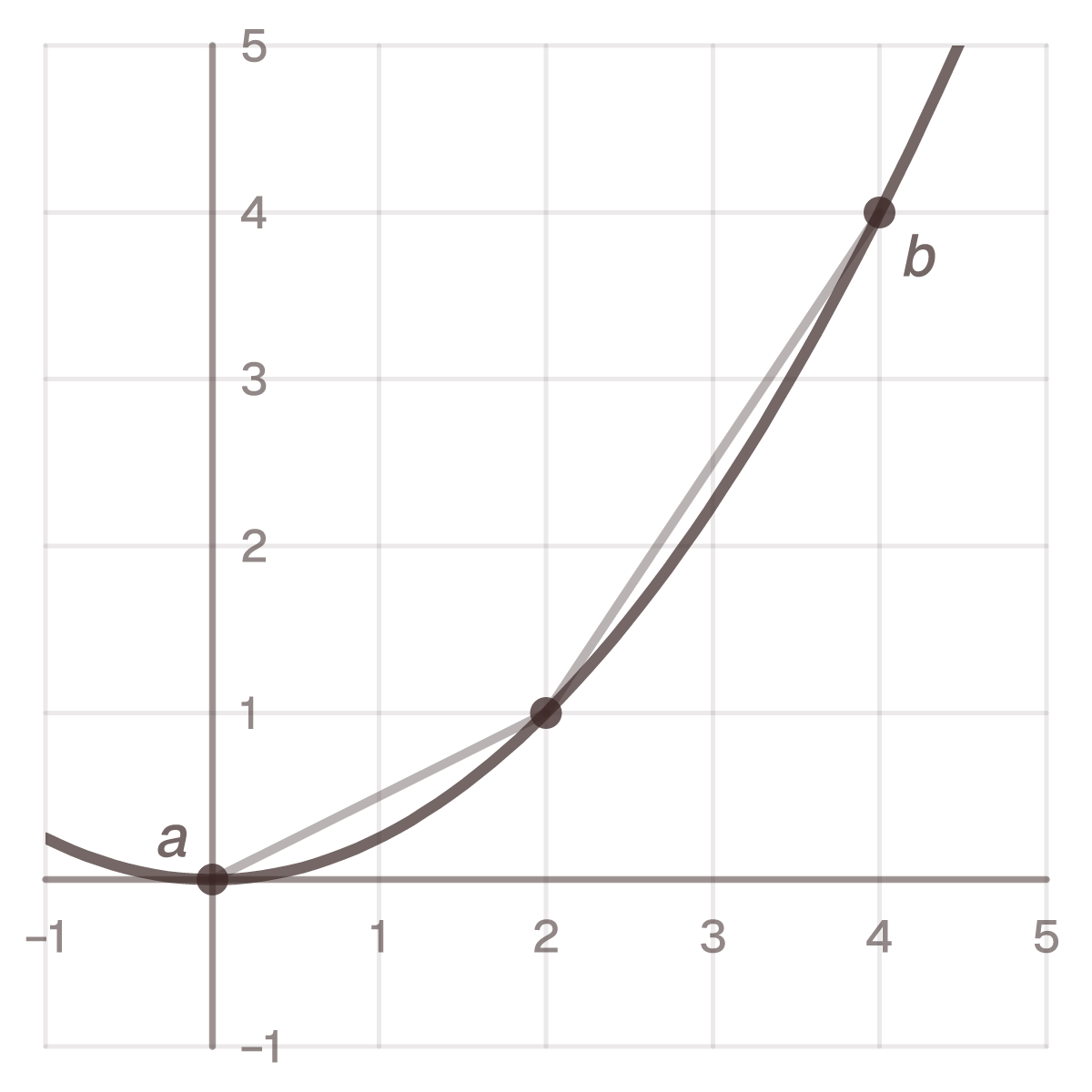
What the formula says
L = ∫ₐᵇ √(1 + f′(x)²) dx
L is the length of the curve y = f(x) from x = a to x = b, measured along the curve. It is a
theorem, and the reason is the Pythagorean theorem.
A short piece of the curve is nearly straight. If it runs dx across, it rises about f′(x) · dx, and the
length of the piece is the hypotenuse:
√(dx² + (f′(x) dx)²) = √(1 + f′(x)²) dx
The integral adds up the pieces.
Holds when f′ is continuous on [a, b], so that the curve has no corners or jumps.
Worked example
The curve f(x) = ⅔ x^(3/2) from x = 3 to x = 8.
- The derivative: f′(x) = ⅔ · (3/2) · x^(1/2) = √x.
- Square it and add 1: 1 + f′(x)² = 1 + x.
- Integrate: L = ∫₃⁸ √(1 + x) dx = [⅔ (1 + x)^(3/2)]₃⁸ = ⅔ (27 − 8) = 38/3 ≈ 12.67.
A check: the straight segment between the curve’s end points, (3, 3.46) and (8, 15.08), is √(5² + 11.62²) ≈ 12.65. The curve is a little longer than the segment, as it has to be.
The derivative, not the function
Under the root stands f′(x), squared, plus 1. Each part can go missing, and each mistake gives a plausible number:
| Integrand | Result on [3, 8] | What it is |
|---|---|---|
| √(1 + f′(x)²) | 12.67 | the arc length |
| f′(x) | 11.62 | the rise f(8) − f(3), without the 1 and the root |
| √(1 + f(x)²) | 44.45 | f in place of f′ — the integrand describes no piece of the curve |
The rise is shorter than the curve, because the curve also runs five units across.
A second example: a straight line
f(x) = 3x/4 from 0 to 8. Here f′(x) = 3/4 everywhere, so the integrand is constant:
L = ∫₀⁸ √(1 + 9/16) dx = ∫₀⁸ 5/4 dx = 10
That is the distance between the points (0, 0) and (8, 6), as it should be: for a straight line the formula is the distance formula.
When the integral has no exact answer
Even a parabola gives an integral that is hard by hand. f(x) = x² from 0 to 1 gives L = ∫₀¹ √(1 + 4x²) dx ≈ 1.4789. Roots of this shape rarely have a simple antiderivative, so arc lengths are often worked out numerically, with Simpson’s rule or the integral calculator, which gives an approximation where no rule applies.
Common mistakes
- f instead of f′. The slope decides how long the pieces are, not the height.
- Forgetting the 1. √(f′(x)²) = |f′(x)|, which only gives the change in height.
- Taking the root term by term. √(1 + f′²) is not 1 + f′.
- Limits in y. a and b are x-values. The length is measured from x = a to x = b.
Common questions
How do you find the length of a curve that is not the graph of a function?
In parametric form. If x = x(t) and y = y(t) for t from t₁ to t₂, the length is
∫ √(x′(t)² + y′(t)²) dt. The formula on this page is the special case x = t.
Does the formula work for a circle?
Yes. The upper half of a circle with radius r is f(x) = √(r² − x²). Then 1 + f′(x)² = r²/(r² − x²), and
the integral from −r to r comes to πr, half the circumference.
Where does the dx go?
Outside the root, as in every integral. It is the width of a piece of the curve, and √(1 + f′(x)²) is
how many times longer than its width the piece is.