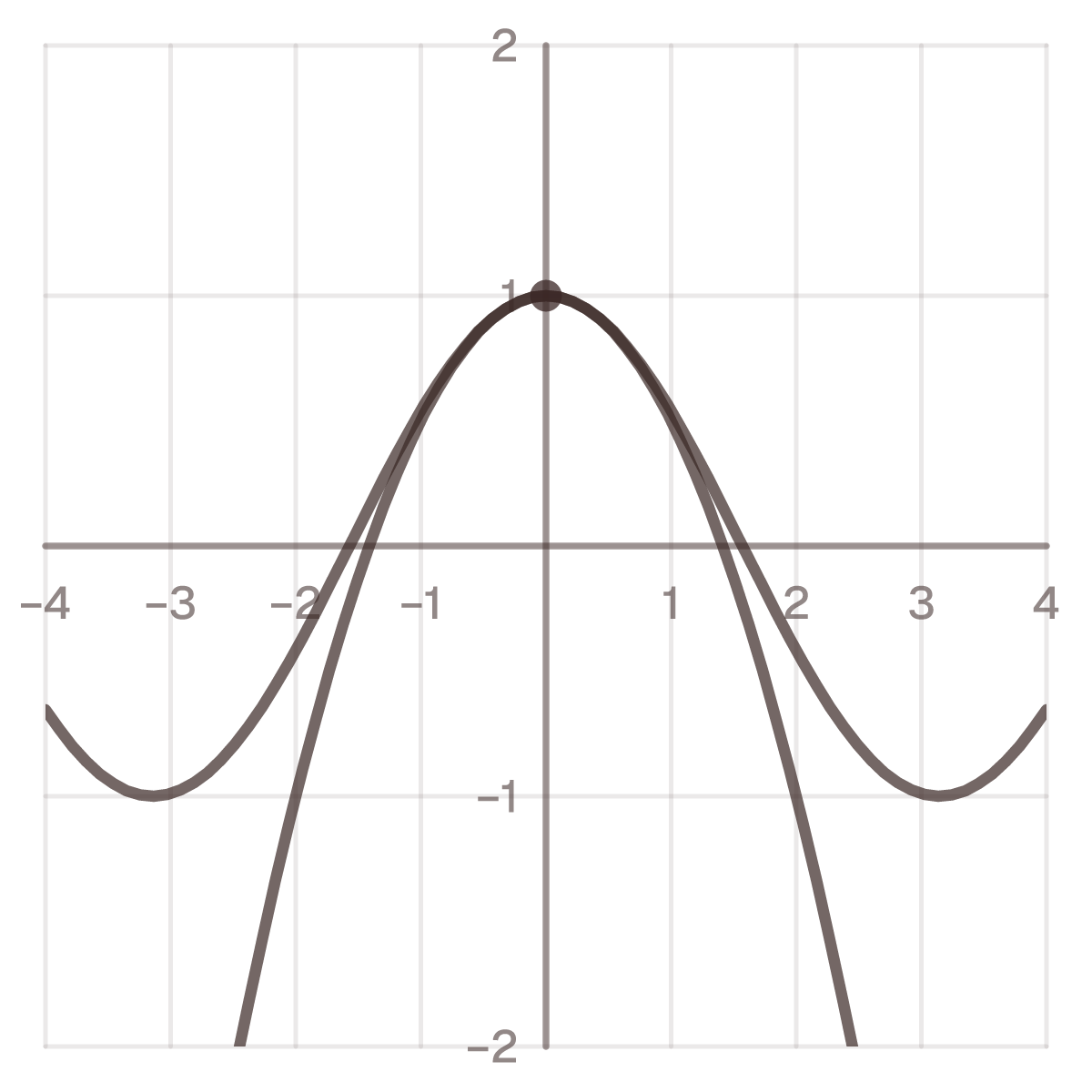
The expansion
- cos x = Σk=0n (−1)k x2k/(2k)! + O(x2n+2) as x → 0
Holds when x is in radians. Cosine has only even powers, so the term after x2n that is not 0 is x2n+2, and the remainder is O(x2n+2): near 0, at most a constant times |x|2n+2. After 1 − x²/2 that is O(x⁴), not O(x³).
The expansion is the derivative of the sine expansion term by term. For a value at a point, the Taylor polynomial card for sine computes sin x, and cos x = sin(x + π/2).
Worked example: a limit
limx→0 (1 − cos x)/x². With n = 1:
1 − cos x = x²/2 + O(x⁴), so (1 − cos x)/x² = 1/2 + O(x²) → 1/2.
The standard limits page reaches the same ½ through 1 − cos x = 2 sin²(x/2). The expansion gets there without the identity.
A second example: one term further
limx→0 (cos x − 1 + x²/2)/x⁴. Now the first two terms cancel and n = 2 is needed:
cos x − 1 + x²/2 = x⁴/24 + O(x⁶), so the limit is 1/24.
Common mistakes
- Stopping one term short. With cos x = 1 − x²/2 + O(x⁴) the second limit leaves O(x⁴)/x⁴, which is bounded but not known.
- A sign. The x⁴ term is +x⁴/24; the signs alternate from 1, not from −1.
- Degrees. The expansion is in radians.
Related pages
Maclaurin series explains where the coefficients come from.