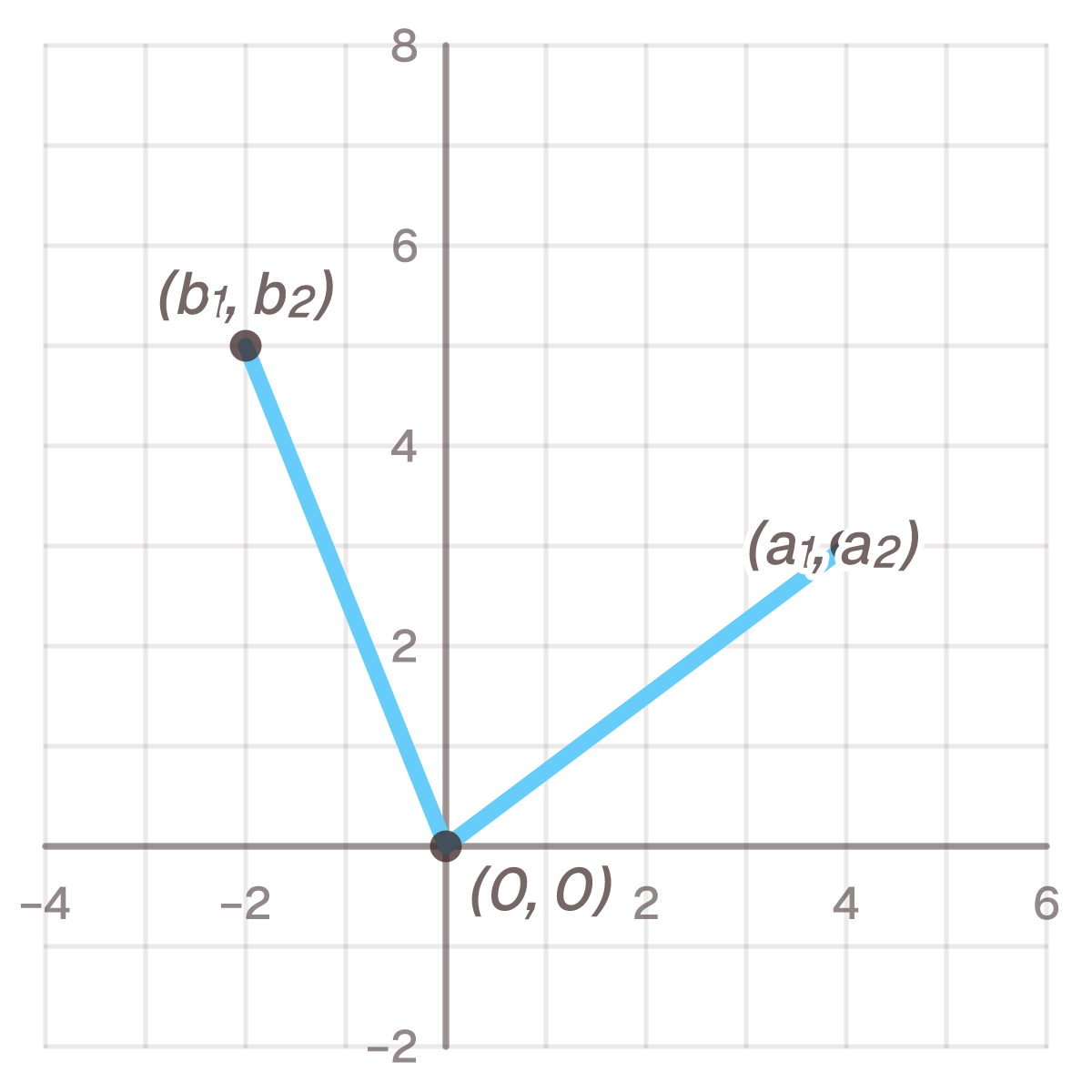
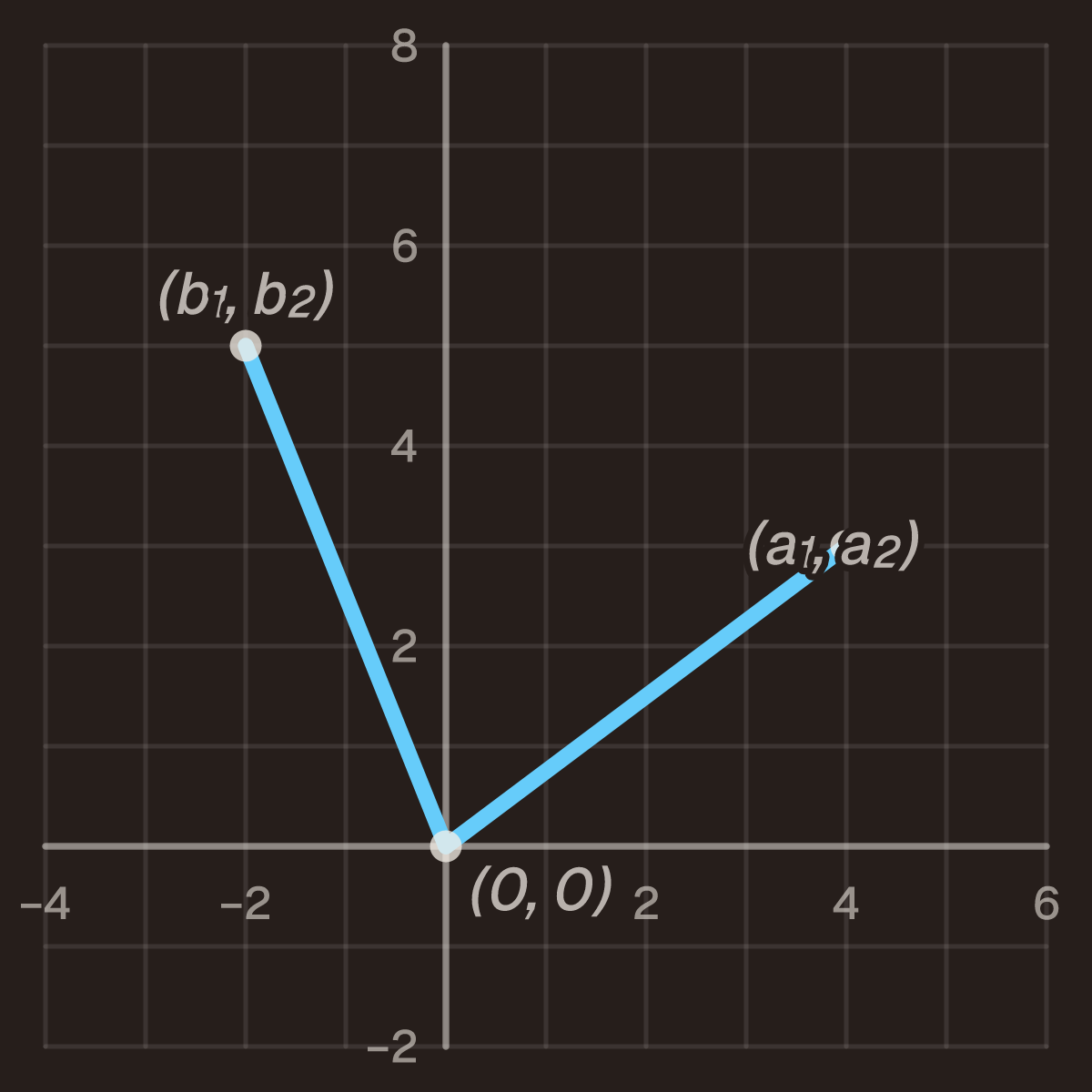
For the vectors a = (a₁, a₂) and b = (b₁, b₂), multiply the components in pairs, first with first and
second with second, and add the two products. Some books write the same thing with coordinates,
x₁x₂ + y₁y₂; the subscripts then say which vector a coordinate belongs to.
With a = (4, 3) and b = (−2, 5):
a · b = 4 · (−2) + 3 · 5 = −8 + 15 = 7
The answer is a single number. That is why it is also called the scalar product: a scalar is a number with
no direction.
Pairing the right components
A common mistake is to pair the wrong components. Multiplying across — a₁ with b₂ and a₂ with b₁ — also
gives a number, and it looks just as plausible:
| Working |
Result |
| 4 · (−2) + 3 · 5 (first with first, second with second) |
7 |
| 4 · 5 + 3 · (−2) (across) |
14 |
Write the vectors one above the other before you start, so the first components stand in the same column:
Multiply straight down each column and add.
What the sign says about the angle
For two vectors that both have a length greater than 0, the sign of the dot product gives away the angle
between them:
| Dot product |
Angle between the vectors |
| positive |
less than 90° |
| 0 |
exactly 90°, the vectors are perpendicular |
| negative |
more than 90° |
The vectors above have a dot product of 7, so the angle between them is acute. The angle itself comes
from the angle between two vectors, which
divides the dot product by the two
magnitudes.
Find t so that the vectors are perpendicular
A common exercise runs backwards. The vectors a = (t, 3) and b = (6, −4) are to be perpendicular.
Perpendicular vectors have a dot product of 0:
t · 6 + 3 · (−4) = 0
6t − 12 = 0, so t = 2.
Check: (2, 3) · (6, −4) = 12 − 12 = 0. On the card above, set the dot product to 0 and choose a₁ as the
unknown.
In three dimensions
A vector in space has three components, and the dot product gains a third term:
- a · b = a₁b₁ + a₂b₂ + a₃b₃
The rule is the same: pairs, then the sum. (1, −2, 4) · (3, 5, 2) = 3 − 10 + 8 = 1.
Common mistakes
- Multiplying across. a₁ goes with b₁, and a₂ with b₂.
- Answering with a vector. (4 · (−2), 3 · 5) = (−8, 15) is not the dot product. The sum of the two
products is.
- Losing a minus sign. Put a negative component in brackets when you multiply.
- Reading 0 as a zero vector. A dot product of 0 between two vectors with length means they are
perpendicular.
Common questions
What does the dot product mean geometrically?
It equals |a| · |b| · cos θ, where θ is the angle between the vectors. The component form and that form
give the same number, so the sign of the dot product is the sign of cos θ.
Does the order matter?
No. a · b = b · a, because a₁b₁ = b₁a₁ and a₂b₂ = b₂a₂.
Where is the dot product used in physics?
The work a force does is the force and the displacement multiplied this way. Only the part of the force
along the path counts, which is what
work done at an angle calculates.