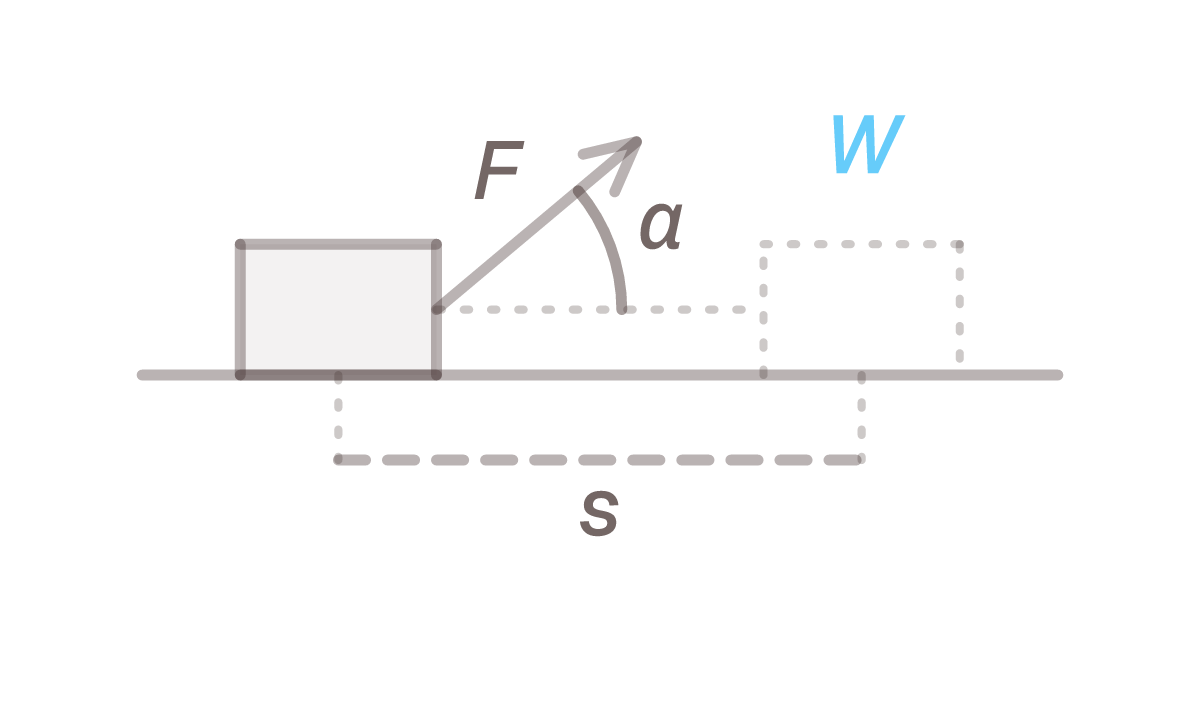
F is the force in newtons, s the distance in metres, α the angle between the force and the
direction of motion, and W the work in joules. Pushing a lawn mower 25 m with 75 N along the handle, at
35° below the horizontal, does 75 · 25 · cos 35° ≈ 1,536 J. Many English books write the angle as θ
and the distance as d; the relation is the same.
Holds when the force and the angle stay constant over the whole distance and the path is straight.
With α = 0°, cos α = 1 and the formula becomes work in its plain
form, W = F · s.
Why the cosine
The force splits into two components: F·cos α along the path and F·sin α across it. The part across the
path presses the mower into the ground but does not move it forward, and does no work. What is left is
F·cos α times the distance.
With the sine instead the answer is 75 · 25 · sin 35° ≈ 1,075 J, a third too small and still a
believable number. The angle is measured between the force and the path. If the problem gives the
angle from the vertical, sine and cosine swap places.
Negative work
The angle can run from 0° to 180°. Past 90° the cosine is negative and so is the work: the force acts
against the motion and takes energy from the object.
| Angle |
cos α |
The work |
| 0° |
1 |
F·s, the whole force forward |
| 35° |
0.819 |
82% of F·s |
| 60° |
0.5 |
half of F·s |
| 90° |
0 |
no work |
| 120° |
−0.5 |
negative |
| 180° |
−1 |
−F·s, straight back |
Worked examples
Friction. A 40 N friction force acts straight against the motion, α = 180°, while a box slides 10 m:
W = 40 · 10 · (−1) = −400 J. The box loses 400 J of kinetic energy.
The force from the work. A sledge is pulled 50 m by a rope at 20° and 3,000 J of work is done:
F = 3,000 / (50 · cos 20°) ≈ 63.9 N.
Common mistakes
- Sine instead of cosine. With the angle between the force and the path, it is the cosine.
- The angle from the vertical. Then it is the sine. Sketch the force and the path and see which angle
you have.
- Calculator in radians. cos 35 in radians is −0.90, and the work turns negative for no reason.
- Dropping the sign. Negative work is a real answer: the force is slowing the object down.
Frequently asked questions
Does gravity do work on a car driving on level ground?
No. Gravity is vertical and the motion horizontal, α = 90° and cos 90° = 0.
How does this connect to power?
Power is work per unit time. Divide the work by the time, or use F · v · cos α with the speed v. See
mechanical power.