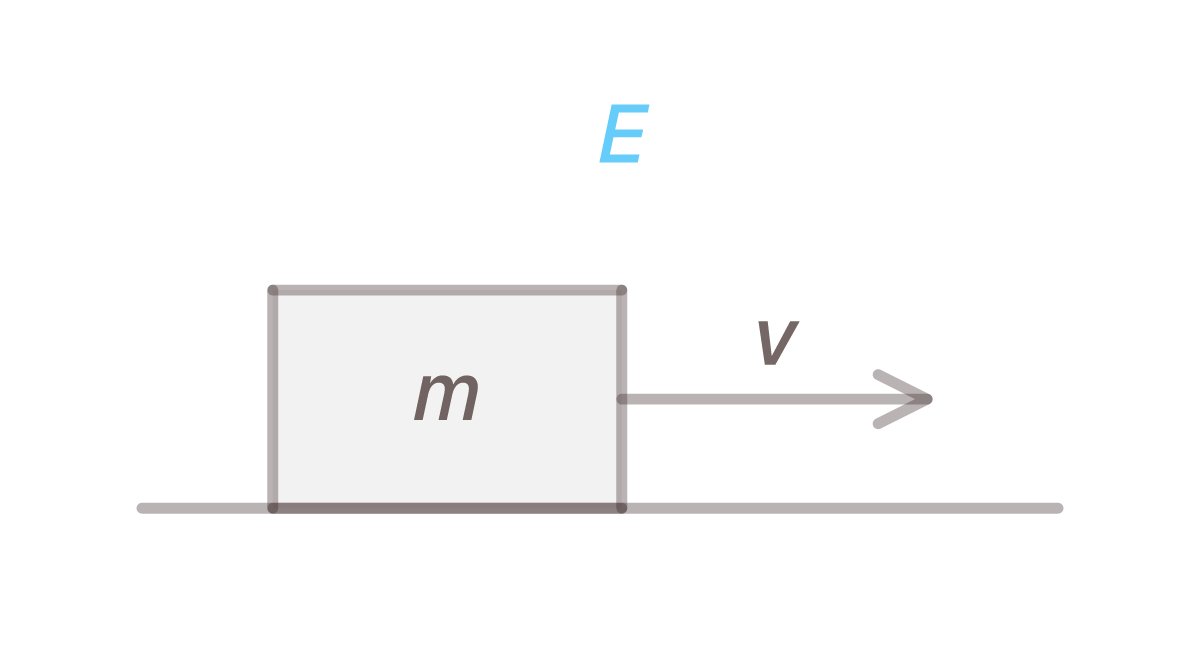
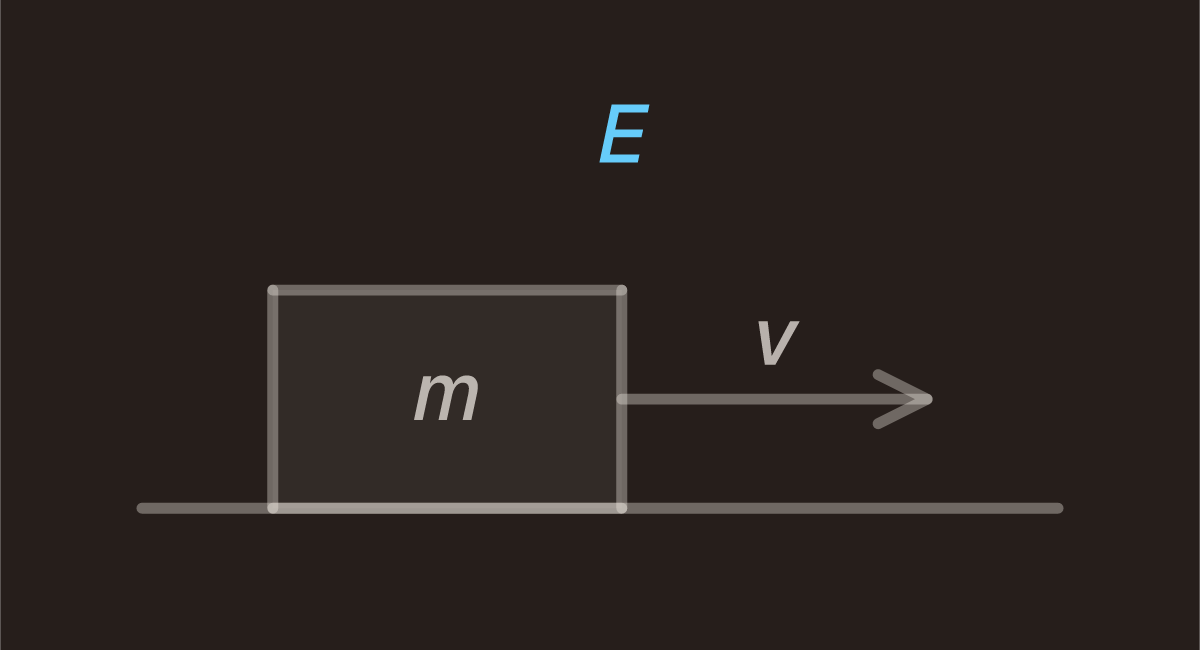
m is the mass in kilograms, v the speed in metres per second and E the kinetic energy in joules. A
1,200 kg car at 25 m/s has 1,200 · 25² / 2 = 375,000 J.
Holds when the speed is far below the speed of light. Near it, relativistic kinetic
energy takes over.
The square
The mass sits plainly in the formula: twice the mass is twice the energy. The speed is squared.
| Speed |
Energy for 1,200 kg |
| 10 m/s (36 km/h) |
60,000 J |
| 20 m/s (72 km/h) |
240,000 J |
| 30 m/s (108 km/h) |
540,000 J |
| 40 m/s (144 km/h) |
960,000 J |
Four times the speed is sixteen times the energy. It is why the difference between 30 and 50 km/h in a
town is not “a bit faster” but nearly three times as much energy for something to absorb in a crash.
Energy and braking distance
The brakes do work, which is force times distance, and the force
from the tyres on the road is much the same whatever the speed. Set it equal to the kinetic energy and
the square moves straight across into the braking distance: twice the speed, four times the distance.
It is the same mathematics that velocity without time
states with acceleration instead of energy.
Worked examples
A cyclist. 80 kg at 8 m/s: 80 · 64 / 2 = 2,560 J.
The same car at half the speed. 1,200 kg at 12.5 m/s: 1,200 · 156.25 / 2 = 93,750 J — a quarter
of 375,000 J.
Speed from the energy. 200,000 J in 1,000 kg gives v = √(400,000 / 1,000) = √400 = 20 m/s.
Mass from the energy. 45,000 J at 15 m/s: m = 90,000 / 225 = 400 kg.
Common mistakes
- Forgetting to square first.
m · v² / 2 — the square applies to the speed, not to the product.
- Working in km/h. 90 km/h is 25 m/s. Divide by 3.6 before substituting.
- Dropping the two. Without it the answer is twice too large.
- Assuming twice the speed is twice the energy. It is four times.
Frequently asked questions
Where does the kinetic energy go when something brakes?
In ordinary braking it becomes heat, mostly in the brake discs and some in the tyres. An electric car
braking with its motor instead puts part of it back into the battery.
Does something standing still have kinetic energy?
No, it is zero. But “still” depends on who is watching — a passenger on a train has no kinetic energy
seen from inside the carriage and a great deal seen from the platform.
How is it different from momentum?
Momentum is m·v and has a direction; kinetic energy is
m·v²/2 and has none. They are conserved in different circumstances and answer different questions.