Moment of a force
The relation
M
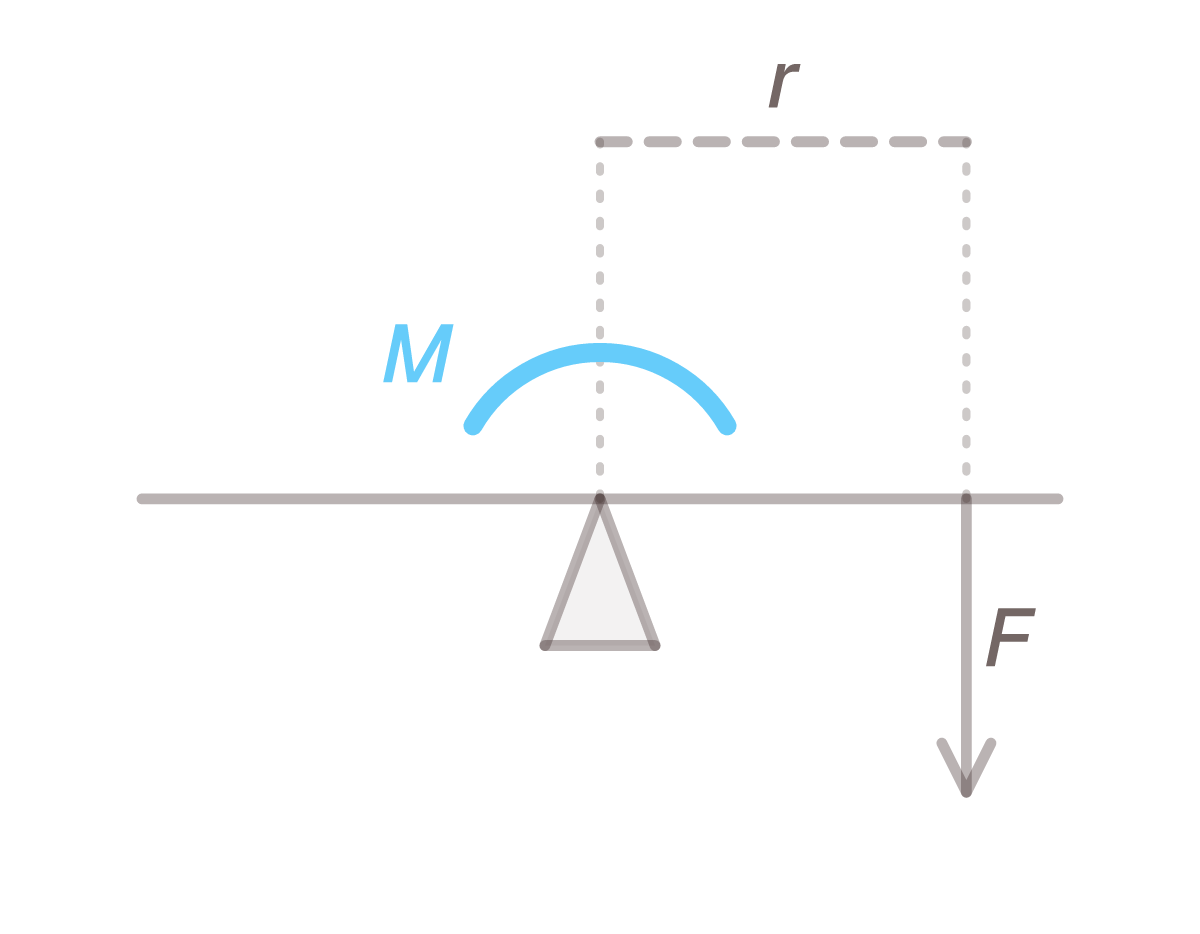
A force times its distance from the pivot. The same turning effect comes from a small force far out or a large one close in.
Solve for
M=100N·m
M equals 200 times 0.5, equals 100 N·m
Den här sidan finns på svenska. Byt till svenska
Definition — what does that mean?
Force times distance — which is why the nut gives with a longer spanner.
In Swedish: Moment
M
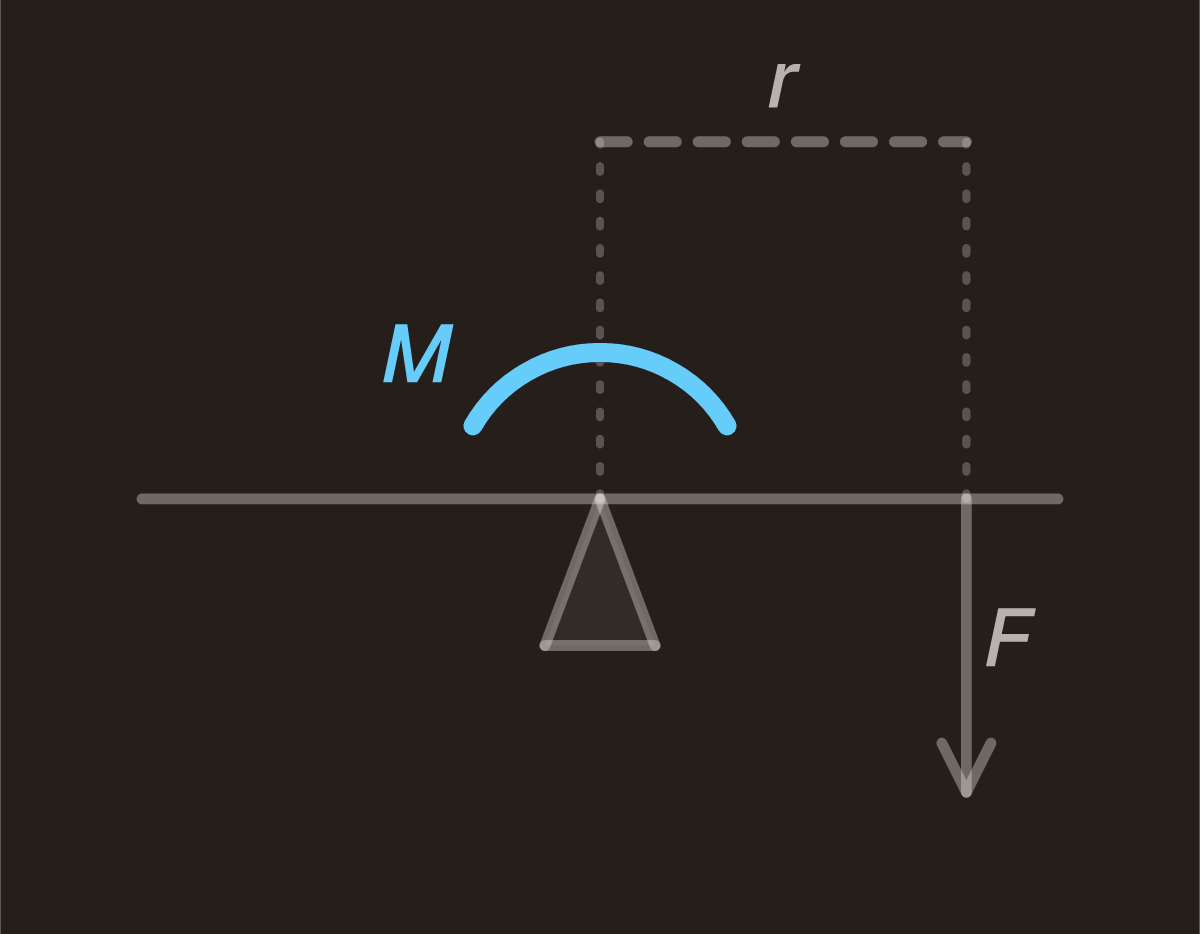
A force times its distance from the pivot. The same turning effect comes from a small force far out or a large one close in.
M=100N·m
M equals 200 times 0.5, equals 100 N·m
You are given
F is the force in newtons, r the distance from the pivot in metres and M the moment in newton
metres. 200 N half a metre out gives 200 · 0.5 = 100 N·m.
The distance has to be measured perpendicular to the force. Pull at an angle and only the perpendicular part counts, which is why you free a nut by pulling straight out from the spanner rather than askew.
A lever balances when the moments on both sides are equal:
The same relation runs the seesaw, the crowbar, the wheelbarrow and the pair of scissors. Two children of 30 and 45 kg balance when the heavier sits closer to the middle in the same ratio: 45 · 1 = 30 · 1.5.
The force you gain you pay for in distance. A crowbar that multiplies your force fivefold moves the load a fifth as far — force times distance is unchanged, as long as friction can be neglected.
A spanner. The same hand giving 150 N produces 150 · 0.2 = 30 N·m on a short spanner and 150 · 0.4 = 60 N·m on one twice as long. So a workshop keeps long spanners.
What force is needed? A tightening torque of 90 N·m with a 0.3 m spanner needs 90 / 0.3 = 300 N.
The seesaw. A 30 kg child (294 N) sits 1.5 m out. To balance, a 45 kg child (441 N) has to sit 294 · 1.5 / 441 ≈ 1.0 m out.
A wheelbarrow. A 600 N load sits 0.4 m from the wheel, the handles 1.2 m. You lift with 600 · 0.4 / 1.2 = 200 N, a third of the load.
What is the difference between a moment and torque?
None in the mathematics. Torque is usually said of a turning effect on a shaft and moment in
statics, but the formula is the same.
Why do bolts come with a tightening torque?
So that the bolt is tensioned to the right degree: too little and it works loose, too much and the
thread strips. A torque wrench measures M directly, whatever lever arm you give it.
How do I handle several forces?
Add the moments with signs — clockwise one way, anticlockwise the other. If the total is zero the
rotation does not change: an object at rest stays at rest, and one that turns keeps the same angular
velocity.
| Solve for | Rearranged | With the numbers | Comes to |
|---|---|---|---|
| F | Mr | 1000.5 | 200 N |
| r | MF | 100200 | 0.5 m |
| M | Fr | 200·0.5 | 100 N·m |
Last reviewed October 6, 2026 ·How pages are reviewed
Sheets that ask this formula, with their answer keys. Open one to see the questions or print it.
Eight questions on the moment of a force and eight on moment equilibrium, where a force or a lever arm is asked for.
Copy the code into your page where the formula card should appear. It loads from lovetocalc.com, so it stays current on its own — all we ask is that the credit line comes with it.