Volume flow rate
The relation
Q
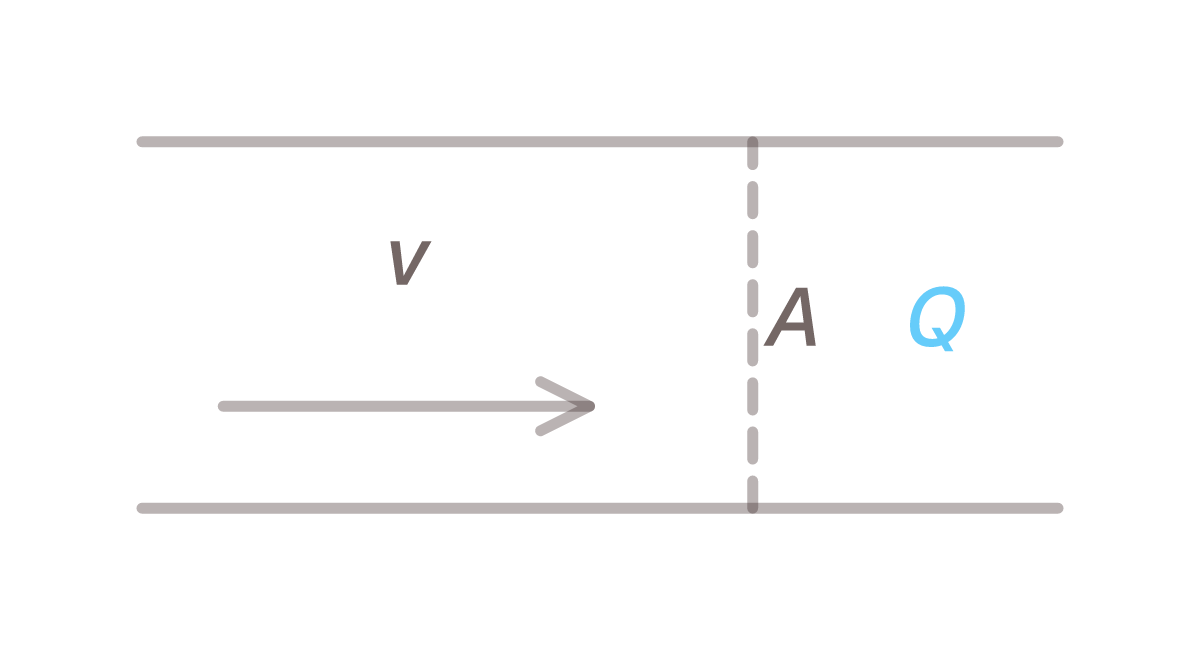
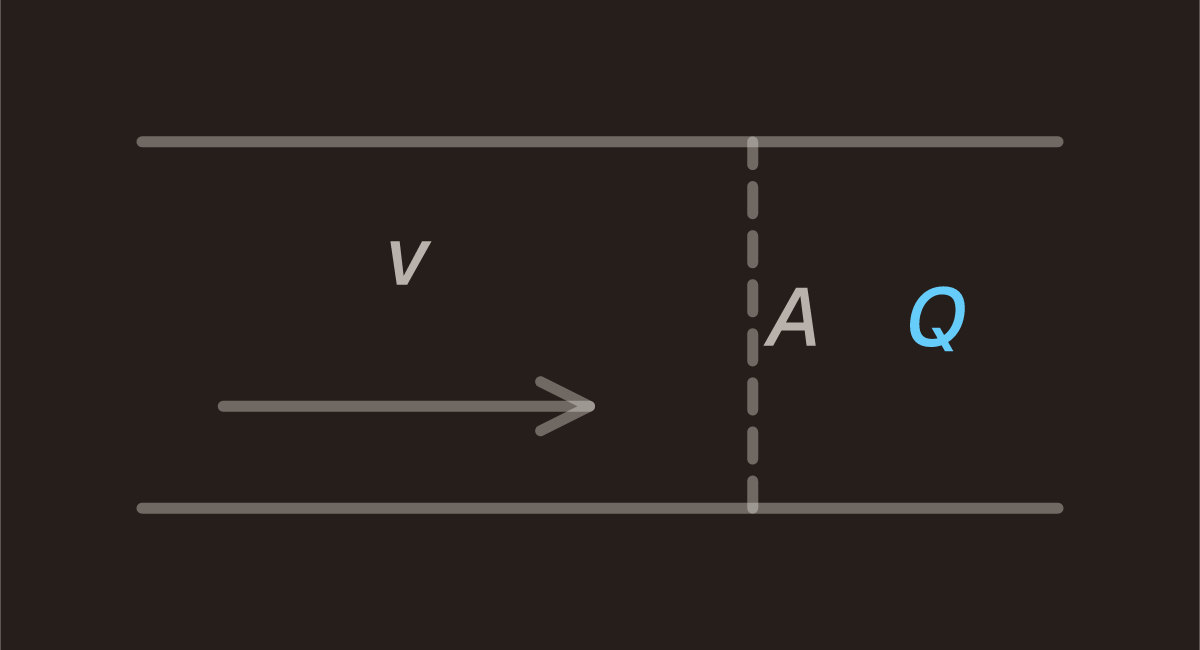
How much volume passes a cross-section each second: the area times the mean speed through it. 1 m³/s is 1,000 litres a second.
Solve for
Q=0.003m³/s
Q equals 0.002 times 1.5, equals 0.003 m³/s
Den här sidan finns på svenska. Byt till svenska
Definition — what does that mean?
Area times speed — how many cubic metres pass a cross-section each second.
In Swedish: Volymflöde
Q
How much volume passes a cross-section each second: the area times the mean speed through it. 1 m³/s is 1,000 litres a second.
Q=0.003m³/s
Q equals 0.002 times 1.5, equals 0.003 m³/s
You are given
A is the cross-sectional area in m², v the mean flow speed in m/s and Q the volume flow rate in
m³/s. A pipe with a cross-section of 0.002 m² carrying water at 1.5 m/s delivers 0.002 · 1.5 =
0.003 m³/s, which is 3 litres a second.
It is also called the volumetric flow rate, or discharge.
Holds when v is the mean speed over the whole cross-section and the flow crosses it at right angles. In
a real pipe the water at the wall moves more slowly than at the centre.
The same quantity can be written Q = V / t: the volume that passes divided by the time.
The formula gives m³/s only when the area is in m². A hose is measured in millimetres and a flow often in litres per minute, so the conversion is where most errors happen.
| From | To |
|---|---|
| 1 cm² | 0.0001 m² |
| 1 mm² | 0.000001 m² |
| 1 m³/s | 1,000 L/s |
| 1 L/s | 60 L/min |
1 cm² is 0.0001 m², not 0.01 — a square centimetre is a hundredth of a metre in both directions.
The speed in a garden hose. 0.5 litres a second, 0.0005 m³/s, runs through a hose of radius 0.9 cm. The area is π · 0.009² ≈ 0.000254 m², and the speed is v = 0.0005 / 0.000254 ≈ 1.96 m/s.
Through the nozzle. The same flow through a nozzle of radius 0.25 cm: the area is just under a thirteenth as large, and the speed comes to about 25.5 m/s. That the flow is the same through both is the continuity equation.
From a bucket. A 10-litre bucket fills in 40 seconds: Q = 10 / 40 = 0.25 L/s, or 15 L/min.
How is it different from mass flow rate?
Mass flow rate is kilograms per second: the volume flow rate times the density. For water, 1 L/s is
about 1 kg/s.
Why does the water go further when I put my thumb over the hose?
Your thumb reduces the area. The flow from the tap stays about the same, so the speed has to rise and
the water leaves faster.
| Solve for | Rearranged | With the numbers | Comes to |
|---|---|---|---|
| A | Qv | 0.0031.5 | 0.002 m² |
| v | QA | 0.0030.002 | 1.5 m/s |
| Q | Av | 0.002·1.5 | 0.003 m³/s |
Last reviewed October 6, 2026 ·How pages are reviewed
Copy the code into your page where the formula card should appear. It loads from lovetocalc.com, so it stays current on its own — all we ask is that the credit line comes with it.