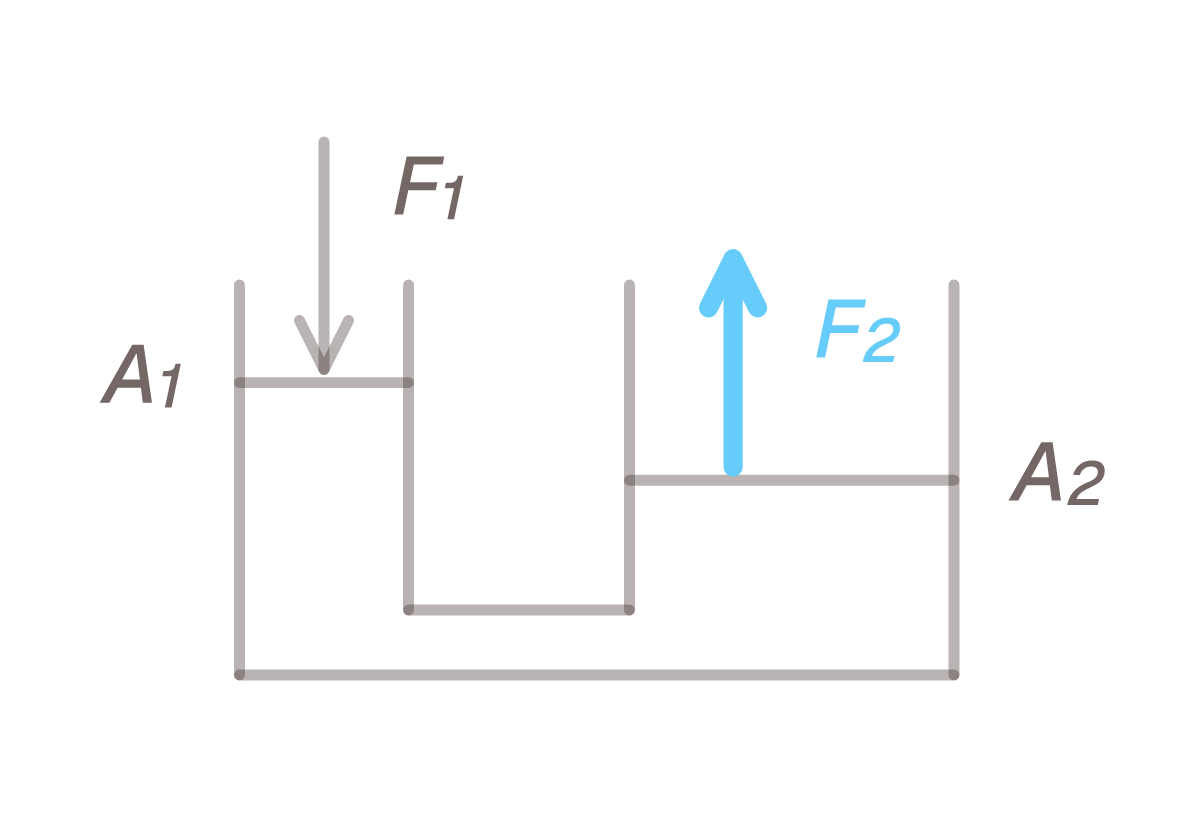
F₁ / A₁ = F₂ / A₂
F₁ is the force on the small piston and A₁ its area. F₂ and A₂ belong to the large one. Both
ratios are the pressure in the liquid. Pressure applied to an enclosed liquid is passed
on undiminished through all of it; a difference in height adds ρgh, which in a jack is small.
It is also called Pascal’s law.
Holds for an enclosed, incompressible liquid at rest, with the pistons at the same height and no friction.
The force grows, the distance shrinks
If the large piston is 50 times the small one, the force is 50 times larger. But no energy is created. For
the large piston to move 1 cm, the small one has to be pushed down 50 cm. Force times distance, the
work, is the same on both sides.
Worked examples
The defaults. 100 N on a 0.001 m² piston, a large piston of 0.05 m²:
F₂ = 100 · 0.05 / 0.001 = 5,000 N. That is enough to lift about 500 kg.
A jack. A 1,200 kg car weighs about 11,800 N. With a large piston 100 times the small one, 118 N on
the handle is enough.
Common mistakes
- Mixing cm² and m². As long as both areas are in the same unit it works, since only the ratio counts.
- Using the diameter as the area. Twice the diameter gives four times the area.
- Expecting free energy. You gain force, but pay in distance.
Frequently asked questions
Why oil and not air?
Air can be compressed. Part of the movement then goes into squeezing the air rather than moving the large
piston. Oil is almost incompressible.
Where is it used?
In car brakes, excavators, jacks, hydraulic presses and barber’s chairs.