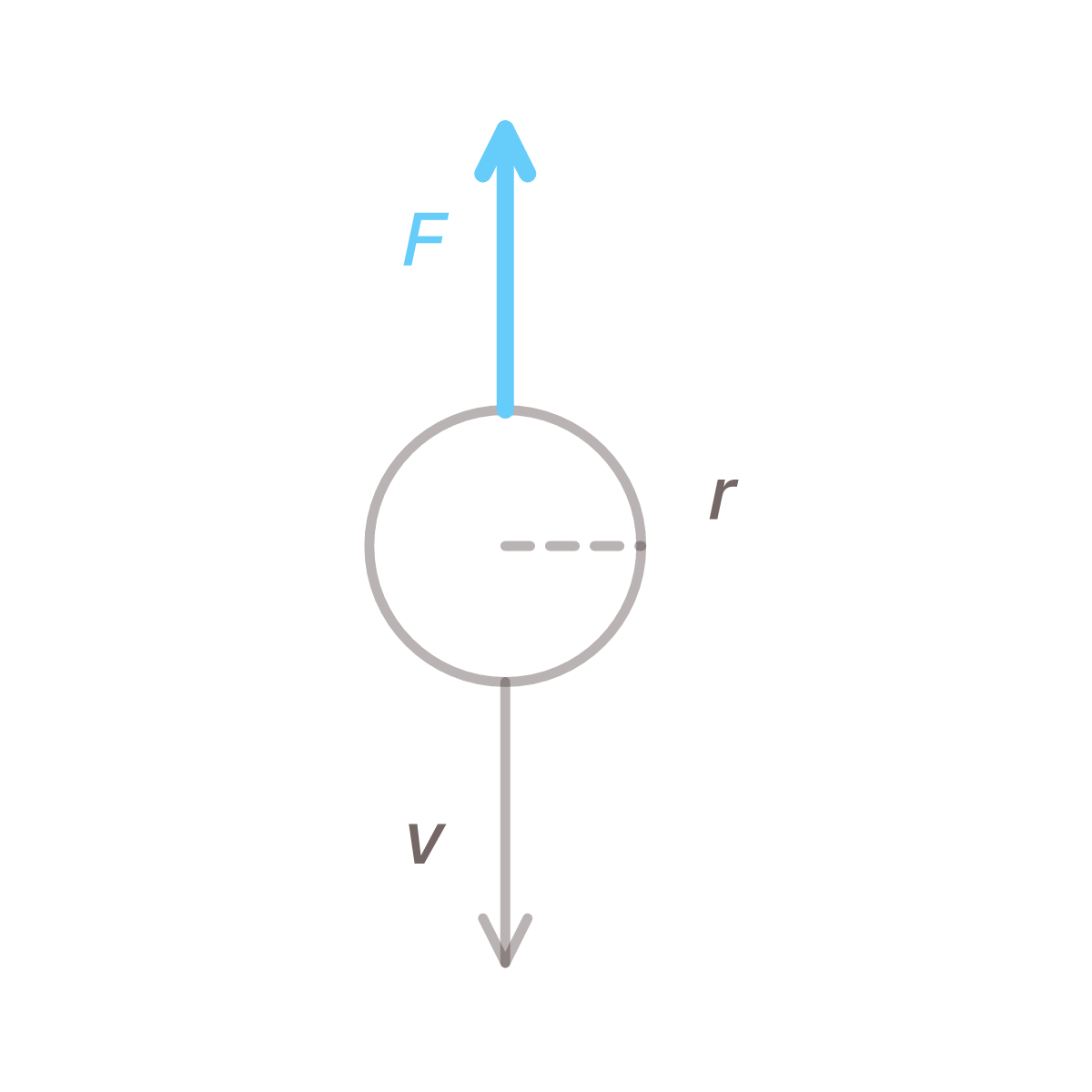
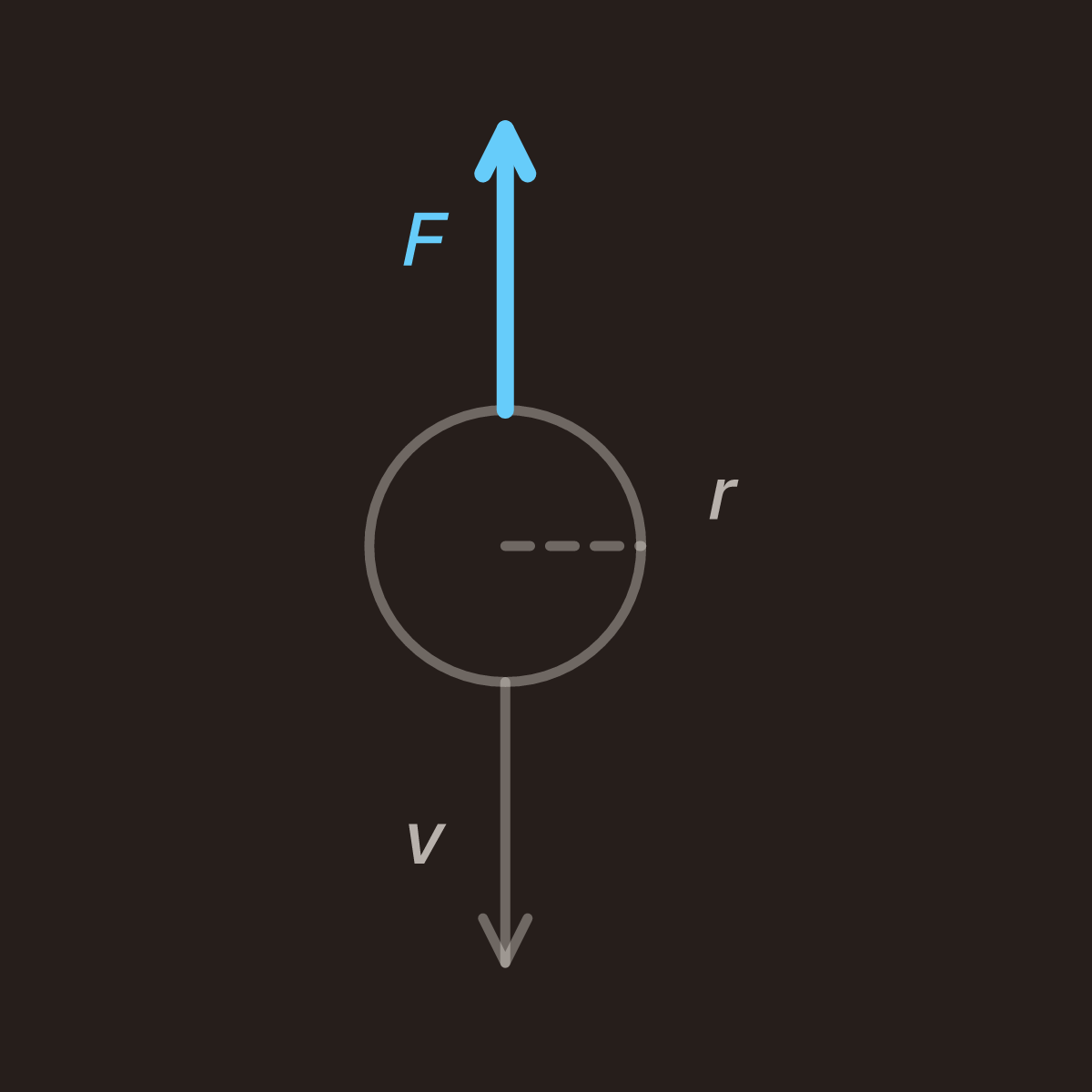
F = 6π · η · r · v
η (eta) is the fluid’s dynamic viscosity in Pa·s, r the radius of the sphere in metres, v its speed
relative to the fluid in m/s, and F the drag force in newtons. Some books write the viscosity as μ, as
the Reynolds number page does; it is the same quantity.
Holds when the body is a sphere, the Reynolds number Re = ρ · v · 2r / η is well below 1, and the fluid
around it is otherwise at rest and far from walls.
A silt grain of radius 0.05 mm sinking at 1 mm/s through water at 20 °C (η = 1.0016 · 10⁻³ Pa·s):
F = 6π · 1.0016 · 10⁻³ · 5 · 10⁻⁵ · 0.001 ≈ 9.44 · 10⁻¹⁰ N.
Its Reynolds number is 1,000 · 0.001 · 10⁻⁴ / 1.0016 · 10⁻³ ≈ 0.1, inside the range.
Stokes or ½ρC_dAv²
The site has two drag formulas, and they describe opposite ends of the same scale:
|
Stokes’ law |
Drag equation |
| Formula |
F = 6πηrv |
F = ½ρC_dAv² |
| Grows with |
v |
v² |
| Set by |
viscosity |
density |
| Used where |
Re well below 1 |
Re far above 1 |
| Typical case |
dust, droplets, fine sediment |
cars, cyclists, falling stones |
The Reynolds number decides which one applies. A 5 cm stone (r = 0.025 m) at 1 m/s in water has
Re = 1,000 · 1 · 0.05 / 0.001 ≈ 50,000. Stokes’ law would give 6π · 1.0016 · 10⁻³ · 0.025 · 1 ≈
4.7 · 10⁻⁴ N. The drag equation, with C_d = 0.5 for a sphere, gives
½ · 1,000 · 0.5 · π · 0.025² · 1² ≈ 0.49 N — about a thousand times more. Both numbers look like a
force; only one of them belongs to a stone.
A droplet falling at its terminal velocity
A water droplet in fog, radius 10 µm, falls until the drag balances its weight. Its mass is
1,000 · (4/3)π · (10⁻⁵)³ ≈ 4.19 · 10⁻¹² kg, so its weight is about 4.11 · 10⁻¹¹ N. Setting
6π · η · r · v equal to that, with air’s η = 18.13 µPa·s at 20 °C:
v = 4.11 · 10⁻¹¹ / (6π · 1.813 · 10⁻⁵ · 10⁻⁵) ≈ 0.012 m/s, about 1.2 cm/s.
With air at about 1.2 kg/m³ the Reynolds number is roughly 0.02, so the law holds. That slow fall is why a
fog hangs in the air. The general terminal velocity
formula is built on the quadratic drag equation instead, and gives a far larger speed for the same drop.
Common mistakes
- Diameter for radius. The r in the formula is the radius; a quoted grain size is usually a diameter.
- Ignoring the Reynolds number. Above Re ≈ 1 the drag grows faster than v and the formula
underestimates it.
- Kinematic for dynamic viscosity. Tables list both; Stokes’ law needs the dynamic one, in Pa·s, not
the kinematic one in m²/s.
- Forgetting the temperature. Water’s viscosity falls from 1.00 mPa·s at 20 °C to 0.55 mPa·s at
50 °C, so the same grain sinks about 1.8 times as fast in the warmer water.
Frequently asked questions
How is Stokes’ law used to measure viscosity?
In a falling-ball viscometer a ball of known size and density sinks through the liquid at constant speed.
Weight minus buoyancy equals 6πηrv, and with r and v measured, η is the only unknown.
Why is it linear in the speed?
At low Reynolds number the fluid’s inertia is negligible and only viscous friction matters, and viscous
stress is proportional to how fast the fluid is sheared. Doubling the speed doubles the shear and so the
force.
Does it work for shapes other than a sphere?
The factor 6π is for a sphere. Other shapes have their own factors at low Reynolds number, often written
as a correction to the sphere’s value.