Potential energy
The relation
E
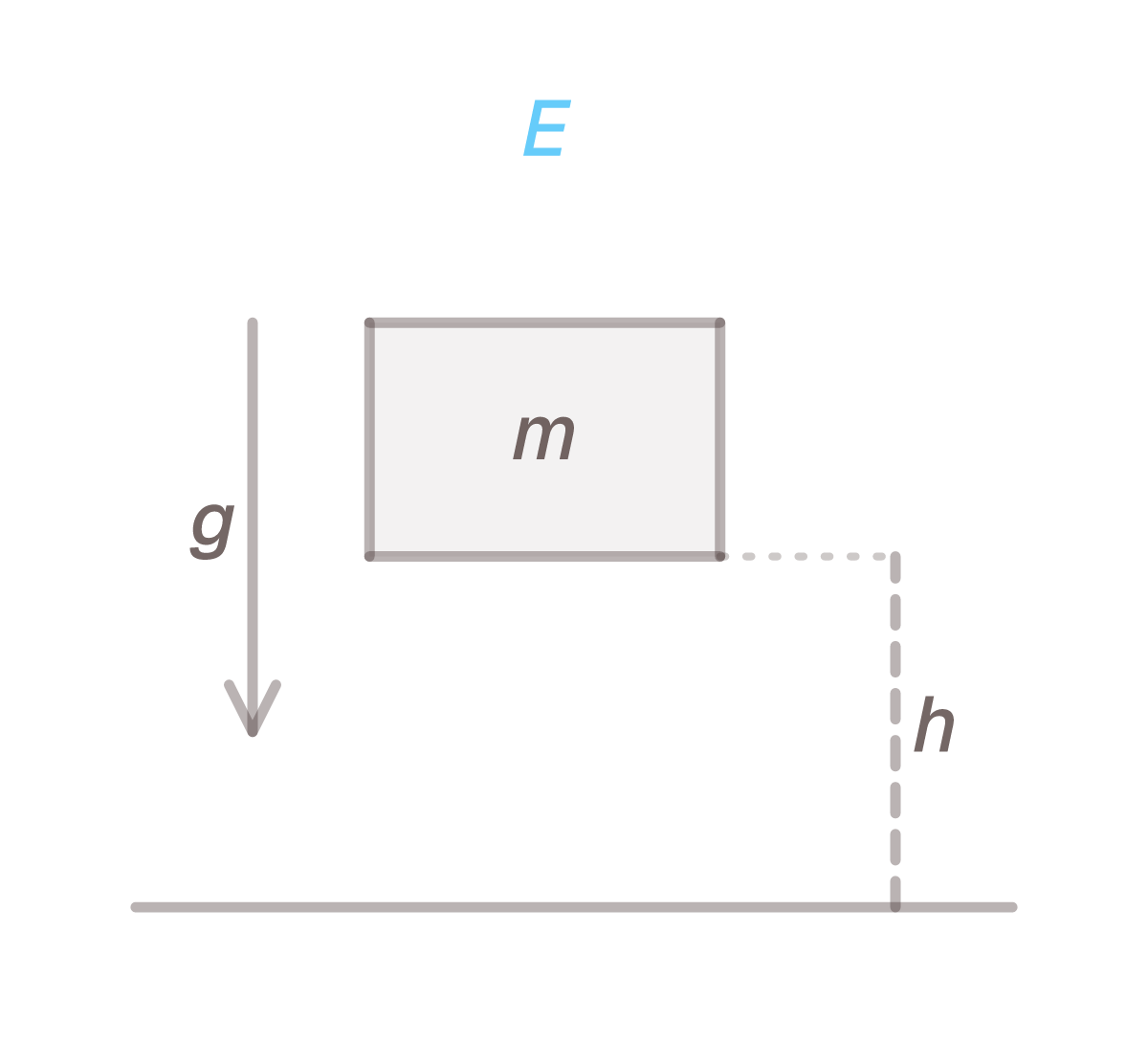
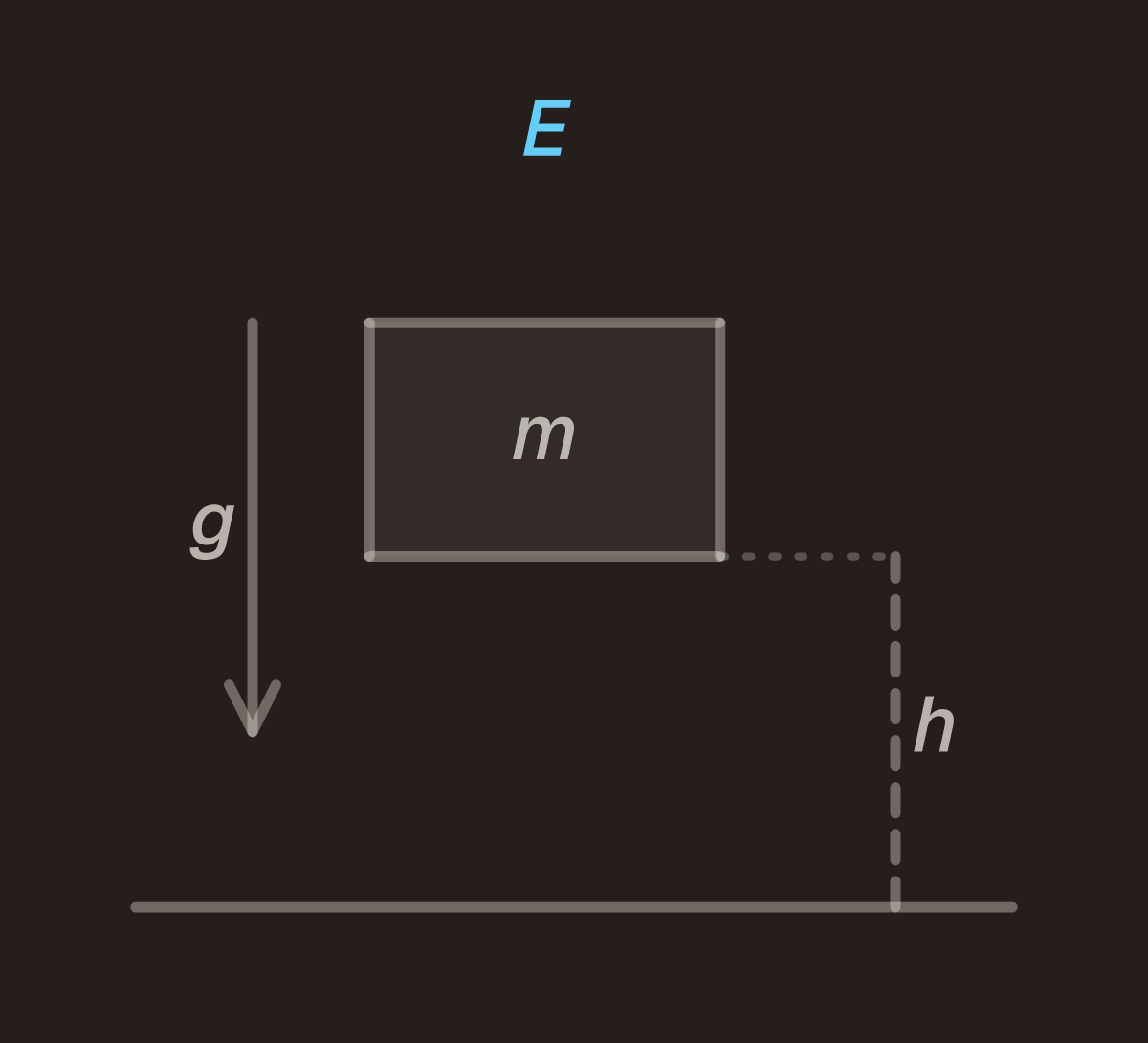
The energy stored by lifting something. Let it fall and you get the same number back as kinetic energy.
Solve for
E=196.2J
E equals (2 times 9.81) times 10, equals 19.62 times 10, equals 196.2 J
Den här sidan finns på svenska. Byt till svenska
Definition — what does that mean?
The energy you store by lifting — and get back when you let go.
In Swedish: Lägesenergi
E
The energy stored by lifting something. Let it fall and you get the same number back as kinetic energy.
E=196.2J
E equals (2 times 9.81) times 10, equals 19.62 times 10, equals 196.2 J
You are given
Round to 2 decimals.
m is the mass in kilograms, g gravity in m/s², h the height in metres and E the potential energy
in joules. 2 kg lifted 10 metres: 2 · 9.81 · 10 = 196.2 J.
It is also called gravitational potential energy, GPE for short.
Holds when the height is small next to the Earth’s radius, so that g can be taken as constant.
g is an input rather than a constant in the formula: the standard value is 9.81, and many books round
to 9.8. Use the value your book uses.
“How high is it?” has no absolute answer. A book on a table is 0.8 metres above the floor, 4 metres above the street outside and 40 metres above sea level — and the potential energy differs in all three cases.
It does not matter, because calculations use the difference in potential energy. As long as you measure from the same zero at the start and at the end of a calculation, the choice cancels. Pick whichever level makes the problem easiest: the floor, the ground, or wherever something lands.
Let it go and the potential energy becomes kinetic energy, joule for joule:
The mass appears on both sides and cancels, which is what free fall says in other words: the mass makes no difference to the speed. What is left is v = √(2gh) — a 10-metre fall gives 14 m/s, whether it is a stone or a car that falls, as long as air resistance can be neglected.
| Drop | Speed at the ground |
|---|---|
| 1 m | 4.4 m/s |
| 5 m | 9.9 m/s |
| 10 m | 14.0 m/s |
| 20 m | 19.8 m/s |
A lift. 15 kg onto a shelf 1.8 m above the floor: 15 · 9.81 · 1.8 ≈ 265 J.
A hydroelectric dam. A tonne of water falling 25 metres: 1,000 · 9.81 · 25 = 245,250 J, that is 0.068 kWh. It is why the dams are so large — the energy per kilogram is small.
Height from the energy. 500 J in a 4 kg ball: h = 500 / (4 · 9.81) ≈ 12.7 m.
Mass from the energy. 1,000 J at a height of 5 metres: m = 1,000 / (9.81 · 5) ≈ 20.4 kg.
g is already in the formula.Can potential energy be negative?
Yes, if the object is below your zero level. Nothing strange about it — it only means energy is needed
to bring it back up to zero.
Does the path up matter?
No. Walking a long winding trail or climbing straight up gives the same potential energy at the top.
Only the height difference counts.
Does mgh hold everywhere?
Near the Earth’s surface, where the height is small next to the Earth’s radius. Further out gravity weakens, and then the
law of gravitation is needed instead.
| Solve for | Rearranged | With the numbers | Comes to |
|---|---|---|---|
| m | Egh | 196.29.81·10 | 2 kg |
| g | Emh | 196.22·10 | 9.81 m/s² |
| h | Emg | 196.22·9.81 | 10 m |
| E | mgh | 2·9.81·10 | 196.2 J |
Last reviewed October 6, 2026 ·How pages are reviewed
Sheets that ask this formula, with their answer keys. Open one to see the questions or print it.
Sixteen questions on work, kinetic energy, potential energy and mechanical power.
Copy the code into your page where the formula card should appear. It loads from lovetocalc.com, so it stays current on its own — all we ask is that the credit line comes with it.